PUBLISHER: Mordor Intelligence | PRODUCT CODE: 2065765

PUBLISHER: Mordor Intelligence | PRODUCT CODE: 2065765
Vacation Rental - Market Share Analysis, Industry Trends & Statistics, Growth Forecasts (2026 - 2031)
According to Mordor Intelligence, the vacation rental market size is projected to be USD 104.62 billion in 2025, USD 109.40 billion in 2026, and reach USD 136.78 billion by 2031, growing at a CAGR of 4.57% from 2026 to 2031.
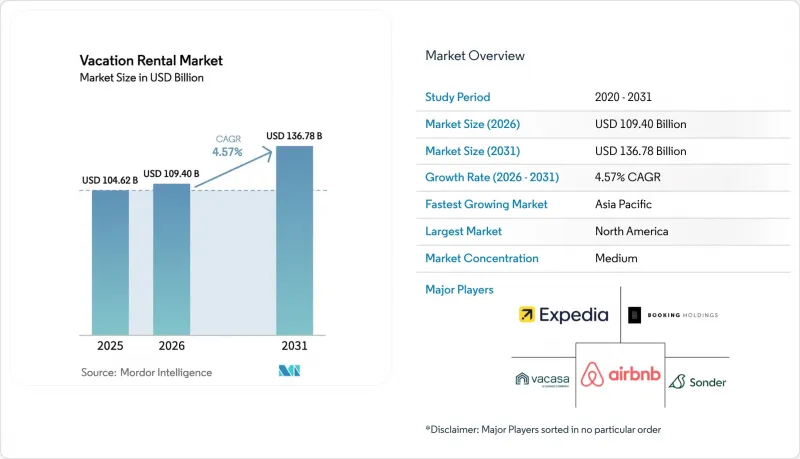
This report is Segmented by by Property Type (Homes, Apartments, Resort / Condominium, and More), Booking Mode (Online Platforms, Direct-To-Owner Websites, and More), by Rental Duration (Short-Term (<7 Nights), and More), Traveller Type (Families, Couples, and More), Price Tier (Budget, Mid-Scale, and Luxury / Premium), and Geography. The Market Forecasts are Provided in Terms of Value (USD).
Global Vacation Rental Market Trends and Insights
Mainstream rise of online booking platforms
Digital journeys dominate discovery and purchase as 90% of Gen Z travellers source trip ideas on social media and then convert within app-based ecosystems within the vacation rental market. Inventory depth and instant confirmations are increasing platform stickiness, illustrated by a 22.2% jump in Booking Holdings' merchant revenue in Q1 2025 . Operators deploying AI search and voice assistants report lower abandonment rates, signalling that frictionless UX is now a competitive baseline.
Growing millennial and Gen Z travel spending
Delayed home ownership and a bias toward experiences over assets redirect discretionary income toward travel. A Global Business Travel Association study confirmed that 46% of corporate travellers now combine work and holiday, blending spending from employer budgets with personal outlays . Price rather than brand loyalty guides 88% of younger customers, favouring transparent marketplaces that surface total stay costs up-front in the vacation rental market.
Safety and security concerns
High-profile incidents remind travellers that host-run properties lack uniform brand standards. The fragmented supply base complicates regulatory supervision, while many travel-insurance products exclude damage cover for vacation rentals. Platforms now require identity verification and install tamper-proof smart locks, yet inconsistent roll-outs perpetuate guest hesitation.
Other drivers and restraints analyzed in the detailed report include:
- Expansion of mid-term "workcation" demand
- AI-driven dynamic pricing adoption
- Tightening local STR regulations
For complete list of drivers and restraints, kindly check the Table Of Contents.
Segment Analysis
Resort and condominium units are expanding at a 5.52% CAGR, surpassing traditional homes that still hold 42.10% of the vacation rental market share in 2025. The vacation rental market size for resort-style inventory is forecast to widen further as affluent travellers migrate from hotels toward full-service apartments with on-site gyms and pools.
Premiumisation deepens as smart locks, touchless thermostats and integrated media hubs become standard. Villas and cabins secure niche demand among privacy-seekers and rural tourists, but scale economics currently favour multi-unit complexes that amortise amenity investments across larger keys.
Offline agents still controlled 50.60% of the vacation rental market share in 2025, yet online portals are forecast to grow at a 6.38% CAGR. Mobile usage climbs as 68% of travellers now complete an entire booking journey on a smartphone, favouring one-click checkout and in-app support.
Hosts are investing in direct-booking engines to preserve margin, but aggregated marketplaces remain discovery gateways thanks to SEO dominance and loyalty wallets that unlock instant refunds. Social media's influence is unmistakable; 90% of Gen Z travellers say trip ideas start on TikTok or Instagram. Voice search adoption is next: early pilots by Booking Holdings show a 9% uplift in conversion when travellers can query accommodation options hands-free. To safeguard brand trust, portals now highlight verified reviews, mandatory identity checks, and flexible cancellation badges, dampening post-purchase anxiety and nudging indecisive browsers toward confirmation.
Geography Analysis
North America commands 36.10% of 2025 revenue in the vacation rental market, reflecting a mature but regulation-strained environment. Inventory caps in New York and Los Angeles suppress listing growth, but suburban and drive-to destinations gain share as domestic leisure trips remain sticky. AI pricing tools and smart-device automation improve cost control for professional managers in Orlando and Scottsdale.
Asia-Pacific is the growth engine with an 8.76% CAGR to 2031. The Pacific Asia Travel Association projects international arrivals to reach 813.7 million by 2027, fuelling room-night demand across Japan, Indonesia, and India . Middle-class expansion, supported by Mastercard's consumer-expenditure forecasts, channels spending into domestic long-weekend breaks and outbound group tours . Governments from Thailand to Malaysia now issue digital-nomad visas that stimulate mid-term bookings and diversify seasonal revenue.
Europe remains structurally important yet highly fragmented. Municipal crack-downs restrict city-core supply, pushing growth to rural wine routes and coastal eco-villages backed by European Union sustainability grants. Hosts retrofit energy-efficient HVAC and install solar panels to comply with upcoming carbon-reporting directives, positioning green features as a rate premium rather than a cost burden.
- Airbnb, Inc.
- Vrbo (Expedia Group, Inc.)
- Booking Holdings Inc.
- TripAdvisor, Inc.
- Expedia Group, Inc.
- Vacasa LLC
- Sonder Holdings Inc.
- Wyndham Destinations, Inc.
- MakeMyTrip Limited
- Oravel Stays Private Limited (OYO)
- 9flats.com Pte Ltd.
- Hotelplan Holding AG
- NOVASOL A/S
- Interhome AG
- Evolve Vacation Rental Network, Inc.
- TUI AG (Holiday Homes)
- TurnKey Vacation Rentals, Inc.
- Agoda Company Pte. Ltd.
- Trip.com Group Limited (Homestay)
- Stayz Pty Ltd.
Additional Benefits:
- The market estimate (ME) sheet in Excel format
- 3 months of analyst support
TABLE OF CONTENTS
1 INTRODUCTION
- 1.1 Market Definition and Study Assumptions
- 1.2 Scope of the Study
2 RESEARCH METHODOLOGY
3 EXECUTIVE SUMMARY
4 MARKET LANDSCAPE
- 4.1 Market Overview
- 4.2 Market Drivers
- 4.2.1 Mainstream rise of online booking platforms
- 4.2.2 Growing millennial and Gen-Z travel spending
- 4.2.3 Expansion of mid-term workcation demand
- 4.2.4 Professionalisation of property management
- 4.2.5 AI-driven dynamic pricing adoption
- 4.2.6 Regulatory incentives for rural tourism
- 4.3 Market Restraints
- 4.3.1 Safety and security concerns
- 4.3.2 Tightening local STR regulations
- 4.3.3 Rising cleaning and compliance costs
- 4.3.4 Hotel sector's targeted loyalty discounts
- 4.4 Value / Supply-Chain Analysis
- 4.5 Evaluation of Critical Regulatory Framework
- 4.6 Impact Assessment of Key Stakeholders
- 4.7 Technological Outlook
- 4.8 Porter's Five Forces Analysis
- 4.8.1 Bargaining Power of Suppliers
- 4.8.2 Bargaining Power of Consumers
- 4.8.3 Threat of New Entrants
- 4.8.4 Threat of Substitutes
- 4.8.5 Intensity of Competitive Rivalry
- 4.9 Impact of Macro-economic Factors
5 MARKET SIZE AND GROWTH FORECASTS (VALUE)
- 5.1 By Property Type
- 5.1.1 Homes
- 5.1.2 Apartments
- 5.1.3 Resort / Condominium
- 5.1.4 Villas
- 5.1.5 Cabins / Cottages
- 5.1.6 Others
- 5.2 By Booking Mode
- 5.2.1 Online Platforms
- 5.2.2 Direct-to-Owner Websites
- 5.2.3 Offline / Travel Agent
- 5.3 By Rental Duration
- 5.3.1 Short-Term (<7 nights)
- 5.3.2 Mid-Term (8-30 nights)
- 5.3.3 Long-Term (>30 nights)
- 5.4 By Traveller Type
- 5.4.1 Families
- 5.4.2 Couples
- 5.4.3 Solo / Digital Nomads
- 5.4.4 Business Travellers
- 5.4.5 Groups (Friends, Events)
- 5.5 By Price Tier
- 5.5.1 Budget
- 5.5.2 Mid-scale
- 5.5.3 Luxury / Premium
- 5.6 By Geography
- 5.6.1 North America
- 5.6.1.1 United States
- 5.6.1.2 Canada
- 5.6.1.3 Mexico
- 5.6.2 South America
- 5.6.2.1 Brazil
- 5.6.2.2 Argentina
- 5.6.2.3 Rest of South America
- 5.6.3 Europe
- 5.6.3.1 Germany
- 5.6.3.2 United Kingdom
- 5.6.3.3 France
- 5.6.3.4 Italy
- 5.6.3.5 Spain
- 5.6.3.6 Russia
- 5.6.3.7 Rest of Europe
- 5.6.4 Asia-Pacific
- 5.6.4.1 China
- 5.6.4.2 Japan
- 5.6.4.3 India
- 5.6.4.4 South Korea
- 5.6.4.5 Australia and New Zealand
- 5.6.4.6 Rest of Asia-Pacific
- 5.6.5 Middle East and Africa
- 5.6.5.1 Middle East
- 5.6.5.1.1 Saudi Arabia
- 5.6.5.1.2 United Arab Emirates
- 5.6.5.1.3 Turkey
- 5.6.5.1.4 Rest of Middle East
- 5.6.5.2 Africa
- 5.6.5.2.1 South Africa
- 5.6.5.2.2 Nigeria
- 5.6.5.2.3 Egypt
- 5.6.5.2.4 Rest of Africa
- 5.6.5.1 Middle East
- 5.6.1 North America
6 COMPETITIVE LANDSCAPE
- 6.1 Market Concentration
- 6.2 Strategic Moves
- 6.3 Market Share Analysis
- 6.4 Company Profiles (includes Global level Overview, Market level overview, Core Segments, Financials as available, Strategic Information, Market Rank/Share for key companies, Products and Services, and Recent Developments)
- 6.4.1 Airbnb, Inc.
- 6.4.2 Vrbo (Expedia Group, Inc.)
- 6.4.3 Booking Holdings Inc.
- 6.4.4 TripAdvisor, Inc.
- 6.4.5 Expedia Group, Inc.
- 6.4.6 Vacasa LLC
- 6.4.7 Sonder Holdings Inc.
- 6.4.8 Wyndham Destinations, Inc.
- 6.4.9 MakeMyTrip Limited
- 6.4.10 Oravel Stays Private Limited (OYO)
- 6.4.11 9flats.com Pte Ltd.
- 6.4.12 Hotelplan Holding AG
- 6.4.13 NOVASOL A/S
- 6.4.14 Interhome AG
- 6.4.15 Evolve Vacation Rental Network, Inc.
- 6.4.16 TUI AG (Holiday Homes)
- 6.4.17 TurnKey Vacation Rentals, Inc.
- 6.4.18 Agoda Company Pte. Ltd.
- 6.4.19 Trip.com Group Limited (Homestay)
- 6.4.20 Stayz Pty Ltd.
7 MARKET OPPORTUNITIES AND FUTURE TRENDS
- 7.1 White-space and Unmet-need Assessment

