PUBLISHER: Mordor Intelligence | PRODUCT CODE: 2065793

PUBLISHER: Mordor Intelligence | PRODUCT CODE: 2065793
Aronia Berries - Market Share Analysis, Industry Trends & Statistics, Growth Forecasts (2026 - 2031)
According to Mordor Intelligence, the aronia berries market size was valued at USD 0.82 billion in 2025 and estimated to grow from USD 0.86 billion in 2026 to USD 1.11 billion by 2031, registering a CAGR of 5.2% through 2026-2031.
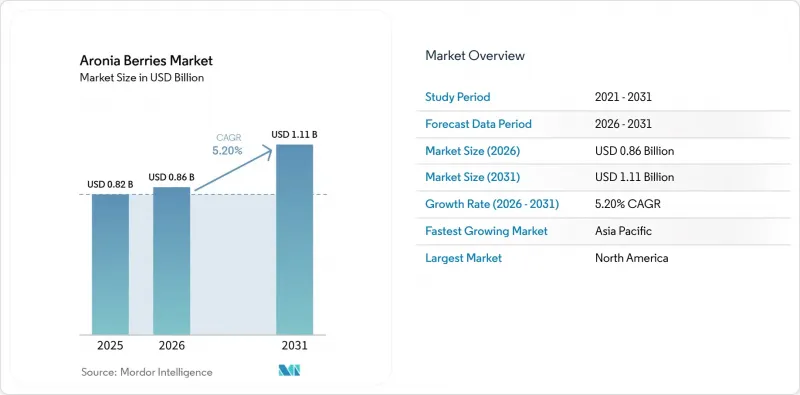
This report Segments the Industry by Geography (North America, Europe, and More). The Report Includes Production Analysis (Volume), Consumption Analysis (Value and Volume), Import Analysis (Value and Volume), Export Analysis (Value and Volume), Wholesale Price Trend Analysis and Forecast, List of Key Players, and More. The Market Forecasts are Provided in Terms of Value (USD) and Volume (Metric Tons).
Global Aronia Berries Market Trends and Insights
Increased Demand for Aronia Berries Due to Health Benefits
The 2025 Nutrients article "Black Chokeberry Extracts (Aronia melanocarpa) as an Ingredient of Functional Food Potential, Challenges and Directions of Development" by Skupien and Jedryczka demonstrated that aronia anthocyanins improved lipid profiles and lowered systolic blood pressure, elevating the berry from commodity fruit to a bioactive-rich input accepted by supplement formulators. United States organic berry sales grew 10.5% year over year in 2025, confirming shopper willingness to pay a premium for scientifically supported health benefits. Processors consequently convert spot purchases into multi-year contracts that specify minimum polyphenol content, guaranteeing offtake for growers who can document batch chemistry. This migration toward evidence-backed positioning lifts average selling prices and underpins the strong growth outlook for the aronia berries market.
Adoption of Precision Horticulture Using Internet of Things-Enabled Fertigation and Drones
Growers are integrating unmanned aerial vehicles, soil-moisture sensors and weather stations to optimize irrigation and nitrogen, cutting waste and improving berry phytochemical uniformity. In 2025, The European Commission's FRIETS project showed that remotely sensed vegetation indices predict yields weeks in advance, allowing processors to sequence harvest deliveries and minimize cold-store congestion. Water-stress management is critical because anthocyanin accumulation rises when deficits are precisely timed, and buyers now penalize loads falling below declared potency. Finnish Superberries oversees 220 hectares of organic orchards that run sensor-guided fertigation and sell up to 2.5 million kilograms annually to European beverage brands. Precision systems lower unit costs over time, enabling technologically advanced farms to secure nutraceutical contracts and strengthen the market's future growth.
Pest and viral disease pressure
Excessive rainfall during the 2025 Midwest season, including one of the wettest Julys on record, caused a severe Southern Rust outbreak in Iowa. Iowa State University Extension reported yield losses of 20% to 40% in the worst-hit areas. Fungicides like Luna Tranquility are labeled, yet profit margins rarely justify multiple sprays, leaving many fields untreated. Surveillance resources already stretched by Plum pox virus management in stone fruit limit extension outreach for aronia, so knowledge transfer lags, thereby hindering the market.
Other drivers and restraints analyzed in the detailed report include:
- Government crop incentives in Europe and United States
- Cold-chain build-out in South-East Asia
- Tight labor for mechanical harvest retrofits
For complete list of drivers and restraints, kindly check the Table Of Contents.
Geography Analysis
North America remained the largest region, accounting for 34.5% of the aronia berries market share in 2025, buoyed by established fresh-produce distribution networks, processor purchase agreements, and federal crop incentives. Fe Ongoing United States Department of Agriculture programs that underwrite organic transition on marginal land keep acreage expansion financially attractive. Asia-Pacific is the fastest region, advancing at a 9.5% CAGR during 2026-2031 as new temperature-controlled warehouses in Vietnam and Thailand reduce post-harvest losses and enable steady imports of standardized extracts. Collectively, these two regions set the pace for both volume growth and value-added product uptake within the global supply network.
Europe supplies much of the world's raw fruit through Poland's concentrated production base, while Germany acts as a redistribution hub for processors across Western Europe. Border disruptions have prompted Ukrainian growers to reroute exports through Germany and France, increasing freight costs but diversifying destination markets. South America gains relevance as Brazilian and Argentine orchards expand, leveraging lower labor costs and flexible planting windows. The Middle East and Africa continue importing primarily frozen fruit, although South African and Kenyan trials indicate rising local cultivation potential.
Regional demand patterns increasingly favor powder and extract formats, with Asia-Pacific beverage brands and European nutraceutical makers signing multi-year supply agreements that prioritize anthocyanin potency. North American processors deepen vertical integration to secure raw material for premium supplements, while European Union subsidies steer growers toward certified organic acreage. Emerging producers in South America, the Middle East, and Africa seek technology transfer and investment to meet importer traceability standards, positioning them for gradual share gains. Collectively, these geographic dynamics are anticipated to broaden the aronia berries market size well beyond current forecasts as cold-chain infrastructure and policy support converge worldwide.
- The market estimate (ME) sheet in Excel format
- 3 months of analyst support
TABLE OF CONTENTS
1 Introduction
- 1.1 Study Assumptions and Market Definition
- 1.2 Scope of the Study
2 Research Methodology
3 Executive Summary
4 Market Landscape
- 4.1 Market Overview
- 4.2 Market Drivers
- 4.2.1 Increased demand for Aronia berries due to health benefits
- 4.2.2 Adoption of precision horticulture
- 4.2.3 Rising functional-food processing capacity
- 4.2.4 Government crop incentives in Europe and United States
- 4.2.5 Cold-chain build-out in South-East Asia
- 4.2.6 Polyphenol-standard contracts by nutraceutical majors
- 4.3 Market Restraints
- 4.3.1 Pest and viral disease pressure
- 4.3.2 Growing incidence of berry-fruit allergies
- 4.3.3 Price shocks from Poland-Ukraine logistic bottlenecks
- 4.3.4 Tight labor for mechanical harvest retrofits
- 4.4 Opportunities
- 4.5 Challenges
- 4.6 Value Chain Analysis
- 4.7 Technologies and usage of AI in the Industry
- 4.8 Input Market Analysis
- 4.8.1 Seeds
- 4.8.2 Fertilizers
- 4.8.3 Crop Protection Chemicals
- 4.9 Distribution Channel Analysis
- 4.10 Market Sentiment Analysis
- 4.11 PESTLE Analysis
5 Market Size and Growth Forecast (Value and Volume)
- 5.1 By Geography
- 5.1.1 North America
- 5.1.1.1 United States
- 5.1.1.1.1 Production Analysis (Area Harvested, Yield, and Production Volume)
- 5.1.1.1.2 Consumption Analysis (Consumption Value and Volume)
- 5.1.1.1.3 Import Market Analysis (Import Value, Volume, and Key Supplying Markets)
- 5.1.1.1.4 Export Market Analysis (Export Value, Volume, and Key Destination Markets)
- 5.1.1.1.5 Wholesale Price Trend Analysis and Forecast
- 5.1.1.1.6 Regulatory Framework
- 5.1.1.1.7 List of Key Players
- 5.1.1.1.8 Logistics and Infrastructure
- 5.1.1.1.9 Seasonality Analysis
- 5.1.1.2 Canada
- 5.1.1.2.1 Production Analysis (Area Harvested, Yield, and Production Volume)
- 5.1.1.2.2 Consumption Analysis (Consumption Value and Volume)
- 5.1.1.2.3 Import Market Analysis (Import Value, Volume, and Key Supplying Markets)
- 5.1.1.2.4 Export Market Analysis (Export Value, Volume, and Key Destination Markets)
- 5.1.1.2.5 Wholesale Price Trend Analysis and Forecast
- 5.1.1.2.6 Regulatory Framework
- 5.1.1.2.7 List of Key Players
- 5.1.1.2.8 Logistics and Infrastructure
- 5.1.1.2.9 Seasonality Analysis
- 5.1.1.3 Mexico
- 5.1.1.3.1 Production Analysis (Area Harvested, Yield, and Production Volume)
- 5.1.1.3.2 Consumption Analysis (Consumption Value and Volume)
- 5.1.1.3.3 Import Market Analysis (Import Value, Volume, and Key Supplying Markets)
- 5.1.1.3.4 Export Market Analysis (Export Value, Volume, and Key Destination Markets)
- 5.1.1.3.5 Wholesale Price Trend Analysis and Forecast
- 5.1.1.3.6 Regulatory Framework
- 5.1.1.3.7 List of Key Players
- 5.1.1.3.8 Logistics and Infrastructure
- 5.1.1.3.9 Seasonality Analysis
- 5.1.1.1 United States
- 5.1.2 South America
- 5.1.2.1 Brazil
- 5.1.2.1.1 Production Analysis (Area Harvested, Yield, and Production Volume)
- 5.1.2.1.2 Consumption Analysis (Consumption Value and Volume)
- 5.1.2.1.3 Import Market Analysis (Import Value, Volume, and Key Supplying Markets)
- 5.1.2.1.4 Export Market Analysis (Export Value, Volume, and Key Destination Markets)
- 5.1.2.1.5 Wholesale Price Trend Analysis and Forecast
- 5.1.2.1.6 Regulatory Framework
- 5.1.2.1.7 List of Key Players
- 5.1.2.1.8 Logistics and Infrastructure
- 5.1.2.1.9 Seasonality Analysis
- 5.1.2.2 Argentina
- 5.1.2.2.1 Production Analysis (Area Harvested, Yield, and Production Volume)
- 5.1.2.2.2 Consumption Analysis (Consumption Value and Volume)
- 5.1.2.2.3 Import Market Analysis (Import Value, Volume, and Key Supplying Markets)
- 5.1.2.2.4 Export Market Analysis (Export Value, Volume, and Key Destination Markets)
- 5.1.2.2.5 Wholesale Price Trend Analysis and Forecast
- 5.1.2.2.6 Regulatory Framework
- 5.1.2.2.7 List of Key Players
- 5.1.2.2.8 Logistics and Infrastructure
- 5.1.2.2.9 Seasonality Analysis
- 5.1.2.1 Brazil
- 5.1.3 Europe
- 5.1.3.1 Germany
- 5.1.3.1.1 Production Analysis (Area Harvested, Yield, and Production Volume)
- 5.1.3.1.2 Consumption Analysis (Consumption Value and Volume)
- 5.1.3.1.3 Import Market Analysis (Import Value, Volume, and Key Supplying Markets)
- 5.1.3.1.4 Export Market Analysis (Export Value, Volume, and Key Destination Markets)
- 5.1.3.1.5 Wholesale Price Trend Analysis and Forecast
- 5.1.3.1.6 Regulatory Framework
- 5.1.3.1.7 List of Key Players
- 5.1.3.1.8 Logistics and Infrastructure
- 5.1.3.1.9 Seasonality Analysis
- 5.1.3.2 United Kingdom
- 5.1.3.2.1 Production Analysis (Area Harvested, Yield, and Production Volume)
- 5.1.3.2.2 Consumption Analysis (Consumption Value and Volume)
- 5.1.3.2.3 Import Market Analysis (Import Value, Volume, and Key Supplying Markets)
- 5.1.3.2.4 Export Market Analysis (Export Value, Volume, and Key Destination Markets)
- 5.1.3.2.5 Wholesale Price Trend Analysis and Forecast
- 5.1.3.2.6 Regulatory Framework
- 5.1.3.2.7 List of Key Players
- 5.1.3.2.8 Logistics and Infrastructure
- 5.1.3.2.9 Seasonality Analysis
- 5.1.3.3 France
- 5.1.3.3.1 Production Analysis (Area Harvested, Yield, and Production Volume)
- 5.1.3.3.2 Consumption Analysis (Consumption Value and Volume)
- 5.1.3.3.3 Import Market Analysis (Import Value, Volume, and Key Supplying Markets)
- 5.1.3.3.4 Export Market Analysis (Export Value, Volume, and Key Destination Markets)
- 5.1.3.3.5 Wholesale Price Trend Analysis and Forecast
- 5.1.3.3.6 Regulatory Framework
- 5.1.3.3.7 List of Key Players
- 5.1.3.3.8 Logistics and Infrastructure
- 5.1.3.3.9 Seasonality Analysis
- 5.1.3.4 Russia
- 5.1.3.4.1 Production Analysis (Area Harvested, Yield, and Production Volume)
- 5.1.3.4.2 Consumption Analysis (Consumption Value and Volume)
- 5.1.3.4.3 Import Market Analysis (Import Value, Volume, and Key Supplying Markets)
- 5.1.3.4.4 Export Market Analysis (Export Value, Volume, and Key Destination Markets)
- 5.1.3.4.5 Wholesale Price Trend Analysis and Forecast
- 5.1.3.4.6 Regulatory Framework
- 5.1.3.4.7 List of Key Players
- 5.1.3.4.8 Logistics and Infrastructure
- 5.1.3.4.9 Seasonality Analysis
- 5.1.3.1 Germany
- 5.1.4 Asia-Pacific
- 5.1.4.1 China
- 5.1.4.1.1 Production Analysis (Area Harvested, Yield, and Production Volume)
- 5.1.4.1.2 Consumption Analysis (Consumption Value and Volume)
- 5.1.4.1.3 Import Market Analysis (Import Value, Volume, and Key Supplying Markets)
- 5.1.4.1.4 Export Market Analysis (Export Value, Volume, and Key Destination Markets)
- 5.1.4.1.5 Wholesale Price Trend Analysis and Forecast
- 5.1.4.1.6 Regulatory Framework
- 5.1.4.1.7 List of Key Players
- 5.1.4.1.8 Logistics and Infrastructure
- 5.1.4.1.9 Seasonality Analysis
- 5.1.4.2 Japan
- 5.1.4.2.1 Production Analysis (Area Harvested, Yield, and Production Volume)
- 5.1.4.2.2 Consumption Analysis (Consumption Value and Volume)
- 5.1.4.2.3 Import Market Analysis (Import Value, Volume, and Key Supplying Markets)
- 5.1.4.2.4 Export Market Analysis (Export Value, Volume, and Key Destination Markets)
- 5.1.4.2.5 Wholesale Price Trend Analysis and Forecast
- 5.1.4.2.6 Regulatory Framework
- 5.1.4.2.7 List of Key Players
- 5.1.4.2.8 Logistics and Infrastructure
- 5.1.4.2.9 Seasonality Analysis
- 5.1.4.3 Australia
- 5.1.4.3.1 Production Analysis (Area Harvested, Yield, and Production Volume)
- 5.1.4.3.2 Consumption Analysis (Consumption Value and Volume)
- 5.1.4.3.3 Import Market Analysis (Import Value, Volume, and Key Supplying Markets)
- 5.1.4.3.4 Export Market Analysis (Export Value, Volume, and Key Destination Markets)
- 5.1.4.3.5 Wholesale Price Trend Analysis and Forecast
- 5.1.4.3.6 Regulatory Framework
- 5.1.4.3.7 List of Key Players
- 5.1.4.3.8 Logistics and Infrastructure
- 5.1.4.3.9 Seasonality Analysis
- 5.1.4.1 China
- 5.1.5 Middle East
- 5.1.5.1 United Arab Emirates
- 5.1.5.1.1 Production Analysis (Area Harvested, Yield, and Production Volume)
- 5.1.5.1.2 Consumption Analysis (Consumption Value and Volume)
- 5.1.5.1.3 Import Market Analysis (Import Value, Volume, and Key Supplying Markets)
- 5.1.5.1.4 Export Market Analysis (Export Value, Volume, and Key Destination Markets)
- 5.1.5.1.5 Wholesale Price Trend Analysis and Forecast
- 5.1.5.1.6 Regulatory Framework
- 5.1.5.1.7 List of Key Players
- 5.1.5.1.8 Logistics and Infrastructure
- 5.1.5.1.9 Seasonality Analysis
- 5.1.5.2 Saudi Arabia
- 5.1.5.2.1 Production Analysis (Area Harvested, Yield, and Production Volume)
- 5.1.5.2.2 Consumption Analysis (Consumption Value and Volume)
- 5.1.5.2.3 Import Market Analysis (Import Value, Volume, and Key Supplying Markets)
- 5.1.5.2.4 Export Market Analysis (Export Value, Volume, and Key Destination Markets)
- 5.1.5.2.5 Wholesale Price Trend Analysis and Forecast
- 5.1.5.2.6 Regulatory Framework
- 5.1.5.2.7 List of Key Players
- 5.1.5.2.8 Logistics and Infrastructure
- 5.1.5.2.9 Seasonality Analysis
- 5.1.5.1 United Arab Emirates
- 5.1.6 Africa
- 5.1.6.1 South Africa
- 5.1.6.1.1 Production Analysis (Area Harvested, Yield, and Production Volume)
- 5.1.6.1.2 Consumption Analysis (Consumption Value and Volume)
- 5.1.6.1.3 Import Market Analysis (Import Value, Volume, and Key Supplying Markets)
- 5.1.6.1.4 Export Market Analysis (Export Value, Volume, and Key Destination Markets)
- 5.1.6.1.5 Wholesale Price Trend Analysis and Forecast
- 5.1.6.1.6 Regulatory Framework
- 5.1.6.1.7 List of Key Players
- 5.1.6.1.8 Logistics and Infrastructure
- 5.1.6.1.9 Seasonality Analysis
- 5.1.6.2 Kenya
- 5.1.6.2.1 Production Analysis (Area Harvested, Yield, and Production Volume)
- 5.1.6.2.2 Consumption Analysis (Consumption Value and Volume)
- 5.1.6.2.3 Import Market Analysis (Import Value, Volume, and Key Supplying Markets)
- 5.1.6.2.4 Export Market Analysis (Export Value, Volume, and Key Destination Markets)
- 5.1.6.2.5 Wholesale Price Trend Analysis and Forecast
- 5.1.6.2.6 Regulatory Framework
- 5.1.6.2.7 List of Key Players
- 5.1.6.2.8 Logistics and Infrastructure
- 5.1.6.2.9 Seasonality Analysis
- 5.1.6.1 South Africa
- 5.1.1 North America
6 End Use and Application
- 6.1 Primary Applications and Emerging Applications
- 6.2 Consumption Breakdown by Industries
7 Competitive Landscape
- 7.1 Overview of the Competition
- 7.2 Recent Developments
- 7.3 Market Concentration Analysis
8 Market Opportunities and Future Outlook

