PUBLISHER: Mordor Intelligence | PRODUCT CODE: 2114971

PUBLISHER: Mordor Intelligence | PRODUCT CODE: 2114971
United Kingdom Berries - Market Share Analysis, Industry Trends & Statistics, Growth Forecasts (2026 - 2031)
According to Mordor Intelligence, the United Kingdom berries market size in 2026 is estimated at USD 2.83 billion, growing from 2025 value of USD 2.72 billion with 2031 projections showing USD 3.42 billion, growing at 3.88% CAGR over 2026-2031.
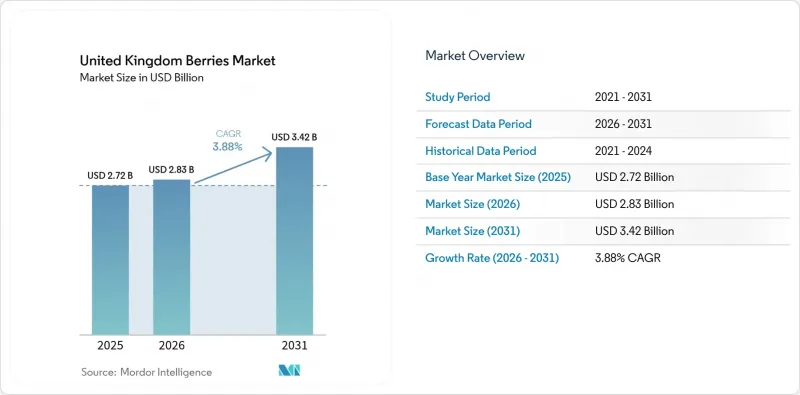
This report is Segmented by Berry Type (Strawberries, Raspberries, Blueberries, Blackberries, and Currants, and Other Berries). The Report Includes Production Analysis (Volume), Consumption Analysis (Volume and Value), Import Analysis (Volume and Value), Export Analysis (Volume and Value), and Price Trend Analysis. The Market Forecasts are Provided in Terms of Value (USD) and Volume (Metric Tons).
United Kingdom Berries Market Trends and Insights
Dominance of Protected-Cropping Infrastructure
Polytunnels and greenhouses dominate berry cultivation in the United Kingdom, delivering up to 30% higher yields compared to open fields. Growers are increasing investments to achieve weather resilience and extended picking seasons. Heating costs constitute 30% of variable expenses, driving the focus toward energy-efficient technologies. Humidity control trials require an additional 0.7 kWh per square meter; they improve fruit quality, demonstrating the balance between performance and costs. The Sustainable Farming Incentive provides subsidies for soil and pest management practices in protected growing systems, reducing capital expenses and supporting year-round berry supply in the United Kingdom market.
Rising Consumer Demand for Fresh Local Produce
Rising health awareness and preference for local produce have driven retail berry sales to new heights, with strawberry revenue reaching GBP 847.5 million (USD 1.06 billion) in 2024. Urban consumers willingly pay higher prices for British berries during the peak season, encouraging growers to align their protected crop harvests with promotional periods. The United Kingdom's blueberry consumption of 1 kilogram per person provides a stable demand foundation and supports growth in domestic production. Retailers have expanded their premium berry selections to meet consumer demand for higher-quality produce. British-grown berries command premium prices during peak growing seasons, as consumers prioritize local sourcing. This domestic market strength helps balance challenges from imported berries, particularly with new border regulations in effect.
High Capital Costs of Substrate and Table-Top Systems
The transition to advanced growing systems creates significant financial barriers that limit adoption rates and strain grower cash flows during a period of compressed margins. Substrate growing and table-top systems require substantial upfront investments in infrastructure, climate control equipment, and specialized growing media, with installations costing significantly more than traditional soil-based operations. The capital intensity poses challenges, as the majority of berry growers operate at a loss, limiting their ability to secure financing for system upgrades. Smaller growers face greater difficulties accessing capital markets for these investments, potentially accelerating industry consolidation as larger operators gain advantages through advanced systems.
Other drivers and restraints analyzed in the detailed report include:
- Expansion of Super-High-Density (SHD) Berry Systems
- Retailer Private-Label Premiumization
- Post-Brexit Supply-Chain Friction for Inputs
For complete list of drivers and restraints, kindly check the Table Of Contents.
Segment Analysis
Strawberries hold 63.62% of the United Kingdom berries market share in 2025, while facing margin pressure from increased labor and input costs despite record retail promotions. The category maintains price leadership through consumer loyalty and peak summer demand, supported by exclusive varieties and protected-cropping methods that deliver consistent quality. In 2024, production costs have increased by GBP 836 per metric ton (USD 1,045 per metric ton) since 2020, though protected systems and automation help manage production risks. The United Kingdom berries market for strawberries continues to grow through improved yields from high-density planting, with excess production directed to processing and exports to maintain price stability.
Blueberries demonstrate a 4.03% projected CAGR, driven by their health benefits and diverse consumption occasions. Controlled-environment production reduces weather-related risks and extends harvest periods to match retail demands, reducing import dependency and expanding the United Kingdom berries market through premium offerings, including snack packs and organic products. Raspberries and blackberries face the highest per-tonne cost increases, leading producers to shift toward more profitable alternatives or integrate frozen processing operations to utilize lower-grade fruit and stabilize revenue across the United Kingdom berries market.
Complete Report Scope:
- By Berry Type (Production Analysis (Volume), Consumption Analysis (Volume and Value), Import Analysis (Volume and Value), Export Analysis (Volume and Value), and Price Trend Analysis)
- Strawberries
- Raspberries
- Blueberries
- Blackberries and Currants
- Other Berries (Gooseberries, Cranberries, etc.)
Additional Benefits:
- The market estimate (ME) sheet in Excel format
- 3 months of analyst support
TABLE OF CONTENTS
1 Introduction
- 1.1 Study Assumptions and Market Definition
- 1.2 Scope of the Study
2 Research Methodology
3 Executive Summary
4 Market Landscape
- 4.1 Market Overview
- 4.2 Market Drivers
- 4.2.1 Dominance of Protected-Cropping Infrastructure
- 4.2.2 Rising Consumer Demand for Fresh, Local Produce
- 4.2.3 Expansion of Super-High-Density (SHD) Berry Systems
- 4.2.4 Retailer Private-Label Premiumization
- 4.2.5 Emerging Carbon-Credit Revenue Streams for Berry Growers
- 4.2.6 Deployment of Harvest Robotics for Peak-Season Labor Shortages
- 4.3 Market Restraints
- 4.3.1 High Capital Costs of Substrate and Table-Top Systems
- 4.3.2 Post-Brexit Supply-Chain Friction for Inputs
- 4.3.3 Phytosanitary Risks from Pest Infestation
- 4.3.4 Volatile Energy Prices Affecting Protected Cropping
- 4.4 Regulatory Landscape
- 4.5 Technological Outlook
- 4.6 Value/Supply-Chain Analysis
- 4.7 PESTLE Analysis
5 Market Size and Growth Forecasts (Value and Volume)
- 5.1 By Berry Type (Production Analysis (Volume), Consumption Analysis (Volume and Value), Import Analysis (Volume and Value), Export Analysis (Volume and Value), and Price Trend Analysis)
- 5.1.1 Strawberries
- 5.1.2 Raspberries
- 5.1.3 Blueberries
- 5.1.4 Blackberries and Currants
- 5.1.5 Other Berries (Gooseberries, Cranberries, etc.)
6 Competitive Landscape
- 6.1 List of Stakeholders
- 6.1.1 BerryWorld Group Ltd
- 6.1.2 Driscoll's UK Ltd (Driscoll's, Inc.)
- 6.1.3 S&A Produce (UK) Ltd
- 6.1.4 Angus Soft Fruits Ltd
- 6.1.5 The Summer Berry Company
- 6.1.6 Winterwood Farms Ltd
- 6.1.7 W B Chambers Farms Limited
- 6.1.8 Hall Hunter Partnership LLP
- 6.1.9 Total Produce UK Ltd (Dole plc)
- 6.1.10 J.O. Sims Ltd
- 6.1.11 Ardo UK Ltd
- 6.1.12 Clock House Farm Limited
- 6.1.13 Keelings (UK) Ltd
- 6.1.14 Kelsey Farms Ltd
- 6.1.15 United Fruit Growers
7 Market Opportunities and Future Outlook

