PUBLISHER: Mordor Intelligence | PRODUCT CODE: 2065794

PUBLISHER: Mordor Intelligence | PRODUCT CODE: 2065794
Bamboos - Market Share Analysis, Industry Trends & Statistics, Growth Forecasts (2026 - 2031)
According to Mordor Intelligence, the bamboos market size was valued at USD 65.59 billion in 2025 and is projected to grow from USD 69.38 billion in 2026 to USD 91.89 billion by 2031, registering a CAGR of 5.78% from 2026 to 2031.
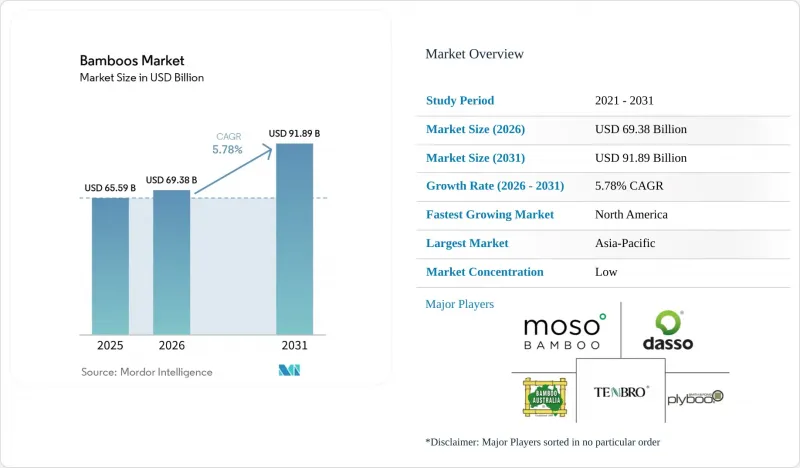
This report is Segmented by Application (Raw Materials, Industrial Products, Furniture, Shoots, and Other Applications) and by Geography (North America, South America, Europe, Asia-Pacific, Middle East, and Africa). The Market Forecasts are Provided in Terms of Value (USD).
Global Bamboos Market Trends and Insights
Plastic Substitution Mandates Boosting Bamboo Packaging Demand
Plastic substitution initiatives are driving growth in the bamboo market by promoting the adoption of bamboo-based alternatives in packaging and industrial applications. According to the Press Information Bureau of India, as of 2025, India possesses the largest bamboo-growing area globally, covering 13.96 million hectares. It is also the second-richest country in bamboo diversity after China, with 136 species, including 125 indigenous and 11 exotic species. This extensive raw material base is bolstering bamboo processing industries and facilitating the production of sustainable bamboo products as substitutes for plastic-based materials.
Engineered Bamboo Adoption in Green Construction Projects
The adoption of engineered bamboo in green construction projects is driving growth in the bamboos market, as architects and developers increasingly prioritize low-carbon structural materials for sustainable building applications. In February 2026, Guadua Bamboo S.A.S. completed a 28-meter structural bamboo tower in Belgium, showcasing the commercial feasibility of engineered bamboo in modern construction. This project enhanced the visibility of bamboo-based structural systems among architects, engineers, and public infrastructure buyers, while boosting demand for certified, specification-grade bamboo materials with verified structural performance and sustainable sourcing credentials.
Fragmented Feedstock Supply and Inconsistent Grading Standards
Fragmented feedstock supply and inconsistent grading standards are hindering growth in the bamboos market, as variability in bamboo quality reduces processing efficiency and complicates standardized manufacturing. A 2025 study by researchers from the University of Pittsburgh, published in npj Materials Sustainability, revealed that designed stresses in full-culm bamboo structures often remain below 20% of the actual material strength after accounting for safety and exposure factors. Variations in culm size, wall thickness, and structural consistency contribute to increased processing waste and limit the broader industrial use of bamboo in engineered construction and export-oriented manufacturing applications.
Other drivers and restraints analyzed in the detailed report include:
- Bamboo-for-Plastic Policies Increasing Industrial Bamboo Demand
- Carbon Monetization Improving Bamboo Plantation Project Economics
- Scrutiny over Textile Certification and Traceability Compliance
For complete list of drivers and restraints, kindly check the Table Of Contents.
Segment Analysis
The bamboos market share for the industrial products segment accounted for the largest 40.6% in 2025, and the bamboos market size for this segment is forecasted to expand at the fastest 5.5% CAGR from 2026 to 2031. Industrial applications continue expanding across engineered panels, bamboo fiber materials, composite products, packaging formats, and construction-related intermediates that compete with wood and petroleum-based materials. Demand is also increasing for specification-grade bamboo products that support sustainability goals and lower-carbon procurement strategies. Growth in processing technology, industrial treatment capability, and export-focused manufacturing continues to strengthen the commercial role of industrial bamboo applications across construction, packaging, transportation, and consumer goods sectors.
Furniture and related consumer applications remain important across the bamboo industry because bamboo products increasingly align with demand for sustainable home furnishing and interior products. Bamboo furniture benefits from lower weight, natural aesthetics, and renewable sourcing advantages compared to traditional hardwood products. Bamboo shoots also maintain stable demand within processed food categories across Asia-Pacific markets. Emerging applications including bamboo textiles, bamboo-wound composite pipes, activated carbon, and biochar continue attracting commercial interest because they support diversification beyond traditional construction and handicraft uses. The expanding application mix is strengthening long-term industry resilience while creating additional opportunities for higher-margin processed bamboo product development globally.
Geography Analysis
The bamboos market share for the Asia-Pacific held the largest 79% in 2025. China remains the leading producer of bamboo globally, driven by its extensive bamboo forest resources, well-developed processing infrastructure, and government policies promoting bamboo as a substitute for plastics and wood materials. According to Xinhua News Agency, the output of China's bamboo industry surpassed CNY 520 billion (USD 71.7 billion) in January 2026, supported by nearly 8 million hectares of bamboo forests. Additionally, the region benefits from cost-effective manufacturing capabilities and robust export infrastructure in countries such as China, Vietnam, Indonesia, and India, further solidifying the Asia-Pacific's role in global bamboo processing and supply chains.
The bamboos market size for North America is forecasted to grow at the fastest 6.2% CAGR from 2026 to 2031. Increasing demand for sustainable construction materials, bio-based packaging, engineered flooring, and low-carbon interior products is driving the adoption of bamboo across residential and commercial sectors. Importers and distributors are expanding their offerings of specification-grade bamboo products for architects, retailers, and infrastructure projects. Consumers are also showing a growing preference for renewable and certified materials in furniture and home improvement categories. Furthermore, stricter environmental regulations and rising interest in alternatives to tropical hardwood products are supporting the broader commercial use of processed bamboo materials in the North American market.
Europe remains a significant export destination as buyers increasingly emphasize certified sourcing, traceability, and sustainable construction materials. According to MOSO International B.V., bamboo flooring gained a pricing advantage in 2025 when European Union anti-dumping measures on multilayered wood flooring from China excluded bamboo flooring products. This regulatory development enhanced commercial opportunities for bamboo-based flooring and interior materials in European construction and renovation markets. Demand in the region continues to grow across applications such as flooring, furniture, hospitality interiors, and sustainable building projects, driven by stricter environmental procurement standards and a rising preference for renewable, low-carbon construction materials.
- Moso International B.V.
- Dasso Industrial Group Co., Ltd.
- Shanghai Tenbro Bamboo Textile Co., Ltd. (Lorpar Industrial Co., Ltd.)
- Bamboo Australia Pty Ltd
- Smith & Fong Company Inc
- EcoPlanet Bamboo Group LLC
- Hunan Taohuajiang Bamboo Science & Technology Co., Ltd.
- Kerala State Bamboo Corporation Ltd. (Government of Kerala)
- Bamboo Village Company Limited
- Fujian Heqichang Bamboo Industry Co., Ltd.
- Xiamen HBD Industry & Trade Co., Ltd.
- Hunan Taohuajiang Bamboo Science & Technology Co., Ltd.
- Guadua Bamboo S.A.S.
- Zhejiang Yongyu Household Co., Ltd.
- Xingyun Bamboo Products Co., Ltd.
Additional Benefits:
- The market estimate (ME) sheet in Excel format
- 3 months of analyst support
TABLE OF CONTENTS
1 Introduction
- 1.1 Study Assumptions and Market Definition
- 1.2 Scope of the Study
2 Research Methodology
3 Executive Summary
4 Market Landscape
- 4.1 Market Overview
- 4.2 Market Drivers
- 4.2.1 Plastic substitution mandates boosting bamboo packaging demand
- 4.2.2 Engineered bamboo adoption in green construction projects
- 4.2.3 Furniture sector shifting toward low-carbon bamboo materials
- 4.2.4 Rising bamboo fiber demand across industrial applications
- 4.2.5 Bamboo-for-plastic policies increasing industrial bamboo demand
- 4.2.6 Carbon monetization improving bamboo plantation project economics
- 4.3 Market Restraints
- 4.3.1 Fragmented feedstock supply and inconsistent grading standards
- 4.3.2 Processing capacity concentrated within limited producer countries
- 4.3.3 Competition from plastics and alternative composite materials
- 4.3.4 Scrutiny over textile certification and traceability compliance
- 4.4 Regulatory Landscape
- 4.5 Technological Outlook
- 4.6 Porter's Five Forces Analysis
- 4.6.1 Bargaining Power of Suppliers
- 4.6.2 Bargaining Power of Buyers
- 4.6.3 Threat of New Entrants
- 4.6.4 Threat of Substitutes
- 4.6.5 Intensity of Competitive Rivalry
5 Market Size and Growth Forecasts (Value)
- 5.1 By Application
- 5.1.1 Raw Materials
- 5.1.2 Industrial Products
- 5.1.3 Furniture
- 5.1.4 Shoots
- 5.1.5 Others
- 5.2 By Geography
- 5.2.1 North America
- 5.2.1.1 United States
- 5.2.1.2 Canada
- 5.2.1.3 Mexico
- 5.2.1.4 Rest of North America
- 5.2.2 South America
- 5.2.2.1 Brazil
- 5.2.2.2 Argentina
- 5.2.2.3 Rest of South America
- 5.2.3 Europe
- 5.2.3.1 Germany
- 5.2.3.2 United Kingdom
- 5.2.3.3 France
- 5.2.3.4 Netherlands
- 5.2.3.5 Rest of Europe
- 5.2.4 Asia-Pacific
- 5.2.4.1 China
- 5.2.4.2 India
- 5.2.4.3 Japan
- 5.2.4.4 Indonesia
- 5.2.4.5 Vietnam
- 5.2.4.6 Philippines
- 5.2.4.7 Rest of Asia-Pacific
- 5.2.5 Middle East
- 5.2.5.1 United Arab Emirates
- 5.2.5.2 Saudi Arabia
- 5.2.5.3 Turkey
- 5.2.5.4 Rest of Middle East
- 5.2.6 Africa
- 5.2.6.1 Ethiopia
- 5.2.6.2 Ghana
- 5.2.6.3 South Africa
- 5.2.6.4 Rest of Africa
- 5.2.1 North America
6 Competitive Landscape
- 6.1 Market Concentration
- 6.2 Strategic Moves
- 6.3 Market Share Analysis
- 6.4 Company Profiles (Includes Global Level Overview, Market Level Overview, Core Segments, Financials as Available, Strategic Information, Market Rank/Share for Key Companies, Products and Services, and Recent Developments)
- 6.4.1 Moso International B.V.
- 6.4.2 Dasso Industrial Group Co., Ltd.
- 6.4.3 Shanghai Tenbro Bamboo Textile Co., Ltd. (Lorpar Industrial Co., Ltd.)
- 6.4.4 Bamboo Australia Pty Ltd
- 6.4.5 Smith & Fong Company Inc
- 6.4.6 EcoPlanet Bamboo Group LLC
- 6.4.7 Hunan Taohuajiang Bamboo Science & Technology Co., Ltd.
- 6.4.8 Kerala State Bamboo Corporation Ltd. (Government of Kerala)
- 6.4.9 Bamboo Village Company Limited
- 6.4.10 Fujian Heqichang Bamboo Industry Co., Ltd.
- 6.4.11 Xiamen HBD Industry & Trade Co., Ltd.
- 6.4.12 Hunan Taohuajiang Bamboo Science & Technology Co., Ltd.
- 6.4.13 Guadua Bamboo S.A.S.
- 6.4.14 Zhejiang Yongyu Household Co., Ltd.
- 6.4.15 Xingyun Bamboo Products Co., Ltd.
7 Market Opportunities and Future Outlook

