PUBLISHER: Mordor Intelligence | PRODUCT CODE: 2066382

PUBLISHER: Mordor Intelligence | PRODUCT CODE: 2066382
Oral Care Products - Market Share Analysis, Industry Trends & Statistics, Growth Forecasts (2026 - 2031)
According to Mordor Intelligence, the oral care products market size is projected to expand from USD 32.74 billion in 2025 and USD 34.36 billion in 2026 to USD 44.91 billion by 2031, registering a CAGR of 5.5% between 2026 to 2031.
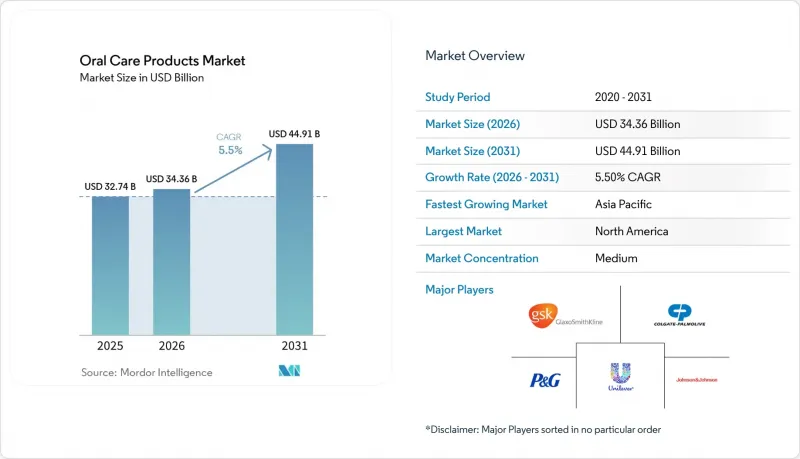
This report is Segmented by Product Type (Toothpastes, and More), Distribution Channel (Hypermarkets & Supermarkets, and More), End-User (Children (0-12 Yrs) and More), and Geography (North America, Europe, Asia-Pacific, Middle East and Africa, and South America). Market Forecasts are Provided in Terms of Value (USD).
Global Oral Care Products Market Trends and Insights
Escalating Global Prevalence of Dental Caries and Periodontal Diseases
World Health Organization data indicate that 3.5 billion people live with oral diseases, underscoring the steady demand for daily-use solutions that promise clinical-grade results[1]. Manufacturers are increasing active-ingredient loads and combining whitening with enamel repair, as seen in Colgate-Palmolive's 2024 Elixir toothpaste. The non-discretionary nature of oral care buffers category volumes during economic downturns and sustains growth in both mature and developing countries.
Rapid Expansion of E-Commerce and Direct-to-Consumer Distribution
Subscription models and social media discovery drove e-commerce penetration above 25% of total category sales in North America and Europe in 2025, while China's Tmall and JD.com surpassed 30%. Digital-native brands bypass shelf constraints and maintain healthier margins, prompting incumbents to launch their own proprietary direct-to-consumer (D2C) portals and data-driven replenishment programs.
Regulatory Scrutiny of Fluoride and Titanium Dioxide in Oral Formulations
The European Food Safety Authority ruled titanium dioxide unsafe, triggering reformulation or withdrawal of whitening pastes across member states[2]. Parallel debates over fluoride in North America add complexity, compelling brands to supply both fluoride-free and fluoride-rich options, which raises SKU counts and inventory costs.
Other drivers and restraints analyzed in the detailed report include:
- Rising Disposable Incomes and Urbanization in Emerging Markets
- Integration of Oral Microbiome Probiotics into Daily Hygiene Regimens
- Volatility in Raw-Material Prices for Sorbitol, Silica, and Packaging Plastics
For complete list of drivers and restraints, kindly check the Table Of Contents.
Segment Analysis
Mouthwashes and rinses are projected to lead value expansion, climbing at 6.24% CAGR on the back of alcohol-free and probiotic formulas that rebalance the oral microbiome. Toothpaste still generated 34.83% of 2025 revenue, thanks to whitening and sensitivity-relief sublines; however, the share is gradually shifting to functional rinses and smart brushes. The oral care products market size for mouthwashes is expected to exceed USD 11 billion by 2031, based on current growth trajectories.
Smart electric toothbrushes, boosted by AI guidance and app gamification, command premium price points, while interdental brushes and floss benefit from dentist-driven awareness. Colgate-Palmolive's launch of a probiotic mouthwash in 2024 and Unilever's enzyme-activated whitening paste illustrate sustained innovation. Overall, the oral care products market continues to bifurcate between high-volume toothpaste and higher-margin adjunct categories.
Geography Analysis
The Asia-Pacific region dominated with 32.40% revenue in 2025 and is forecasted to grow at a 6.89% CAGR as government campaigns and mobile-commerce growth accelerate uptake. India's school-based fluoride-rinse programs and China's live-stream shopping contribute to both wider penetration and premium trading-up. Japan's aging demographic drives demand for sensitive and denture-care products, while Indonesia and Vietnam experience double-digit growth in electric toothbrush adoption.
North America and Europe are expected to maintain modest growth, buoyed by premiumization and value-based insurance schemes. U.S. carriers subsidize smart brushes, and Germany reimburses high-fluoride pastes, channeling demand into evidence-backed products. The swift reformulation of products influences the oral care products market share in Europe to comply with titanium-dioxide restrictions, a capability that favors scaled incumbents.
The Middle East and Africa are registering an accelerating consumption of halal-certified and alcohol-free rinses. At the same time, South America balances economic volatility with steady toothpaste volumes in Brazil and Argentina. Urban centers such as Sao Paulo and Dubai present concentrated opportunities for whitening and smart devices, confirming the geographic spread of premium niches.
- Church & Dwight
- Colgate-Palmolive Company
- Dabur India Ltd.
- Dentsply Sirona
- Dr. Fresh
- GC International AG
- GlaxoSmithKline
- Henkel
- Himalaya
- Straumann Group
- Kenvue
- Koninklijke Philips
- Lion
- Panasonic Holdings Corp.
- Procter & Gamble
- Solventum
- Sunstar Suisse
- Unilever
- Water Pik
- Young Innovations, Inc.
Additional Benefits:
- The market estimate (ME) sheet in Excel format
- 3 months of analyst support
TABLE OF CONTENTS
1 Introduction
- 1.1 Study Assumptions & Market Definition
- 1.2 Scope Of The Study
2 Research Methodology
3 Executive Summary
4 Market Landscape
- 4.1 Market Overview
- 4.2 Market Drivers
- 4.2.1 Escalating Global Prevalence of Dental Caries and Periodontal Diseases
- 4.2.2 Rapid Expansion of E-Commerce and Direct-to-Consumer Distribution
- 4.2.3 Rising Disposable Incomes and Urbanization in Emerging Markets
- 4.2.4 Integration of Oral Microbiome Probiotics into Daily Hygiene Regimens
- 4.2.5 Payor Incentivization of Preventive Oral Health Within Value-Based Care Contracts
- 4.2.6 Corporate Wellness Programs Subsidizing Smart Oral Devices
- 4.3 Market Restraints
- 4.3.1 Regulatory Scrutiny of Fluoride and Titanium Dioxide in Oral Formulations
- 4.3.2 Volatility in Raw Material Prices for Sorbitol, Silica, and Packaging Plastics
- 4.3.3 Supply-Chain Emissions Targets Limiting Aerosol Propellant Use in Whitening Sprays
- 4.3.4 Data Privacy Concerns Around Connected Toothbrush Usage Analytics
- 4.4 Supply Chain Analysis
- 4.5 Regulatory Outlook
- 4.6 Technological Outlook
- 4.7 Porter's Five Forces Analysis
- 4.7.1 Threat of New Entrants
- 4.7.2 Bargaining Power of Buyers
- 4.7.3 Bargaining Power of Suppliers
- 4.7.4 Threat of Substitutes
- 4.7.5 Intensity of Competitive Rivalry
5 Market Size & Growth Forecasts (Value, USD)
- 5.1 By Product Type
- 5.1.1 Toothpaste
- 5.1.1.1 Pastes
- 5.1.1.2 Gels
- 5.1.1.3 Powders
- 5.1.1.4 Polishes
- 5.1.2 Toothbrushes & Accessories
- 5.1.2.1 Manual
- 5.1.2.2 Power (Oscillating, Sonic, Ultrasonic)
- 5.1.2.3 Battery-Powered Toothbrushes
- 5.1.2.4 Replacement Toothbrush Heads
- 5.1.3 Mouthwashes / Rinses
- 5.1.3.1 Non-Medicated Mouthwashes
- 5.1.3.2 Medicated Mouthwashes
- 5.1.4 Dental Accessories / Ancillaries
- 5.1.4.1 Dental Flosses
- 5.1.4.2 Breath Fresheners
- 5.1.4.3 Cosmetic Dental Whitening Products
- 5.1.4.4 Dental Water Jets
- 5.1.5 Dental Products
- 5.1.5.1 Fixatives
- 5.1.5.2 Other Denture Products
- 5.1.6 Dental Prosthesis Cleaning Solutions
- 5.1.1 Toothpaste
- 5.2 By Distribution Channel
- 5.2.1 Hypermarkets & Supermarkets
- 5.2.2 Pharmacies & Drug Stores
- 5.2.3 Online Retail
- 5.3 By End-User
- 5.3.1 Children (0-12 Yrs)
- 5.3.2 Adolescents (13-17 Yrs)
- 5.3.3 Adults (18-59 Yrs)
- 5.3.4 Geriatric (60+ Yrs)
- 5.4 Geography
- 5.4.1 North America
- 5.4.1.1 United States
- 5.4.1.2 Canada
- 5.4.1.3 Mexico
- 5.4.2 Europe
- 5.4.2.1 Germany
- 5.4.2.2 United Kingdom
- 5.4.2.3 France
- 5.4.2.4 Italy
- 5.4.2.5 Spain
- 5.4.2.6 Rest of Europe
- 5.4.3 Asia-Pacific
- 5.4.3.1 China
- 5.4.3.2 Japan
- 5.4.3.3 India
- 5.4.3.4 South Korea
- 5.4.3.5 Australia
- 5.4.3.6 Rest of Asia-Pacific
- 5.4.4 Middle East And Africa
- 5.4.4.1 GCC
- 5.4.4.2 South Africa
- 5.4.4.3 Rest of Middle East and Africa
- 5.4.5 South America
- 5.4.5.1 Brazil
- 5.4.5.2 Argentina
- 5.4.5.3 Rest of South America
- 5.4.1 North America
6 Competitive Landscape
- 6.1 Market Concentration
- 6.2 Market Share Analysis
- 6.3 Company Profiles (Includes Global-Level Overview, Market-Level Overview, Core Business Segments, Financials, Headcount, Key Information, Market Rank, Market Share, Products & Services, Recent Developments)
- 6.3.1 Church & Dwight Co. Inc.
- 6.3.2 Colgate-Palmolive Company
- 6.3.3 Dabur India Ltd.
- 6.3.4 Dentsply Sirona Inc.
- 6.3.5 Dr. Fresh LLC
- 6.3.6 GC International AG
- 6.3.7 GSK plc
- 6.3.8 Henkel AG & Co. KGaA
- 6.3.9 Himalaya Wellness Company
- 6.3.10 Institut Straumann AG
- 6.3.11 Kenvue
- 6.3.12 Koninklijke Philips N.V.
- 6.3.13 Lion Corporation
- 6.3.14 Panasonic Holdings Corp.
- 6.3.15 Procter & Gamble
- 6.3.16 Solventum
- 6.3.17 Sunstar Suisse S.A.
- 6.3.18 Unilever
- 6.3.19 Water Pik, Inc.
- 6.3.20 Young Innovations, Inc.
7 Market Opportunities & Future Outlook
- 7.1 White-Space & Unmet-Need Assessment

