PUBLISHER: Mordor Intelligence | PRODUCT CODE: 2097137

PUBLISHER: Mordor Intelligence | PRODUCT CODE: 2097137
Middle East and Africa Oral Care - Market Share Analysis, Industry Trends & Statistics, Growth Forecasts (2026 - 2031)
According to Mordor Intelligence, Middle East and Africa oral care market size in 2026 is estimated at USD 4.28 billion, growing from 2025 value of USD 4.05 billion with 2031 projections showing USD 5.66 billion, growing at 5.73% CAGR over 2026-2031.
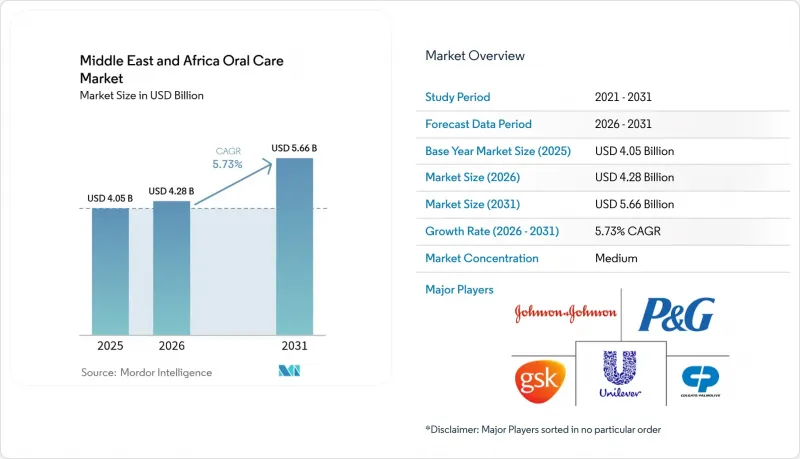
This report is Segmented by Product Type (Toothpaste, Toothbrushes, Mouth Fresheners, Mouthwashes, Denture Care, and Dental Floss), by Ingredient (Conventional and Organic), by End User (Kids/Children and Adults), by Distribution Channel (Supermarkets/Hypermarkets, Drug Stores/Pharmacies, Online Retail Stores, and More), and by Geography. The Market Forecasts are Provided in Terms of Value (USD).
Middle East and Africa Oral Care Market Trends and Insights
Growing Awareness of Oral Hygiene
Across the region, educational initiatives are reshaping consumer behavior and driving market demand. As of 2025, Kuwait's School Oral Health Program, active in all six governorates, caters to around 280,000 public school children. The program administers fluoride varnish applications biannually and imparts comprehensive oral health education. This proactive approach has led to a noticeable decline in disease levels and a reduced need for treatments. By emphasizing prevention, the program is steering long-term demand towards preventive products rather than curative treatments. In Sudan, similar educational programs not only boosted knowledge scores post-intervention but also led to tangible improvements in practices, underscoring the potential for education to drive market expansion. Corporate initiatives are bolstering these government-led efforts. Colgate's "Bright Smiles, Bright Futures" program, as of 2024, has reached over 1.6 billion children worldwide, with a notable presence in the MEA, thanks to collaborations with health and education ministries. The synergy between public and private educational endeavors is fostering a sustained growth in demand, influencing purchasing decisions at the household level. In 2024, WHO reported that around 44% of the African Region's population grappled with oral diseases, underscoring a significant market opportunity for preventive solutions.
Product Innovations and Technology
In the region, discerning consumers are increasingly investing in advanced oral care solutions, showcasing a trend in technology adoption that persists despite economic fluctuations. Philips Sonicare, a key player, offers a diverse range of products in the UAE and Kuwait. Their lineup spans from the entry-level Philips One, boasting a 90-day battery life, to the premium Sonicare 9900 Prestige, equipped with SenseIQ technology. This breadth underscores a robust demand for innovations in electric toothbrushes. The brand's technology, touting up to 62,000 brush movements per minute and clinically validated plaque removal, strikes a chord with health-conscious consumers who prioritize tangible benefits. As regional consumers align more closely with global beauty and wellness trends, oral care is increasingly adopting formats reminiscent of skincare - think serums, specialized applicators, and structured day/night routines. Furthermore, innovation isn't limited to hardware; it's also about integrating bioactive ingredients. Hydroxyapatite aids remineralization, peptides bolster periodontal health, and probiotics ensure a balanced microbiome. These additions cater to the region's sophisticated consumers, who demand clinically validated and dentist-endorsed formulations. With mobile usage in the region averaging over 4 hours daily and social media penetration notably high in the UAE and Saudi Arabia, there's a ripe opportunity for digital marketing and direct engagement strategies for these innovative products.
Low Awareness and Education in Certain Segments
In the Middle East and Africa (MEA), a significant market restraint stems from limited awareness and education regarding specific oral care products and advanced hygiene practices, especially in specialized or premium segments. While urban centers see a rise in awareness for basic products like toothpaste and toothbrushes, many remain oblivious to the advantages of items such as therapeutic mouthwashes, dental floss, and electric or smart toothbrushes. This knowledge gap hampers product adoption, stunting sales growth for manufacturers. For instance, in numerous rural and low-income regions, dental care is often a reactive endeavor, with individuals seeking treatment only after issues escalate, rather than proactively preventing them through a comprehensive oral care regimen. Such behavior directly influences the market for preventive products, like sensitive toothpaste or fluoride treatments. In light of this, government and dental associations have intensified their educational initiatives. In 2024-2025, several African nations marked World Oral Health Day with community and school outreach programs, emphasizing the importance of a holistic oral hygiene routine beyond mere brushing. Additionally, the FDI World Dental Federation's 2024-2026 initiative, "A Happy Mouth Is...", seeks to underscore the connection between oral and overall health, with the goal of fostering enduring behavioral changes. On the product development front, there's a noticeable shift towards natural and herbal ingredients in toothpaste, driving sales and brand recognition in certain regions. Simultaneously, advancements in electric and AI-powered toothbrushes target affluent urban segments, streamlining dental care routines. Yet, despite these innovations, the region grapples with a persistent challenge: a lack of awareness regarding the specific benefits and proper usage of these advanced products.
Other drivers and restraints analyzed in the detailed report include:
- Rising Prevalence of Oral Diseases
- Consumer Shift Towards Natural and Organic Products
- Influence of Unorganized Sector/Counterfeit Products
For complete list of drivers and restraints, kindly check the Table Of Contents.
Segment Analysis
In 2025, toothpaste commands a dominant 45.92% market share, underscoring its entrenched consumer habits and widespread recognition across the MEA region. Meanwhile, mouthwashes and rinses are on a rapid ascent, projected to grow at a 6.43% CAGR through 2031. This surge is fueled by a more discerning consumer base that now seeks holistic oral care, moving beyond mere cleaning. This trend mirrors a broader wellness movement, with consumers adopting intricate oral care routines akin to skincare, targeting specific needs like sensitivity, whitening, and breath freshness. Electric toothbrushes are carving out a notable niche, especially in urban areas where tech-savvy consumers are willing to invest in advanced solutions that promise better plaque removal and added conveniences.
While mouth fresheners and denture care products cater to niche markets, each with its unique growth catalysts and consumer demographics, their trajectories diverge. Cultural inclinations and social habits drive the demand for mouth fresheners, whereas denture care products cater to the needs of an aging demographic in more mature markets. Despite its potential, dental floss remains underutilized, though growing awareness campaigns are spotlighting its importance for interdental cleaning. Regional dynamics reveal a spectrum of consumer maturity: Gulf markets are leaning towards premium and specialized products, while other regions, more price-sensitive, are gravitating towards basic functionality and value.
In 2025, conventional products dominate with an 82.23% market share, underscoring a regional preference for established formulations and a price-sensitive consumer base. Yet, organic alternatives are on the rise, boasting a 6.76% CAGR through 2031, nearly double that of their conventional counterparts. This surge signals a pivotal shift in consumer inclinations towards natural and sustainable oral care. Such a trend is fueled by a growing health consciousness, especially among urban, educated demographics who value ingredient transparency and wellness-aligned products. Moreover, the organic segment is bolstered by cultural and religious factors: halal-certified organic offerings cater to specific dietary needs, steering clear of contentious elements like alcohol-based preservatives and animal-derived ingredients.
Regional manufacturing prowess champions organic product innovation. Companies roll out EcoCert and ISO-compliant natural formulations, marrying international quality benchmarks with local tastes. Ingredient segmentation paints a dual landscape: conventional products lead in volume, thanks to their affordability and accessibility, while organic variants, with their premium positioning and unique benefits, drive value growth. As consumer awareness and income levels rise in pivotal markets, regional regulatory bodies are increasingly backing organic product certification and labeling, setting the stage for further segment expansion.
Complete Report Scope:
- By Product Type
- Toothpaste
- Toothbrushes and accessories
- Manual Toothbrushes
- Electric Toothbrushes
- Mouth Fresheners
- Mouthwashes/rinses
- Denture care products
- Dental Floss
- By Ingredient
- Conventional
- Organic
- By End User
- Kids/Children
- Adults
- By Distribution Channel
- Supermarkets/Hypermarkets
- Drug Stores/Pharmacies
- Online Retail Stores
- Other Distribution Channels
- By Geography
- United Arab Emirates
- South Africa
- Saudi Arabia
- Nigeria
- Egypt
- Kenya
- Morocco
- Turkey
- Rest of Middle East and Africa
List of Companies Covered in this Report:
- Colgate-Palmolive Company
- Procter & Gamble (Oral-B, Crest)
- Unilever PLC (Signal, Close-Up)
- GlaxoSmithKline PLC (Sensodyne, Parodontax)
- Johnson & Johnson (Listerine)
- LG Household & Health Care
- Sunstar Suisse SA
- Orkla Group
- Church & Dwight Co. (Arm & Hammer, TheraBreath)
- Trisa AG
- Philips Oral Healthcare
- GC Corporation
- Dabur Ltd.
- Himalaya Wellness
- Patanjali Ayurved
- Jordan AS
- Curaprox AG
- GSK group of companies
- Miswak Club
- TARA Toothbrush Company LLC
Additional Benefits:
- The market estimate (ME) sheet in Excel format
- 3 months of analyst support
TABLE OF CONTENTS
1 INTRODUCTION
- 1.1 Study Assumptions and Market Definition
- 1.2 Scope of the Study
2 RESEARCH METHODOLOGY
3 EXECUTIVE SUMMARY
4 MARKET LANDSCAPE
- 4.1 Market Overview
- 4.2 Market Drivers
- 4.2.1 Growing awareness of oral hygiene
- 4.2.2 Product innovations and technology
- 4.2.3 Rising prevalence of oral diseases
- 4.2.4 Consumer shift towards natural and organic products
- 4.2.5 Government and NGO-led health campaigns
- 4.2.6 Digital marketing and social media influence
- 4.3 Market Restraints
- 4.3.1 Low awareness and education in certain segments
- 4.3.2 Influence of unorganized sector/counterfeit products
- 4.3.3 Preference for conventional/basic products
- 4.3.4 Fluctuating raw material prices
- 4.4 Supply-Chain Analysis
- 4.5 Regulatory Landscape
- 4.6 Technological Outlook
- 4.7 Porter's Five Forces
- 4.7.1 Threat of New Entrants
- 4.7.2 Bargaining Power of Buyers
- 4.7.3 Bargaining Power of Suppliers
- 4.7.4 Threat of Substitutes
- 4.7.5 Competitive Rivalry
5 MARKET SIZE AND GROWTH FORECASTS
- 5.1 By Product Type
- 5.1.1 Toothpaste
- 5.1.2 Toothbrushes and accessories
- 5.1.2.1 Manual Toothbrushes
- 5.1.2.2 Electric Toothbrushes
- 5.1.3 Mouth Fresheners
- 5.1.4 Mouthwashes/rinses
- 5.1.5 Denture care products
- 5.1.6 Dental Floss
- 5.2 By Ingredient
- 5.2.1 Conventional
- 5.2.2 Organic
- 5.3 By End User
- 5.3.1 Kids/Children
- 5.3.2 Adults
- 5.4 By Distribution Channel
- 5.4.1 Supermarkets/Hypermarkets
- 5.4.2 Drug Stores/Pharmacies
- 5.4.3 Online Retail Stores
- 5.4.4 Other Distribution Channels
- 5.5 By Geography
- 5.5.1 United Arab Emirates
- 5.5.2 South Africa
- 5.5.3 Saudi Arabia
- 5.5.4 Nigeria
- 5.5.5 Egypt
- 5.5.6 Kenya
- 5.5.7 Morocco
- 5.5.8 Turkey
- 5.5.9 Rest of Middle East and Africa
6 COMPETITIVE LANDSCAPE
- 6.1 Market Concentration
- 6.2 Strategic Moves
- 6.3 Market Share Analysis
- 6.4 Company Profiles (includes Global level Overview, Market level overview, Core Segments, Financials as available, Strategic Information, Market Rank/Share for key companies, Products and Services, and Recent Developments)
- 6.4.1 Colgate-Palmolive Company
- 6.4.2 Procter & Gamble (Oral-B, Crest)
- 6.4.3 Unilever PLC (Signal, Close-Up)
- 6.4.4 GlaxoSmithKline PLC (Sensodyne, Parodontax)
- 6.4.5 Johnson & Johnson (Listerine)
- 6.4.6 LG Household & Health Care
- 6.4.7 Sunstar Suisse SA
- 6.4.8 Orkla Group
- 6.4.9 Church & Dwight Co. (Arm & Hammer, TheraBreath)
- 6.4.10 Trisa AG
- 6.4.11 Philips Oral Healthcare
- 6.4.12 GC Corporation
- 6.4.13 Dabur Ltd.
- 6.4.14 Himalaya Wellness
- 6.4.15 Patanjali Ayurved
- 6.4.16 Jordan AS
- 6.4.17 Curaprox AG
- 6.4.18 GSK group of companies
- 6.4.19 Miswak Club
- 6.4.20 TARA Toothbrush Company LLC
7 MARKET OPPORTUNITIES AND FUTURE OUTLOOK

