PUBLISHER: Mordor Intelligence | PRODUCT CODE: 2066504

PUBLISHER: Mordor Intelligence | PRODUCT CODE: 2066504
Europe Oral Care - Market Share Analysis, Industry Trends & Statistics, Growth Forecasts (2026 - 2031)
According to Mordor Intelligence, the europe oral care market size is estimated at USD 15.53 billion in 2026, and is expected to reach USD 20.32 billion by 2031, at a CAGR of 5.53% during the forecast period (2026-2031).
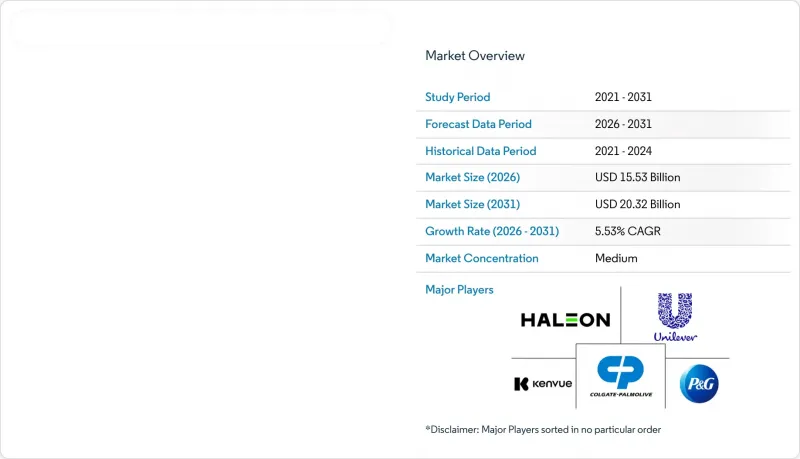
This report is Segmented by Product Type (Toothpaste, Mouthwash/Rinses, and More), Category (Natural/Organic, and Conventional/Synthetic), End-User (Kids/Children, and Adult), Distribution Channel (Supermarkets/Hypermarket, Drug Stores/Pharmacies, and More), and Geography (Germany, United Kingdom, Italy, Spain, and More). The Market Forecasts are Provided in Terms of Value (USD).
Europe Oral Care Market Trends and Insights
Rising Demand for Natural and Organic Toothpaste
Clean-label formulations free from synthetic surfactants, artificial sweeteners, and microplastics are reshaping procurement strategies across European retail chains. Conventional sodium lauryl sulfate is yielding to coconut-derived surfactants, while titanium dioxide, banned in food applications under EU Regulation 2022/63, faces voluntary phase-outs in oral care despite remaining legally permissible. The Humble Co. expanded its bamboo toothbrush and natural toothpaste tablet range in 2024, securing listings in Carrefour and Tesco that previously reserved shelf space for multinational brands. Denttabs introduced fluoride-infused toothpaste tablets in 2024, addressing a long-standing criticism that tablet formats compromised caries prevention, and the product achieved ISO 11609 compliance for abrasivity, signaling readiness for clinical endorsement. This shift is not purely consumer-driven; procurement officers at hospital trusts and care homes are embedding sustainability criteria into tender specifications, favoring suppliers with Cradle to Cradle or EU Ecolabel certifications that verify biodegradable packaging and ethically sourced actives.
Increase Consumer Focus on Oral Hygiene
European consumers are actively prioritizing oral hygiene, which drives growth in the oral care market. They recognize that good oral health directly affects cardiovascular health, diabetes management, and respiratory well-being. This understanding has transformed oral care from a simple daily routine into a crucial health practice. Older adults, who experience more dental problems, actively seek advanced oral care products and follow thorough hygiene routines. According to the OECD, the population aged 65 and older will grow from 21% in 2023 to 30% by 2050 . This aging population actively shapes the oral care market by demanding specific products. They need specialized items like dry mouth toothpaste, anti-gum disease mouthwashes, and denture care solutions. Their requirements for targeted oral health products drive companies to develop new solutions and expand the specialized oral care market.
Prevalence of Traditional Way of Tooth Cleaning
European consumers largely stick to traditional oral care methods, which restricts the growth of advanced oral care products in the region. Many people continue to use manual toothbrushes and basic toothpaste due to cost concerns, lack of awareness about newer products, and limited access to dental education. This behavior is especially common among the elderly and rural populations. Most consumers treat oral care as a simple daily task and believe brushing twice a day with manual tools meets their needs, even when dentists recommend modern alternatives. Lower-income regions in Central and Eastern Europe show minimal adoption of electric toothbrushes, interdental cleaning tools, and therapeutic products. This low adoption directly impacts sales of innovative oral hygiene products.
Other drivers and restraints analyzed in the detailed report include:
- Integration of Smart Technologies in Electric Toothbrush
- Favorable Government Initiatives on Oral Hygiene
- Counterfeit Products Affecting Brand Reputation
For complete list of drivers and restraints, kindly check the Table Of Contents.
Segment Analysis
Toothpaste held a 46.38% share in 2025, reflecting its entrenched position as the primary vehicle for fluoride delivery and daily plaque control, yet mouthwash and rinses are expanding at a 5.97% CAGR through 2031, the fastest pace among product categories. This acceleration stems from the commercialization of alcohol-free, microbiome-preserving formulations that address growing consumer and clinical concerns about antimicrobial resistance and oral dysbiosis. Haleon introduced Parodontax Active Gum Health mouthwash in 2024, incorporating stannous fluoride and cetylpyridinium chloride to target bleeding gums, a formulation that secured reimbursement approval under Germany's statutory health insurance for patients with diagnosed periodontitis. Toothbrushes, encompassing both manual and electric variants, are growing at a moderate pace as smart features command premium pricing but remain confined to affluent urban segments. Other product types, interdental brushes, tongue scrapers, and dental floss, serve niche roles yet collectively contribute incremental volume as dentists prescribe them for post-surgical care and orthodontic maintenance.
Mouthwash's trajectory is further amplified by its compatibility with telemedicine workflows; remote consultations during the COVID-19 pandemic normalized virtual prescriptions for therapeutic rinses, a practice that persists as health systems seek to reduce in-person visit loads. Toothpaste innovation is shifting toward delivery mechanisms, microencapsulated whitening agents, and enzyme-enhanced biofilm disruption that extend efficacy beyond the 2-minute brushing window, yet regulatory inertia slows commercialization as the EU Cosmetics Regulation requires manufacturers to demonstrate safety and efficacy for novel actives through multi-year clinical trials. Toothbrushes are bifurcating into ultra-low-cost manual variants for public procurement and high-tech electric models that integrate with smartphone apps, leaving mid-priced manual brushes in a margin squeeze. The segment's evolution underscores a broader pattern: products that enable measurable health outcomes and align with digital health ecosystems are capturing disproportionate growth, while undifferentiated commodity offerings face pricing pressure from private-label competition.
L29: Conventional and synthetic products commanded an 89.47% share in 2025, sustained by their cost efficiency, established clinical evidence, and compatibility with mass-production infrastructure, yet natural and organic alternatives are accelerating at a 6.35% CAGR through 2031, driven by regulatory tailwinds and shifting procurement criteria. The EU's ban on titanium dioxide in food applications, codified in Regulation 2022/63, created a halo effect that pressured oral care brands to voluntarily reformulate despite the ingredient's continued legality in cosmetics, with Unilever's Zendium Complete Protection, launched in 2024, eliminating synthetic colorants and preservatives in favor of natural enzymes (amyloglucosidase, glucose oxidase, and lactoperoxidase) that mimic saliva's antimicrobial properties.
L30: The European Medicines Agency has approved multiple naturally derived active ingredients for therapeutic oral care products, enabling natural formulations with validated health claims. The WHO's 2024 report on environmental determinants of health emphasizes reducing chemical exposure through personal care products, including oral care, and providing policy support for natural alternatives. The sales value of organic health and beauty products, including oral care, in the United Kingdom increased in 2023, according to the Soil Association . The demand for natural and organic oral care products has grown, driven by scientific research validation and regulatory compliance. Consumers are prioritizing oral care products that combine effectiveness with safety and environmental sustainability.
List of Companies Covered in this Report:
- Colgate-Palmolive Company
- Procter & Gamble Co.
- Unilever PLC
- Haleon PLC
- Kenvue, Inc.
- Koninklijke Philips N.V. (Philips Oral Healthcare)
- Sunstar Suisse S.A.
- Church & Dwight Co., Inc.
- Henkel AG & Co. KGaA
- Pierre Fabre S.A.
- Hawley & Hazel (BVI) Co., Ltd.
- Denttabs GmbH
- The Humble Co.
- Curaden AG
- TePe Munhygienprodukter AB
- Jordan AS (Orkla)
- GC Corporation (Europe)
- Venture Life Group
- Polished London
- Ludovico Martelli SpA
Additional Benefits:
- The market estimate (ME) sheet in Excel format
- 3 months of analyst support
TABLE OF CONTENTS
1 INTRODUCTION
- 1.1 Study Assumptions and Market Definition
- 1.2 Scope of the Study
2 RESEARCH METHODOLOGY
3 EXECUTIVE SUMMARY
4 MARKET LANDSCAPE
- 4.1 Market Overview
- 4.2 Market Drivers
- 4.2.1 Rising demand for natural and organic toothpaste
- 4.2.2 Increase consumer focus on oral hygiene
- 4.2.3 Integration of smart technologies in electric toothbrush
- 4.2.4 Favorable government initiatives on oral-hygiene
- 4.2.5 Aging population and dental health needs
- 4.2.6 Rising disposable income and healthcare spending
- 4.3 Market Restraints
- 4.3.1 Prevalence of traditional way of tooth cleaning
- 4.3.2 Counterfeit products affecting brand reputation
- 4.3.3 Raw material price fluctuations
- 4.3.4 Regulatory compliance requirements
- 4.4 Consumer Demand Analysis
- 4.5 Regulatory Outlook
- 4.6 Porter's Five Forces
- 4.6.1 Threat of New Entrants
- 4.6.2 Bargaining Power of Buyers
- 4.6.3 Bargaining Power of Suppliers
- 4.6.4 Threat of Substitutes
- 4.6.5 Competitive Rivalry
5 MARKET SIZE AND GROWTH FORECASTS (VALUE)
- 5.1 Product Type
- 5.1.1 Toothpaste
- 5.1.2 Mouthwash/Rinses
- 5.1.3 Toothbrush
- 5.1.4 Other Product Types
- 5.2 Category
- 5.2.1 Natural/Organic
- 5.2.2 Conventional/Synthetic
- 5.3 End-User
- 5.3.1 Kids/Children
- 5.3.2 Adult
- 5.4 Distribution Channel
- 5.4.1 Supermarkets/Hypermarkets
- 5.4.2 Drug Stores/Pharmacies
- 5.4.3 Online Stores
- 5.4.4 Other Distribution Channels
- 5.5 Geography
- 5.5.1 Germany
- 5.5.2 United Kingdom
- 5.5.3 Italy
- 5.5.4 France
- 5.5.5 Spain
- 5.5.6 Netherlands
- 5.5.7 Poland
- 5.5.8 Belgium
- 5.5.9 Sweden
- 5.5.10 Rest of Europe
6 COMPETITIVE LANDSCAPE
- 6.1 Market Concentration
- 6.2 Strategic Moves
- 6.3 Market Share Analysis
- 6.4 Company Profiles (includes Global level Overview, Market level overview, Core Segments, Financials as available, Strategic Information, Market Rank/Share for key companies, Products and Services, and Recent Developments)
- 6.4.1 Colgate-Palmolive Company
- 6.4.2 Procter & Gamble Co.
- 6.4.3 Unilever PLC
- 6.4.4 Haleon PLC
- 6.4.5 Kenvue, Inc.
- 6.4.6 Koninklijke Philips N.V. (Philips Oral Healthcare)
- 6.4.7 Sunstar Suisse S.A.
- 6.4.8 Church & Dwight Co., Inc.
- 6.4.9 Henkel AG & Co. KGaA
- 6.4.10 Pierre Fabre S.A.
- 6.4.11 Hawley & Hazel (BVI) Co., Ltd.
- 6.4.12 Denttabs GmbH
- 6.4.13 The Humble Co.
- 6.4.14 Curaden AG
- 6.4.15 TePe Munhygienprodukter AB
- 6.4.16 Jordan AS (Orkla)
- 6.4.17 GC Corporation (Europe)
- 6.4.18 Venture Life Group
- 6.4.19 Polished London
- 6.4.20 Ludovico Martelli SpA
7 MARKET OPPORTUNITIES AND FUTURE OUTLOOK

