PUBLISHER: Mordor Intelligence | PRODUCT CODE: 2066391

PUBLISHER: Mordor Intelligence | PRODUCT CODE: 2066391
Dual Carbon Battery - Market Share Analysis, Industry Trends & Statistics, Growth Forecasts (2026 - 2031)
According to Mordor Intelligence, the dual carbon battery market size is expected to grow from USD 3.98 billion in 2025 to USD 4.42 billion in 2026 and is forecast to reach USD 7.45 billion by 2031 at 11.03% CAGR over 2026-2031.
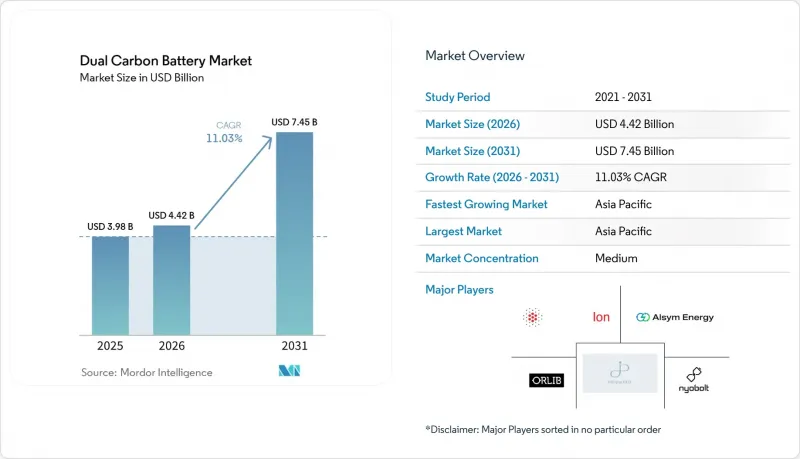
This report is Segmented by Battery Type (Disposable Dual-Carbon Cells and Rechargeable Dual-Carbon Cells), Capacity (Below 10 KWh, 10 To 100 KWh, 100 To 500 KWh, and Above 500 KWh), Application (Automotive Batteries, Industrial Stationary Storage, Portable/Consumer Electronics, Aerospace and Defense, and More), and Geography (North America, Europe, Asia-Pacific, South America, and Middle East and Africa).
Global Dual Carbon Battery Market Trends and Insights
Rapid EV Electrification Mandates
Policies banning new internal-combustion models from 2035 in the EU and several U.S. states significantly expand the addressable demand for batteries that can charge from 10-80% in five minutes without high-cost cooling loops. Dual carbon electrodes withstand elevated currents while maintaining core temperatures 18 °C lower than those of comparable lithium-ion packs, enabling simpler thermal management hardware. China's New Energy Vehicle target of 40% sales penetration by 2030 further cements volume pull, as domestic OEMs diversify beyond NMC chemistries to hedge against nickel and cobalt volatility. Staggered compliance deadlines align with expected gigafactory ramp-ups, allowing specialist developers to lock in offtake agreements before legacy suppliers adapt.
Carbon-Neutral Supply-Chain Incentives
The EU Battery Passport, which becomes compulsory from February 2027, requires manufacturers to disclose cradle-to-gate CO2 intensities and recycled-content percentages. Full-carbon electrodes reduce embodied emissions by eliminating high-temperature metal smelting, positioning the chemistry for premium scoring under the regulation. In the United States, the Inflation Reduction Act tax credits increase to USD 45 per kWh when domestic content exceeds 60%, a threshold that is attainable for dual carbon producers using U.S. natural graphite or carbon fiber. Corporate buyers seeking Scope 3 emission reductions increasingly request life-cycle assessment data at the request-for-quotation stage, turning low-carbon chemistries into a procurement prerequisite rather than a marketing plus.
Cell-to-Pack Thermal-Runaway Tests Pending
Most homologation protocols still revolve around lithium-ion abuse modes, leaving chemistries like dual carbon without explicit pass-fail criteria. Regulatory agencies require bespoke test matrices, and the absence of codified standards prolongs qualification by six to nine months per vehicle program. Interim guidelines are currently under draft at the ISO and IEC, but are not expected until late 2026, which will constrain near-term automotive launches. The delay particularly hurts mid-tier suppliers that lack the resources to run parallel validation programs across multiple regions.
Other drivers and restraints analyzed in the detailed report include:
- End-of-Life Recyclability Regulations
- 20x-Faster Charge Pilots in E-buses
- Limited Large-Scale Carbon Precursor Supply
For complete list of drivers and restraints, kindly check the Table Of Contents.
Segment Analysis
Rechargeable products accounted for 86.35% of the dual carbon battery market in 2025, reflecting the chemistry's suitability for repeated-cycle applications, such as passenger EVs and fleet e-buses. Long-term road tests demonstrate 3,000 full-depth cycles with 80% capacity retention, resulting in a lower total cost of ownership compared to metal-based cells that require pack oversizing to meet warranty obligations. Disposable dual-carbon formats remain niche, chiefly in aerospace emergency power, where benign failure modes trump unit economics.
Commercial traction for rechargeables accelerated after a leading developer secured USD 30 million Series C funding and disclosed eight automotive design wins in 2025. Standardized 21700 and 46xx form factors now roll off pilot lines, enabling pack-maker integration with minimal tooling change. As deployment widens, economies of scale are expected to reduce the cost per kWh by an estimated 22% between 2025 and 2028, thereby narrowing the pricing gap with lithium-iron-phosphate.
Geography Analysis
Asia-Pacific's 49.02% share in 2025 underscores deep vertical integration from needle coke feedstock to finished electrodes. Chinese synthetic-graphite producers leverage captive power sourced from hydroelectric and solar sources, keeping embodied emissions under 4 kg CO2-eq per kWh, which is well below European averages. Regional governments offer 20% capital-grant ratios for pilot lines, accelerating local output and maintaining export cost leadership. The dual carbon battery market size in Asia-Pacific is forecast to advance at a 12.1% CAGR to 2031, supported by national policies mandating minimum domestic content in EV packs.
North America is the fastest-growing market in the region. Inflation Reduction Act credits worth up to USD 3,750 per vehicle battery module drove at least four OEMs to sign conditional offtake agreements with U.S. dual carbon start-ups in 2025. The Department of Energy's USD 25 million funding round supports eleven projects that scale electrode coating and ionic-liquid electrolyte synthesis onshore. Canadian mining ventures enhance feedstock security with two large flake-graphite projects scheduled for commissioning in 2027, which helps lower logistics costs.
Europe's trajectory hinges on sustainability regulations that align squarely with carbon-based chemistries. The Battery Passport favors traceable, low-emission materials. Lignin-derived carbon pilot plants in Finland and Sweden target a combined annual capacity of 15,000 tons by 2028. European automakers currently import prototype cells from Japanese lines but intend to localize modules once the precursor supply matures. Middle East and African markets remain small, although Gulf utilities have expressed interest in desert-climate storage, where high ambient temperatures penalize traditional lithium-ion systems.
- PJP Eye Ltd (Power Japan Plus)
- Nyobolt
- Alsym Energy
- Carbon-Ion
- ORLIB Ltd
- Farad Power
- Panasonic Energy
- LG Energy Solution
- BYD Co. Ltd
- CATL
- Samsung SDI
- Hitachi Energy
- Toshiba
- Envision AESC
- Sion Power
- StoreDot
- Enevate
- QuantumScape
- Skeleton Technologies
- Northvolt
Additional Benefits:
- The market estimate (ME) sheet in Excel format
- 3 months of analyst support
TABLE OF CONTENTS
1 Introduction
- 1.1 Study Assumptions & Market Definition
- 1.2 Scope of the Study
2 Research Methodology
3 Executive Summary
4 Market Landscape
- 4.1 Market Overview
- 4.2 Market Drivers
- 4.2.1 Rapid EV electrification mandates
- 4.2.2 Carbon-neutral supply-chain incentives
- 4.2.3 End-of-life recyclability regulations
- 4.2.4 20x-faster charge pilots in e-buses
- 4.2.5 OEM shift to anode-free chemistries
- 4.2.6 Grid-edge ultra-fast storage tenders
- 4.3 Market Restraints
- 4.3.1 Cell-to-pack thermal-runaway tests pending
- 4.3.2 Absence of ISO/IEC performance standard
- 4.3.3 Limited large-scale carbon precursor supply
- 4.3.4 VC funding tilt towards solid-state
- 4.4 Comparative Analysis: Dual-Carbon vs Other Battery Technologies
- 4.5 Supply-Chain Analysis
- 4.6 Regulatory Landscape
- 4.7 Technological Outlook
- 4.8 Porter's Five Forces
- 4.8.1 Bargaining Power of Suppliers
- 4.8.2 Bargaining Power of Consumers
- 4.8.3 Threat of New Entrants
- 4.8.4 Threat of Substitute Products
- 4.8.5 Intensity of Competitive Rivalry
5 Market Size & Growth Forecasts
- 5.1 By Battery Type
- 5.1.1 Disposable Dual-Carbon Cells
- 5.1.2 Rechargeable Dual-Carbon Cells
- 5.2 By Capacity
- 5.2.1 Below 10 kWh
- 5.2.2 10 to 100 kWh
- 5.2.3 100 to 500 kWh
- 5.2.4 Above 500 kWh
- 5.3 By Application
- 5.3.1 Automotive Batteries
- 5.3.2 Industrial Stationary Storage
- 5.3.3 Portable/Consumer Electronics
- 5.3.4 Aerospace and Defense
- 5.3.5 Other Niche Uses
- 5.4 By Geography
- 5.4.1 North America
- 5.4.1.1 United States
- 5.4.1.2 Canada
- 5.4.1.3 Mexico
- 5.4.2 Europe
- 5.4.2.1 Germany
- 5.4.2.2 United Kingdom
- 5.4.2.3 France
- 5.4.2.4 Italy
- 5.4.2.5 Spain
- 5.4.2.6 Russia
- 5.4.2.7 Rest of Europe
- 5.4.3 Asia-Pacific
- 5.4.3.1 China
- 5.4.3.2 India
- 5.4.3.3 Japan
- 5.4.3.4 South Korea
- 5.4.3.5 Australia
- 5.4.3.6 ASEAN Countries
- 5.4.3.7 Rest of Asia-Pacific
- 5.4.4 South America
- 5.4.4.1 Argentina
- 5.4.4.2 Brazil
- 5.4.4.3 Rest of South America
- 5.4.5 Middle East and Africa
- 5.4.5.1 Saudi Arabia
- 5.4.5.2 United Arab Emirates
- 5.4.5.3 South Africa
- 5.4.5.4 Rest of Middle East and Africa
- 5.4.1 North America
6 Competitive Landscape
- 6.1 Market Concentration
- 6.2 Strategic Moves (M&A, Partnerships, PPAs)
- 6.3 Market Share Analysis (Market Rank/Share for key companies)
- 6.4 Company Profiles (includes Global level Overview, Market level overview, Core Segments, Financials as available, Strategic Information, Products & Services, and Recent Developments)
- 6.4.1 PJP Eye Ltd (Power Japan Plus)
- 6.4.2 Nyobolt
- 6.4.3 Alsym Energy
- 6.4.4 Carbon-Ion
- 6.4.5 ORLIB Ltd
- 6.4.6 Farad Power
- 6.4.7 Panasonic Energy
- 6.4.8 LG Energy Solution
- 6.4.9 BYD Co. Ltd
- 6.4.10 CATL
- 6.4.11 Samsung SDI
- 6.4.12 Hitachi Energy
- 6.4.13 Toshiba
- 6.4.14 Envision AESC
- 6.4.15 Sion Power
- 6.4.16 StoreDot
- 6.4.17 Enevate
- 6.4.18 QuantumScape
- 6.4.19 Skeleton Technologies
- 6.4.20 Northvolt
7 Market Opportunities & Future Outlook
- 7.1 White-space & Unmet-Need Assessment

