
PUBLISHER: Mordor Intelligence | PRODUCT CODE: 2066618

PUBLISHER: Mordor Intelligence | PRODUCT CODE: 2066618
Spain Courier, Express, And Parcel (CEP) - Market Share Analysis, Industry Trends & Statistics, Growth Forecasts (2026 - 2031)
According to Mordor Intelligence, the spain courier, express, and parcel market size was valued at USD 4.39 billion in 2025 and estimated to grow from USD 4.58 billion in 2026 to reach USD 5.48 billion by 2031, at a 3.67% CAGR during the forecast period (2026-2031).
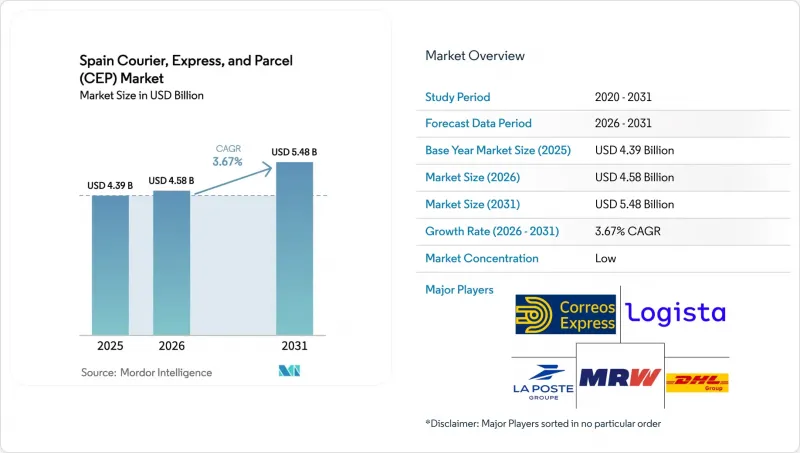
Spain's double-digit e-commerce penetration, a persistently high 22% return rate, and growing demand for cold-chain services keep parcel volumes on an upward trajectory. This report is Segmented by Destination (Domestic, International), by Speed of Delivery (Express, Non-Express), by Model (Business-To-Business, and More), by Shipment Weight (Heavy Weight, Light Weight, Medium Weight), by Mode of Transport (Air, Road, Others), and by End User Industry (E-Commerce, Financial Services, and More). The Market Forecasts are Provided in Terms of Value (USD).
Spain Courier, Express, And Parcel (CEP) Market Trends and Insights
Surge in Reverse Logistics Driven by Spain's 22% E-Commerce Return Rate
Return rates near 22% make Spain one of Europe's most challenging e-commerce environments, prompting operators to rebuild hub-and-spoke networks for two-way flows while installing inspection and refurbishment lines inside depots. Fashion and footwear account for the bulk of returns and often exceed 30% due to size uncertainty and bracketing purchases. Peer-to-peer marketplaces add another layer of bidirectional traffic as every C2C shipment doubles touchpoints. Operators that invest in dedicated reverse logistics capacity and inventory-visibility platforms increasingly turn a traditional cost center into a source of differentiation. As more brands introduce take-back schemes, reverse flow volumes inside the Spain courier, express, and parcel market are projected to outpace forward shipment growth over the next five years.
AI-Powered Dynamic Route Planning and Load Balancing Cutting Cost per Kilometer
Machine-learning algorithms that ingest traffic, weather, and historical delivery patterns now trim 12-18% off line-haul and last-mile costs. Real-time re-sequencing raises stops per hour by more than 20% on dense Barcelona routes, allowing carriers to protect margins despite platform-driven rate pressure. Capital-intensive robotics hubs such as Amazon's Asturias facility combine AI sortation with automated guided vehicles to sustain peak-season throughput. Mid-tier providers unable to fund data-science talent increasingly adopt white-label SaaS optimization tools or partner with technology firms, widening the capability gap among competitors in the Spain courier, express, and parcel market.
Inflation Spikes in Corrugate, Fuel, and Refrigerants Adding More Than 8% to Unit Costs
Corrugate surged 15-20% on pulp shortages, diesel prices swung between EUR 1.20-1.60 per liter, and F-gas phase-downs inflated refrigerant costs, collectively compressing margins in 2025. Carriers hedged fuel and signed fixed-rate packaging contracts, yet high-volume platforms controlling over 80% of orders resisted price adjustments. Smaller providers found limited headroom to absorb spikes, prompting defensive mergers and stronger focus on AI efficiency levers inside the Spain courier, express, and parcel market.
Other drivers and restraints analyzed in the detailed report include:
- Cross-Border Grocery and Meal-Kit Boom Boosting Temperature-Controlled Parcel Demand
- EU-Funded Hydrogen Truck Pilots Lowering Long-Haul Emission Costs and Toll Exposure
- CSRD-Mandated ESG Auditing Increasing Compliance Overheads for CEP Firms
For complete list of drivers and restraints, kindly check the Table Of Contents.
Segment Analysis
Manufacturing generated 32.41% of the Spain Courier, Express, and Parcel (CEP) market share in 2025, supported by steady automotive and machinery output in Catalonia and Navarre. The Spain courier, express, and parcel market linked to manufacturing remains resilient but posts modest mid-single-digit growth tied to industrial production cycles.
E-commerce parcels, including C2C resale, are forecast to grow 4.00% CAGR through 2031, buoyed by deepening online penetration in fashion, electronics, and homeware baskets. Manufacturers increasingly adopt B2B e-commerce portals for spare parts, driving predictable small-batch shipments, while fashion retailers leverage reverse logistics hubs to cope with returns exceeding 30%. Financial services sustain high-margin document couriers, and stricter GDP rules push healthcare senders toward premium express services. End-user diversification staves off sector-specific volatility and rewards operators able to run multi-vertical networks inside the Spain courier, express, and parcel market.
Domestic parcels represented 63.92% of the Spain Courier, Express, and Parcel (CEP) market size in 2025, yet face slowing growth as urban markets reach service saturation. International flows will register 3.80% CAGR to 2031, lifted by EU VAT harmonization and IOSS rules that cut customs friction for sub-EUR 150 shipments.
Cross-border growth clusters along Spain-France-Germany corridors supported by hydrogen truck pilots and rail-road services that eliminate 11,500 annual truck trips. Spanish exporters also tap UPS's Estafeta network to Latin America, capitalizing on cultural affinity and time-zone alignment. The widening international mix compels carriers to refine customs-brokerage capabilities and invest in multi-currency, multi-language customer portals across the Spain courier, express, and parcel market.
List of Companies Covered in this Report:
- Correos Express
- DHL Group
- FedEx
- GEODIS
- La Poste Group (including SEUR)
- Logista
- MRW
- Paack
- Szendex
- International Distribution Services plc
- Amazon, Inc.
- CTT Express
- Envialia
- TIPSA
- Stuart Delivery
- Sending Transporte Urgente
- Rangel Logistics
- Zeleris
- ID Logistics
- United Parcel Service of America, Inc. (UPS)
Additional Benefits:
- The market estimate (ME) sheet in Excel format
- 3 months of analyst support
TABLE OF CONTENTS
1 Introduction
- 1.1 Study Assumptions and Market Definition
- 1.2 Scope of the Study
2 Research Methodology
3 Executive Summary
4 Market Landscape
- 4.1 Market Overview
- 4.2 Demographics
- 4.3 GDP Distribution by Economic Activity
- 4.4 GDP Growth by Economic Activity
- 4.5 Inflation
- 4.6 Economic Performance and Profile
- 4.6.1 Trends in E-Commerce Industry
- 4.6.2 Trends in Manufacturing Industry
- 4.7 Transport and Storage Sector GDP
- 4.8 Export Trends
- 4.9 Import Trends
- 4.10 Fuel Price
- 4.11 Logistics Performance
- 4.12 Infrastructure
- 4.13 Regulatory Framework
- 4.14 Value Chain and Distribution Channel Analysis
- 4.15 Market Drivers
- 4.15.1 Surge in Reverse Logistics Driven by Spain's 22 % E-Commerce Return Rate
- 4.15.2 AI-Powered Dynamic Route-Planning and Load-Balancing Cutting Cost Per Kilometer
- 4.15.3 Cross-Border Grocery and Meal-Kit Boom Boosting Temperature-Controlled Parcel Demand
- 4.15.4 EU-Funded Hydrogen Truck Pilots Lowering Long-Haul Emission Costs and Toll Exposure
- 4.15.5 Stricter EU GDP Pharma Rules Expanding Cold-Chain Express Volumes
- 4.15.6 Rapid Rise of C2C Resale Platforms (Wallapop, Vinted) Multiplying Micro-Parcel Flows
- 4.16 Market Restraints
- 4.16.1 Inflation Spikes in Corrugate, Fuel, and Refrigerants Adding More Than 8 % to Unit Costs
- 4.16.2 CSRD-Mandated ESG Auditing Increasing Compliance Overheads for CEP Firms
- 4.16.3 Escalating Cyber-Attacks on Tracking APIs Causing SLA Penalties and Brand Damage
- 4.16.4 Saturation of Urban Pick-Up/Locker Points Limiting Further Last-Mile Density Gains
- 4.17 Technology Innovations in the Market
- 4.18 Porter's Five Forces Analysis
- 4.18.1 Threat of New Entrants
- 4.18.2 Bargaining Power of Buyers
- 4.18.3 Bargaining Power of Suppliers
- 4.18.4 Threat of Substitutes
- 4.18.5 Competitive Rivalry
5 Market Size and Growth Forecasts (Value, USD)
- 5.1 By Destination
- 5.1.1 Domestic
- 5.1.2 International
- 5.2 By Speed of Delivery
- 5.2.1 Express
- 5.2.2 Non-Express
- 5.3 By Model
- 5.3.1 Business-to-Business (B2B)
- 5.3.2 Business-to-Consumer (B2C)
- 5.3.3 Consumer-to-Consumer (C2C)
- 5.4 By Shipment Weight
- 5.4.1 Heavy Weight Shipments
- 5.4.2 Light Weight Shipments
- 5.4.3 Medium Weight Shipments
- 5.5 By Mode of Transport
- 5.5.1 Air
- 5.5.2 Road
- 5.5.3 Others
- 5.6 By End User Industry
- 5.6.1 E-Commerce
- 5.6.2 Financial Services (BFSI)
- 5.6.3 Healthcare
- 5.6.4 Manufacturing
- 5.6.5 Primary Industry
- 5.6.6 Wholesale and Retail Trade (Offline)
- 5.6.7 Others
6 Competitive Landscape
- 6.1 Market Concentration
- 6.2 Key Strategic Moves
- 6.3 Market Share Analysis
- 6.4 Company Profiles (Includes Global Level Overview, Market Level Overview, Core Segments, Financials as Available, Strategic Information, Market Rank/Share for Key Companies, Products and Services, and Recent Developments)
- 6.4.1 Correos Express
- 6.4.2 DHL Group
- 6.4.3 FedEx
- 6.4.4 GEODIS
- 6.4.5 La Poste Group (including SEUR)
- 6.4.6 Logista
- 6.4.7 MRW
- 6.4.8 Paack
- 6.4.9 Szendex
- 6.4.10 International Distribution Services plc
- 6.4.11 Amazon, Inc.
- 6.4.12 CTT Express
- 6.4.13 Envialia
- 6.4.14 TIPSA
- 6.4.15 Stuart Delivery
- 6.4.16 Sending Transporte Urgente
- 6.4.17 Rangel Logistics
- 6.4.18 Zeleris
- 6.4.19 ID Logistics
- 6.4.20 United Parcel Service of America, Inc. (UPS)
7 Market Opportunities and Future Outlook
- 7.1 White-Space and Unmet-Need Assessment

