PUBLISHER: Mordor Intelligence | PRODUCT CODE: 2066697

PUBLISHER: Mordor Intelligence | PRODUCT CODE: 2066697
Asia-Pacific Cyanoacrylate Adhesives - Market Share Analysis, Industry Trends & Statistics, Growth Forecasts (2026 - 2031)
According to Mordor Intelligence, the asia-Pacific cyanoacrylate adhesives market size was valued at USD 1.26 billion in 2025 and is estimated to grow from USD 1.33 billion in 2026 to reach USD 1.76 billion by 2031, at a CAGR of 5.72% during the forecast period (2026-2031).
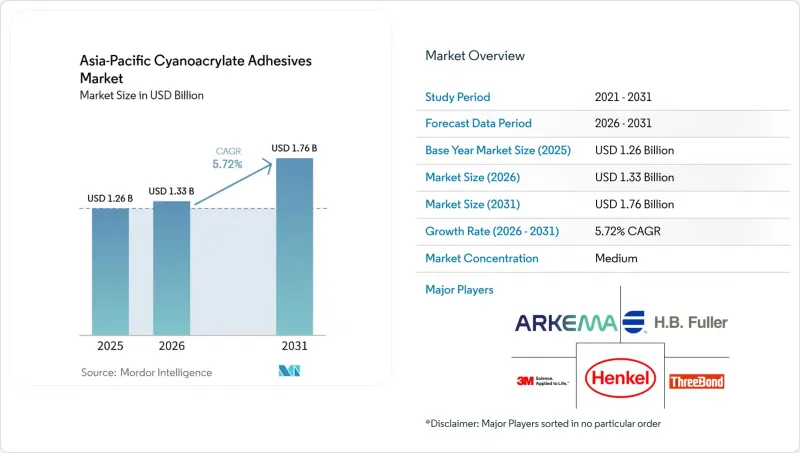
This report is Segmented by End User Industry (Aerospace, Automotive, Building and Construction, Footwear and Leather, Healthcare, Woodworking and Joinery, and More), Technology (Reactive and UV-Cured), and Geography (Australia, China, India, Indonesia, Japan, Malaysia, Singapore, South Korea, Thailand, and Rest of Asia-Pacific). The Market Forecasts are Provided in Terms of Value (USD).
Asia-Pacific Cyanoacrylate Adhesives Market Trends and Insights
Surging Electronics Assembly Demand
Multiple projects approved under India's Electronics Component Manufacturing Scheme by January 2026 are attracting billions in capital and thousands of new jobs, lifting instant-adhesive offtake for multilayer printed circuit boards (PCBs), camera modules, and optical devices. In China, strong gains in industrial-robot output and equipment manufacturing value add demonstrate expanding automation that boosts adhesive consumption on high-speed lines. Henkel's Singapore Technical Center now recreates dispensing, die-attach, and lamination processes, cutting qualification times for cyanoacrylates aimed at semiconductor packaging. UPM's Johor Bahru coating line, coming online mid-2026, adds filmic constructions for durable labels and foldable-display films, catering to Southeast Asian electronics makers.
Rising Automotive Lightweighting Initiatives
China has increased its production of motor vehicles and new-energy vehicles, boosting the demand for cyanoacrylate in battery pack housings, trims, and electronics. Consequently, Toagosei has experienced a notable rise in sales of its battery-related adhesives compared to previous levels, prompting subsidiaries in Vietnam and India to expand during 2024. Hyundai Mobis requires suppliers to declare substances and reduce heavy-metal and copper content, favoring fast-curing, low- volatile organic compound (VOCs) instant bonds that eliminate heat in mixed-material joints. As OEMs target bio-based or recycled plastics, cyanoacrylates complement structural acrylics by delivering quick green strength without ovens, supporting throughput in gigafactories.
Price Volatility of Cyanoacrylate Monomers
Pidilite disclosed falling vinyl acetate monomer costs that widened gross margins but underscored susceptibility to feedstock swings. China's producer price index fell in 2025, limiting pass-through room for adhesive makers even as ethylene investment rose. Japan's chemicals database shows modest local alkyl-cyanoacrylate production volumes, constraining scale economies. Smaller converters, lacking hedging tools, absorb spot spikes or lose share, pushing many toward tolling deals with integrated multinationals in the Asia Pacific cyanoacrylate adhesives market.
Other drivers and restraints analyzed in the detailed report include:
- Booming Residential DIY Market
- Growing Medical Device Usage of Topical Skin Adhesives
- Stringent Volatile Organic Compound (VOC) and Workplace Exposure Limits
For complete list of drivers and restraints, kindly check the Table Of Contents.
Segment Analysis
Healthcare held 31.48% of the Asia Pacific cyanoacrylate adhesives market share in 2025 and is projected to grow at 6.04% CAGR through 2026 to 2031. The segment advances as China's Class III rules remove ambiguity and Indian firms win U.S. clearances, encouraging capital inflows into sterile production lines. Hospitals prefer topical skin adhesives to speed wound closure and cut needlestick risk. Cross-border demand from Asia-based OEM contract sterilizers also supports volume growth. Rising disposable incomes across ASEAN expand elective surgery counts, further lifting medical-grade cyanoacrylate uptake within the Asia Pacific cyanoacrylate adhesives market size for this segment.
Consumer DIY and woodworking remain steady contributors. Pidilite's rural channel expansion strengthens category resilience during urban slowdowns. Footwear and leather workshops leverage instant bonds for sole attachment and trim finishing. Construction uptake moderates in China, yet stays positive due to green-transition retrofits. Automotive and electronics retain double-digit share as lightweighting and miniaturization continue, though heat-critical joints migrate to epoxies. Aerospace demand is niche but stable, focused on non-critical cabin and avionics fastening.
List of Companies Covered in this Report:
- 3M
- Aica Kogyo Co., Ltd.
- Arkema
- DELO Industrial Adhesives
- Dymax Corporation
- EpoxySet Inc.
- H.B. Fuller Company
- Henkel AG & Co. KGaA
- Hubei Huitian New Materials Co. Ltd
- ITW Performance Polymers
- Kangda New Materials (Group) Co., Ltd.
- NANPAO RESINS CHEMICAL GROUP
- Pidilite Industries Ltd.
- Sika AG
- ThreeBond Holdings Co., Ltd.
- Toagosei Co., Ltd.
Additional Benefits:
- The market estimate (ME) sheet in Excel format
- 3 months of analyst support
TABLE OF CONTENTS
1 Introduction
- 1.1 Study Assumptions and Market Definition
- 1.2 Scope of the Study
2 Research Methodology
3 Executive Summary
4 Market Landscape
- 4.1 Market Overview
- 4.2 Market Drivers
- 4.2.1 Surging electronics assembly demand
- 4.2.2 Rising automotive lightweighting initiatives
- 4.2.3 Booming residential DIY market
- 4.2.4 Growing medical device usage of topical skin adhesives
- 4.2.5 Shift to low-odor/low-bloom formulations for worker safety
- 4.3 Market Restraints
- 4.3.1 Price volatility of cyanoacrylate monomers
- 4.3.2 Stringent VOC and workplace exposure limits
- 4.3.3 Limited heat-resistance versus epoxies
- 4.4 Value Chain Analysis
- 4.5 Regulatory Landscape
- 4.6 Distribution Channel Analysis
- 4.7 Porter's Five Forces
- 4.7.1 Threat of New Entrants
- 4.7.2 Bargaining Power of Suppliers
- 4.7.3 Bargaining Power of Buyers
- 4.7.4 Threat of Substitutes
- 4.7.5 Competitive Rivalry
5 Market Size and Growth Forecasts (Value)
- 5.1 End User Industry
- 5.1.1 Aerospace
- 5.1.2 Automotive
- 5.1.3 Building and Construction
- 5.1.4 Footwear and Leather
- 5.1.5 Healthcare
- 5.1.6 Woodworking and Joinery
- 5.1.7 Other End-user Industries
- 5.2 Technology
- 5.2.1 Reactive
- 5.2.2 UV-Cured
- 5.3 Geography
- 5.3.1 China
- 5.3.2 India
- 5.3.3 Indonesia
- 5.3.4 Japan
- 5.3.5 Malaysia
- 5.3.6 Singapore
- 5.3.7 South Korea
- 5.3.8 Thailand
- 5.3.9 Australia
- 5.3.10 Rest of Asia-Pacific
6 Competitive Landscape
- 6.1 Market Concentration
- 6.2 Strategic Moves
- 6.3 Market Share(%)/Ranking Analysis
- 6.4 Company Profiles (includes Global level Overview, Market level overview, Core Segments, Financials as available, Strategic Information, Products and Services, and Recent Developments)
- 6.4.1 3M
- 6.4.2 Aica Kogyo Co., Ltd.
- 6.4.3 Arkema
- 6.4.4 DELO Industrial Adhesives
- 6.4.5 Dymax Corporation
- 6.4.6 EpoxySet Inc.
- 6.4.7 H.B. Fuller Company
- 6.4.8 Henkel AG & Co. KGaA
- 6.4.9 Hubei Huitian New Materials Co. Ltd
- 6.4.10 ITW Performance Polymers
- 6.4.11 Kangda New Materials (Group) Co., Ltd.
- 6.4.12 NANPAO RESINS CHEMICAL GROUP
- 6.4.13 Pidilite Industries Ltd.
- 6.4.14 Sika AG
- 6.4.15 ThreeBond Holdings Co., Ltd.
- 6.4.16 Toagosei Co., Ltd.
7 Market Opportunities and Future Outlook
- 7.1 White-space and Unmet-need Assessment

