PUBLISHER: Mordor Intelligence | PRODUCT CODE: 2066698

PUBLISHER: Mordor Intelligence | PRODUCT CODE: 2066698
Europe Cyanoacrylate Adhesives - Market Share Analysis, Industry Trends & Statistics, Growth Forecasts (2026 - 2031)
According to Mordor Intelligence, the europe cyanoacrylate adhesives market size is projected to expand from USD 0.78 billion in 2025 to USD 0.82 billion in 2026 and USD 1.06 billion by 2031, registering a CAGR of 5.28% between 2026 and 2031.
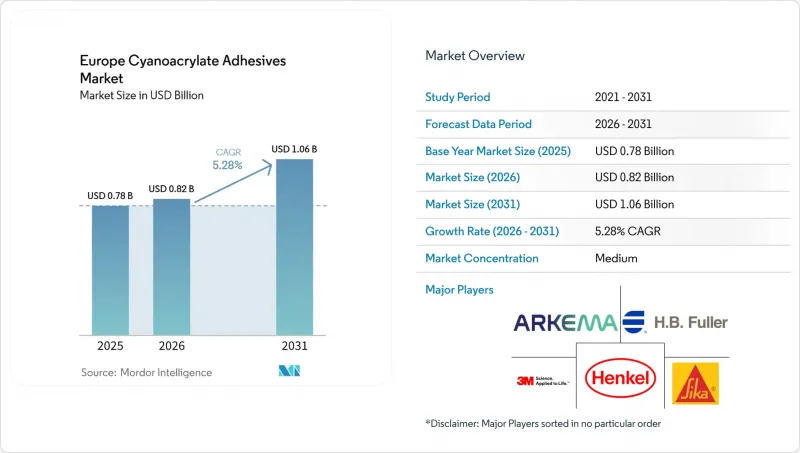
This report is Segmented by End-User Industry (Aerospace, Automotive, Building and Construction, Footwear and Leather, Healthcare, Woodworking and Joinery, and Other End-User Industries), Technology (Reactive, and UV Cured Adhesives), and Geography (France, Germany, Italy, Russia, Spain, United Kingdom, and Rest of Europe). The Market Forecasts are Provided in Terms of Value (USD).
Europe Cyanoacrylate Adhesives Market Trends and Insights
Accelerating Lightweighting Initiatives in European Automotive Production
European automakers blend aluminum, carbon fiber, and high-strength steel to trim mass without sacrificing crash performance. Adhesive bonding eliminates rivets, raises fatigue life, and permits mixed-material joints. Cyanoacrylates excel in interior trim, sensor housings, and wiring harness strain relief, where sub-30-second fixture times support just-in-time sequencing. Henkel's early 2026 campaign on its LOCTITE and TEROSON ranges underscores the link between lightweighting, fleet carbon dioxide targets, and rapid production changeovers. The European Union's circular-design proposals call for reversible bonding; suppliers investing in thermally debondable cyanoacrylates gain first-mover advantage. Electric vehicle battery modules add dielectric and thermal-runaway constraints, nudging formulators toward hybrid or filled grades that dissipate heat while remaining non-structural.
Rapid Adoption of Tissue Grade Cyanoacrylates in Minimally Invasive Surgeries
N-butyl-2- and octyl-2-cyanoacrylate glues now close incisions, fix meshes, and seal varices across laparoscopic specialties. Randomized studies reported 100% mesh fixation success and lower pain scores versus absorbable tacks, while the United Kingdom's National Institute for Health and Care Excellence (NICE) guidance states clinical equivalence to mechanical fixation with shorter hospital stays. The EU Medical Device Regulation classifies these glues as Class III, demanding exhaustive biocompatibility data. Premium pricing reflects sterile single-use applicators and ISO 10993 validation, yet hospitals tolerate higher unit costs thanks to quicker procedure turnover and lower readmission rates.
Stringent Occupational Safety Labeling (H315/H335) Limiting Industrial Throughput
H315/H335 classifications obligate local exhaust, goggles, and polymer-laminate gloves. Manual assembly lines are slow as operators don respirators, raising labor cost per part. Mid-2025 Safety Data Sheet (SDS) updates from 3M and ITW enumerate exposure limits and push customers toward automated dispensing cells that vent fumes and minimize hand contact. Small firms lacking capital may exit, accelerating market consolidation.
Other drivers and restraints analyzed in the detailed report include:
- Growth of Engineered Wood and Modular Furniture Manufacturing
- Shift to Low-Odor, Low-Bloom Formulations to Meet Stricter VOC Rules
- Performance Discrepancies Above 120 °C
For complete list of drivers and restraints, kindly check the Table Of Contents.
Segment Analysis
Healthcare's 31.48% share of 2025 demand reflected operating-room preferences for tissue-grade glues that shorten OR time and reduce postoperative pain. A 6.04% CAGR through 2026-2031 keeps the segment atop the growth league, as European Union Medical Device Regulation (EU-MDR) compliance and ISO 10993 testing become standard procurement prerequisites. Automotive remains a significant segment; however, heat resistance limits applications to interior trim and wire management. Construction, footwear, and woodworking contribute a steady volume in price-sensitive formulations.
A 2026 Journal of Clinical Medicine reviewed across 10 studies spanning six countries found lower infection rates for octyl-2-cyanoacrylate in breast surgery than subcuticular sutures, though wound dehiscence risk rose under high tension. Medical-device firms such as B. Braun, Advanced Medical Solutions, and GEM commercialize single-use applicators that fetch margins above industrial grades. Outside healthcare, aerospace engineers adopt low-outgassing Dymax 9773 for printed circuit board (PCB) staking on satellites and avionics, meeting American Society for Testing and Materials (ASTM) E595 and Military Standard (MIL-STD)-883 benchmarks in seconds, with fast ultraviolet (UV) cure.
List of Companies Covered in this Report:
- 3M
- Arkema
- Bolton Group
- CHEMENCE
- DELO Industrie Klebstoffe GmbH & Co. KGaA
- Dymax Corporation
- H.B. Fuller Company
- Henkel AG & Co. KGaA
- Hoenle AG
- Illinois Tool Works Inc.
- Jowat SE
- Kisling Deutschland GmbH
- Master Bond
- Parson Adhesives Inc.
- Permabond LLC
- Sika AG
- Soudal Holding N.V.
- ThreeBond Holdings Co., Ltd.
- WEICON GmbH & Co. KG
Additional Benefits:
- The market estimate (ME) sheet in Excel format
- 3 months of analyst support
TABLE OF CONTENTS
1 Introduction
- 1.1 Study Assumptions and Market Definition
- 1.2 Scope of the Study
2 Research Methodology
3 Executive Summary
4 Market Landscape
- 4.1 Market Overview
- 4.2 Market Drivers
- 4.2.1 Accelerating lightweighting initiatives in European automotive production
- 4.2.2 Rapid adoption of tissue-grade cyanoacrylates in minimally-invasive surgeries
- 4.2.3 Growth of engineered wood and modular furniture manufacturing
- 4.2.4 DIY and home-improvement retail boom fuelled by e-commerce penetration
- 4.2.5 Shift to low-odor, low-bloom formulations to meet stricter REACH and VOC rules
- 4.3 Market Restraints
- 4.3.1 Stringent occupational safety labelling (H315/H335) limiting industrial throughput
- 4.3.2 Performance gap versus structural acrylics and epoxies at >120 °C applications
- 4.3.3 Feedstock volatility for methyl-2-cyanoacrylate monomer, driven by acetonitrile supply swings
- 4.4 Value Chain Analysis
- 4.5 Regulatory Landscape
- 4.6 Distribution Chain Analysis
- 4.7 Porter's Five Forces
- 4.7.1 Threat of New Entrants
- 4.7.2 Bargaining Power of Suppliers
- 4.7.3 Bargaining Power of Buyers
- 4.7.4 Threat of Substitutes
- 4.7.5 Competitive Rivalry
5 Market Size and Growth Forecasts (Value)
- 5.1 By End-User Industry
- 5.1.1 Aerospace
- 5.1.2 Automotive
- 5.1.3 Building and Construction
- 5.1.4 Footwear and Leather
- 5.1.5 Healthcare
- 5.1.6 Woodworking and Joinery
- 5.1.7 Other End-user Industries
- 5.2 By Technology
- 5.2.1 Reactive
- 5.2.2 UV-Cured Adhesives
- 5.3 By Geography
- 5.3.1 France
- 5.3.2 Germany
- 5.3.3 Italy
- 5.3.4 Russia
- 5.3.5 Spain
- 5.3.6 United Kingdom
- 5.3.7 Rest of Europe
6 Competitive Landscape
- 6.1 Market Concentration
- 6.2 Strategic Moves
- 6.3 Market Share(%)/Ranking Analysis
- 6.4 Company Profiles (includes Global level Overview, Market level overview, Core Segments, Financials as available, Strategic Information, Products and Services, and Recent Developments)
- 6.4.1 3M
- 6.4.2 Arkema
- 6.4.3 Bolton Group
- 6.4.4 CHEMENCE
- 6.4.5 DELO Industrie Klebstoffe GmbH & Co. KGaA
- 6.4.6 Dymax Corporation
- 6.4.7 H.B. Fuller Company
- 6.4.8 Henkel AG & Co. KGaA
- 6.4.9 Hoenle AG
- 6.4.10 Illinois Tool Works Inc.
- 6.4.11 Jowat SE
- 6.4.12 Kisling Deutschland GmbH
- 6.4.13 Master Bond
- 6.4.14 Parson Adhesives Inc.
- 6.4.15 Permabond LLC
- 6.4.16 Sika AG
- 6.4.17 Soudal Holding N.V.
- 6.4.18 ThreeBond Holdings Co., Ltd.
- 6.4.19 WEICON GmbH & Co. KG
7 Market Opportunities and Future Outlook
- 7.1 White-space and Unmet-Need Assessment

