
PUBLISHER: Mordor Intelligence | PRODUCT CODE: 2066712

PUBLISHER: Mordor Intelligence | PRODUCT CODE: 2066712
Italy Architectural Coatings - Market Share Analysis, Industry Trends & Statistics, Growth Forecasts (2026 - 2031)
According to Mordor Intelligence, the italy architectural coatings market size is expected to increase from USD 1.99 billion in 2025 to USD 2.06 billion in 2026 and reach USD 2.42 billion by 2031, growing at a CAGR of 3.28% over 2026-2031.
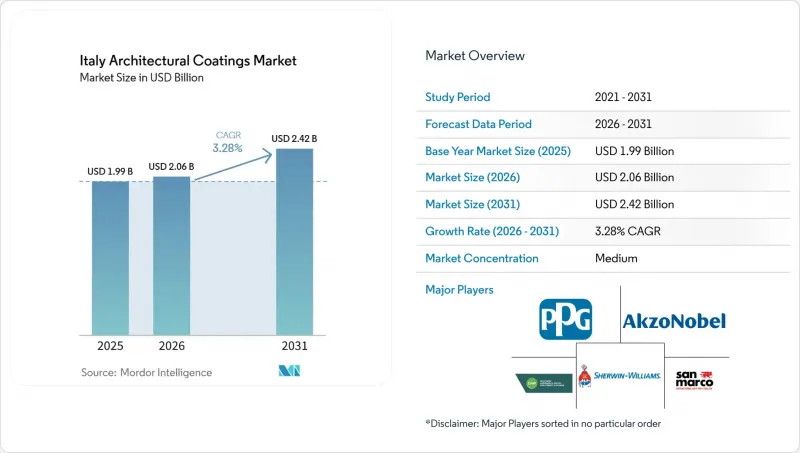
This report is Segmented by End-User Industry (Commercial, Residential), Technology (Solvent-Borne, Water-Borne), Resin Type (Acrylic, Alkyd, Epoxy, Polyester, Polyurethane, Other Resin Types), and Geography (Italy). The Market Forecasts are Provided in Terms of Value (USD).
Italy Architectural Coatings Market Trends and Insights
Rapid Refurbishment of Pre-1970 Housing Stock
In Italy, nearly 70% of homes predate 1970, and over 70% fall short of energy class C standards. Despite the conclusion of the 110% incentive, a continued 50% deduction for primary residences makes energy upgrades appealing. This has driven regions like Lombardy, Piedmont, Veneto, and Emilia-Romagna to increasingly adopt breathable mineral renders, anti-damp systems, and acrylics compatible with insulation. The Organisation for Economic Co-operation and Development (OECD) projects a need of EUR 792 billion (USD 860 billion) to elevate the current housing stock to near-zero energy standards, creating sustained demand for premium facade and interior coatings.
Growth of Italy's Professional Paint-Applicator Networks
The increasing demand for precise coating sequences in heat-pump installations and multilayer insulation systems is driving the growth of certified applicator networks in Milan, Rome, Turin, and Bologna. Manufacturers are offering onsite training, digital color-matching, and technical hotlines to support this growth. However, a gap in skilled labor continues to delay intricate facade projects, particularly those involving historic masonry. PPG's EUR 2 million laboratory in Milan, which can produce 100,000 color matches each year, highlights the support suppliers are providing to applicators.
Volatility in Titanium-Dioxide Prices
Architectural coatings rely heavily on titanium dioxide, the leading white pigment, which constitutes a significant portion of raw material expenses. Prices for titanium dioxide have been volatile, a situation worsened by the EU's imposition of anti-dumping duties on imports. These duties along with energy surcharges and emissions-disclosure regulations have inflated pigment costs. This surge in costs has further squeezed margins for Italian formulators, who are already grappling with a tepid demand for renovations. While the JRC highlights titanium dioxide's dominance in environmental impact categories, a potential switch to zinc sulfide doesn't alleviate the challenges, leaving manufacturers vulnerable.
Other drivers and restraints analyzed in the detailed report include:
- Rebound in Tourism-Related Construction (Hotels, Cultural Sites)
- Government Incentives for Energy-Efficient Facades
- Strict VOC Limits Under EU Green Deal Revisions
For complete list of drivers and restraints, kindly check the Table Of Contents.
Segment Analysis
In 2025, the residential segment dominated Italy's architectural coatings market, capturing 65.44% of the market, and is projected to grow at a 3.84% CAGR through 2031. This growth is attributed to owner-occupiers utilizing deductions ranging from 50% to 36% for envelope improvements. The segment benefits from low mortgage penetration and consistent house price increases, encouraging cash-financed interior upgrades. Furthermore, energy-class improvements continue to drive demand for thermal-insulation coatings.
The commercial segment is experiencing growth due to increased activity in hotels, restaurants, and cultural venue renovations. Non-residential permits rose by 11.1% year-on-year in Q3 2025, reflecting this trend. AkzoNobel's expansion of powder coatings in Como highlights the rising demand for metal facades. This demand is particularly strong in tourism-related construction projects that require durable and color-stable finishes.
List of Companies Covered in this Report:
- AkzoNobel N.V.
- Boero Bartolomeo S.p.A.
- Boero Bartolomeo S.p.A.
- Brillux GmbH & Co. KG
- CIN, S.A.
- Colorificio ATRIA Srl
- Covema Vernici (Rialto)
- Cromology
- DAW SE
- ICA S.p.A.
- Jotun
- Nippon Paint Holdings Co., Ltd.
- Oikos S.p.A.
- PPG Industries, Inc.
- San Marco Group S.p.A.
- The Sherwin-Williams Company
- VALPAINT S.p.A.
Additional Benefits:
- The market estimate (ME) sheet in Excel format
- 3 months of analyst support
TABLE OF CONTENTS
1 Introduction
- 1.1 Study Assumptions and Market Definition
- 1.2 Scope of the Study
2 Research Methodology
3 Executive Summary
4 Market Landscape
- 4.1 Market Overview
- 4.2 Market Drivers
- 4.2.1 Rapid refurbishment of pre-1970 housing stock
- 4.2.2 Growth of Italy's professional paint applicator networks
- 4.2.3 Rebound in tourism-related construction (hotels, cultural sites)
- 4.2.4 Rising DIY culture fuelled by e-commerce tutorials
- 4.2.5 Government "Superbonus 110%" extension for energy-efficient facades
- 4.3 Market Restraints
- 4.3.1 Volatility in titanium-dioxide prices
- 4.3.2 Strict VOC limits under EU Green Deal revisions
- 4.3.3 Skilled labour shortage in building restoration trade
- 4.4 Value Chain Analysis
- 4.5 Regulatory Analysis
- 4.6 Porter's Five Forces
- 4.6.1 Threat of New Entrants
- 4.6.2 Bargaining Power of Buyers
- 4.6.3 Bargaining Power of Suppliers
- 4.6.4 Threat of Substitutes
- 4.6.5 Intensity of Competitive Rivalry
5 Market Size and Growth Forecasts (Value)
- 5.1 By End-User Industry
- 5.1.1 Commercial
- 5.1.2 Residential
- 5.2 By Technology
- 5.2.1 Solvent-borne
- 5.2.2 Water-borne
- 5.3 By Resin Type
- 5.3.1 Acrylic
- 5.3.2 Alkyd
- 5.3.3 Epoxy
- 5.3.4 Polyester
- 5.3.5 Polyurethane
- 5.3.6 Other Resin Types
6 Competitive Landscape
- 6.1 Market Concentration
- 6.2 Strategic Moves
- 6.3 Market Share(%)/Ranking Analysis
- 6.4 Company Profiles (includes Global level Overview, Market level overview, Core Segments, Financials as available, Strategic Information, Products and Services, and Recent Developments)
- 6.4.1 AkzoNobel N.V.
- 6.4.2 Boero Bartolomeo S.p.A.
- 6.4.3 Boero Bartolomeo S.p.A.
- 6.4.4 Brillux GmbH & Co. KG
- 6.4.5 CIN, S.A.
- 6.4.6 Colorificio ATRIA Srl
- 6.4.7 Covema Vernici (Rialto)
- 6.4.8 Cromology
- 6.4.9 DAW SE
- 6.4.10 ICA S.p.A.
- 6.4.11 Jotun
- 6.4.12 Nippon Paint Holdings Co., Ltd.
- 6.4.13 Oikos S.p.A.
- 6.4.14 PPG Industries, Inc.
- 6.4.15 San Marco Group S.p.A.
- 6.4.16 The Sherwin-Williams Company
- 6.4.17 VALPAINT S.p.A.
7 Market Opportunities and Future Outlook
- 7.1 White-space and Unmet-Need Assessment

