PUBLISHER: Mordor Intelligence | PRODUCT CODE: 2066714

PUBLISHER: Mordor Intelligence | PRODUCT CODE: 2066714
Asia Pacific Offshore Seismic Services - Market Share Analysis, Industry Trends & Statistics, Growth Forecasts (2026 - 2031)
According to Mordor Intelligence, the asia pacific offshore seismic services market size is expected to increase from USD 0.83 billion in 2025 to USD 0.94 billion in 2026 and reach USD 1.55 billion by 2031, growing at a CAGR of 10.52% over 2026-2031.
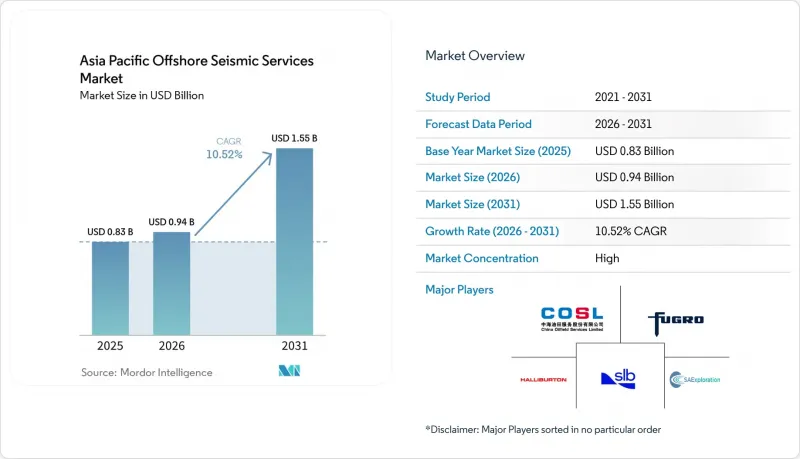
This report is Segmented by Service (Data Acquisition, Others), Seismic Technology (2D, 3D, Others), Water Depth (Shallow-Water Up To 500m, Others), Application (Oil and Gas, Offshore Energy and Marine, Others), and Geography (China, India, Japan, South Korea, Association of Southeast Asian Nations, Rest of Asia-Pacific). The Market Forecasts are Provided in Terms of Value (USD).
Asia Pacific Offshore Seismic Services Market Trends and Insights
Rising Deep-Water E&P Investments
National and international operators are scaling exploration budgets for prospects below 500 m, creating persistent demand for broadband streamer and ocean-bottom node surveys. CNOOC's Huizhou 19-6 discovery exceeded 100 million tonnes of oil equivalent after high-density acquisition and FWI processing. Fugro and Mubadala Energy commenced a Southeast Asian gas imaging program in 2025 valued at USD 100 million. PETRONAS entrusted PXGEO with a multi-year campaign that keeps two vessels active to 2027. Deep-water reserves offset mature shallow assets, justifying higher day rates and undergirding long-term vessel utilization across the Asia Pacific offshore seismic services market.
Government-Backed Offshore Leasing Rounds
Fast-tracked acreage releases shorten the lag between award and first shoot. India's OALP-X and OALP-XI offered 85 blocks in 2025, catalyzing immediate 2D reconnaissance and 3D appraisal commitments. Australia reopened Otway Basin acreage but simultaneously heightened wildlife compliance after NOPSEMA rejected CGG's plan, illustrating that transparent fiscal terms coexist with stricter environmental tests. South Korea, New Zealand, and ASEAN members mirror this model, ensuring a visible multiyear backlog for the Asia Pacific offshore seismic services market.
Lengthy Project Permitting Timelines
Regulatory reviews add 12-18 months to survey starts. NOPSEMA's 2025 rejection of CGG's Otway plan required a full redesign, costing an extra USD 15 million in standby fees. India's EIA pathway stretches to 18 months when coastal consultations are mandatory. Vessel idle time erodes margins, pressuring small contractors in the Asia Pacific offshore seismic services market.
Other drivers and restraints analyzed in the detailed report include:
- Push for Domestic LNG Security
- Emergence of Carbon-Capture Storage (CCS) Site Surveys
- Environmental Activism Delaying Seismic Shoots
For complete list of drivers and restraints, kindly check the Table Of Contents.
Segment Analysis
Data processing and interpretation will grow at 12.3% CAGR, faster than acquisition's dominant 73.8% 2025 share. Operators license reprocessed multi-client packages, such as the 45,000 km2 Sarawak project by DUG and Searcher, to de-risk near-infrastructure prospects and control exploration budgets. Acquisition remains core, yet vessel oversupply squeezes day rates, while AI-driven inversion services command premium margins, anchoring an expanded profit pool for integrated contractors within the Asia Pacific offshore seismic services market.
Processing workloads integrate seismic inversion, rock-physics, and simulation. CNOOC's Beibu Gulf program fused OBC and historic streamer data to detect residual oil, underscoring the value of multi-disciplinary interpretation. TGS secures vessel capacity under three-year Chevron deals, locking revenue visibility and bundling onboard preprocessing. The Asia Pacific offshore seismic services market thus rewards firms that offer cradle-to-grave workflows.
3D imaging retained 45.3% value in 2025, yet 4D/time-lapse seismic is set for 13.1% CAGR as fields mature. Time-lapse campaigns in China's WZ oilfield cut NRMS to 12%, guiding infill drilling and boosting recoveries. TGS demonstrated 4D binning and curvelet-domain co-denoise in the Usan field, a template now marketed to Asia Pacific clients. Growing asset-life surveillance ensures that 4D services eclipse reconnaissance-focused 2D surveys within the Asia Pacific offshore seismic services market by 2031.
Node technology further enhances 4D repeatability. Shearwater's OBN toolkit supports centimeter-scale positioning for Sabah Basin time-lapse sequences, bolstering reservoir management. As velocity-model updates prove essential for HPHT assets, technology differentiation becomes decisive in contract awards.
List of Companies Covered in this Report:
- Schlumberger Limited
- Viridien SA
- PGS ASA
- TGS ASA
- Fugro NV
- China Oilfield Services Ltd (COSL)
- SAExploration Holdings Inc
- BGP Inc.
- Ion Geophysical Corp.
- Shearwater GeoServices
- EMGS
- Spectrum Geo
- Dolphin Geophysical
- GeoEx
Additional Benefits:
- The market estimate (ME) sheet in Excel format
- 3 months of analyst support
TABLE OF CONTENTS
1 Introduction
- 1.1 Study Assumptions & Market Definition
- 1.2 Scope of the Study
2 Research Methodology
3 Executive Summary
4 Market Landscape
- 4.1 Market Overview
- 4.2 Market Drivers
- 4.2.1 Rising deep-water E&P investments
- 4.2.2 Government-backed offshore leasing rounds
- 4.2.3 Push for domestic LNG security
- 4.2.4 Emergence of carbon-capture storage (CCS) site surveys
- 4.2.5 Transition to high-density nodal acquisition
- 4.3 Market Restraints
- 4.3.1 Lengthy project permitting timelines
- 4.3.2 Cap-ex squeeze from low oil-price scenarios
- 4.3.3 Environmental activism delaying seismic shoots
- 4.4 Supply-Chain Analysis
- 4.5 Regulatory Landscape
- 4.6 Technological Outlook
- 4.7 Porter's Five Forces
- 4.7.1 Threat of New Entrants
- 4.7.2 Bargaining Power of Suppliers
- 4.7.3 Bargaining Power of Buyers
- 4.7.4 Threat of Substitutes
- 4.7.5 Competitive Rivalry
5 Market Size & Growth Forecasts
- 5.1 By Service
- 5.1.1 Data Acquisition
- 5.1.2 Data Processing and Interpretation
- 5.2 By Seismic Technology
- 5.2.1 2D Seismic
- 5.2.2 3D Seismic
- 5.2.3 4D/Time-Lapse Seismic
- 5.2.4 Ocean-Bottom Node (OBN) Seismic
- 5.3 By Water Depth
- 5.3.1 Shallow-water (Up to 500 m)
- 5.3.2 Deep-water (500 to 1500 m)
- 5.3.3 Ultra-deep-water (Over 1500 m)
- 5.4 By Application
- 5.4.1 Oil and Gas
- 5.4.2 Offshore Energy and Marine
- 5.4.3 Carbon Capture, Utilization and Storage (CCUS)
- 5.4.4 Mining and Mineral Exploration
- 5.4.5 Geothermal Energy
- 5.4.6 Civil Engineering and Infrastructure
- 5.4.7 Others (Natural Hazard Assessment, Environmental Studies, and Academic & Research)
- 5.5 By Geography
- 5.5.1 China
- 5.5.2 India
- 5.5.3 Japan
- 5.5.4 South Korea
- 5.5.5 ASEAN Countries
- 5.5.6 Australia and New Zealand
- 5.5.7 Rest of Asia-Pacific
6 Competitive Landscape
- 6.1 Market Concentration
- 6.2 Strategic Moves (M&A, Partnerships, PPAs)
- 6.3 Market Share Analysis (Market Rank/Share for key companies)
- 6.4 Company Profiles (includes Global level Overview, Market level overview, Core Segments, Financials as available, Strategic Information, Products & Services, and Recent Developments)
- 6.4.1 Schlumberger Limited
- 6.4.2 Viridien SA
- 6.4.3 PGS ASA
- 6.4.4 TGS ASA
- 6.4.5 Fugro NV
- 6.4.6 China Oilfield Services Ltd (COSL)
- 6.4.7 SAExploration Holdings Inc
- 6.4.8 BGP Inc.
- 6.4.9 Ion Geophysical Corp.
- 6.4.10 Shearwater GeoServices
- 6.4.11 EMGS
- 6.4.12 Spectrum Geo
- 6.4.13 Dolphin Geophysical
- 6.4.14 GeoEx
7 Market Opportunities & Future Outlook
- 7.1 White-space & Unmet-Need Assessment

