
PUBLISHER: Mordor Intelligence | PRODUCT CODE: 2066726

PUBLISHER: Mordor Intelligence | PRODUCT CODE: 2066726
North America Foodservice - Market Share Analysis, Industry Trends & Statistics, Growth Forecasts (2026 - 2031)
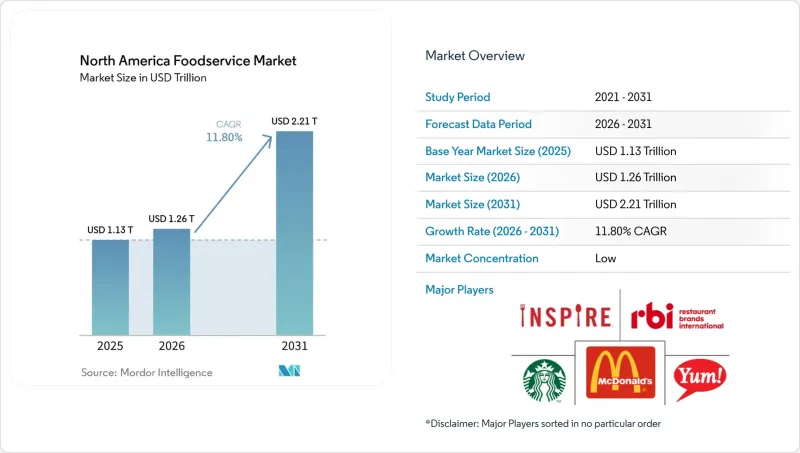
According to Mordor Intelligence, the north american foodservice market size was valued at USD 1.13 trillion in 2025 and estimated to grow from USD 1.26 trillion in 2026 to reach USD 2.21 trillion by 2031, at a CAGR of 11.80% during the forecast period (2026-2031).
This report is Segmented by Foodservice Type (Cafes and Bars, Cloud Kitchen, Full Service Restaurants, and Quick Service Restaurants), by Outlet (Chained Outlets and Independent Outlets), by Location (Leisure, Lodging, Retail, Standalone, and Travel), by Service Type (Dine-In, Takeaway, and Delivery), and by Geography. The Market Forecasts are Provided in Terms of Value (USD).
North America Foodservice Market Trends and Insights
Technological innovation and digital integration
Artificial intelligence, automation, and integrated ordering systems are at the forefront of a digital transformation, reshaping foodservice operations to enhance both customer experience and operational efficiency. McDonald's has rolled out AI-driven voice ordering systems in 13,000 U.S. locations, underscoring the vast scale of this technological shift. Meanwhile, Starbucks employs deep learning algorithms for inventory management, achieving an impressive 15-20% annual reduction in waste. Cloud-based point-of-sale systems are revolutionizing the industry, offering real-time analytics and predictive ordering. This empowers operators to dynamically adjust menu offerings and pricing in response to demand patterns and ingredient costs. Furthermore, the integration of Internet of Things sensors in kitchen equipment is ushering in predictive maintenance capabilities, which not only reduce downtime but also extend the lifecycles of assets. In 2024, a significant 89% of North American consumers embraced mobile payments, solidifying a trend towards contactless transactions that have outlasted their pandemic-era origins.
Menu innovation and customization
Operators leverage personalization technologies to craft bespoke dining experiences, commanding premium prices and fostering customer loyalty through data-driven menu curation and dietary accommodations. In 2024, Chipotle's digital customization platform accounted for 65% of its total revenue, with AI-driven recommendation engines boosting average order values by 18% over traditional methods. Reflecting a shift towards health-conscious and culturally diverse choices, consumers are gravitating towards plant-based protein alternatives and globally-inspired fusion cuisines. Thanks to adaptable supply chain partnerships, operators can rotate seasonal menus, seizing on ingredient cost variations and keeping customers engaged with limited-time offerings. Meanwhile, the adoption of nutritional tracking and allergen management systems not only meets regulatory compliance but also champions consumer health objectives.
Complex food safety and health regulations
Smaller operators, often without dedicated regulatory affairs resources, find themselves disproportionately burdened by evolving food safety standards and health regulations. These regulations not only impose significant compliance costs but also introduce operational complexities. For instance, mid-sized restaurant groups face annual compliance costs averaging between USD 45,000 and 75,000 due to the expanding preventive controls requirements of the FDA Food Safety Modernization Act. Furthermore, state-level mandates such as menu labeling, allergen disclosure, and nutritional information standards add to the administrative load, necessitating system upgrades and staff training. While the rise of artificial intelligence offers advantages in food safety monitoring, the technology demands hefty investments, stretching the budgets of independent operators. Additionally, regulatory fragmentation across provinces and states poses challenges for multi-jurisdictional expansion, especially for emerging chain concepts eyeing rapid geographic growth.
Other drivers and restraints analyzed in the detailed report include:
- Demand for diverse and global cuisines
- Expansion of off-premise dining
- Supply chain disruptions and rising costs
For complete list of drivers and restraints, kindly check the Table Of Contents.
Segment Analysis
In 2025, Quick Service Restaurants (QSRs) held a commanding 48.02% market share, skillfully leveraging operational efficiency and brand recognition to appeal to value-conscious consumers amid economic uncertainties. Meanwhile, Cloud Kitchens are emerging as the segment's growth engine, boasting a robust 14.95% CAGR projected through 2031. This growth is not only challenging traditional real estate norms but also facilitating swift market entry for new brands. Full-service restaurants grapple with margin pressures due to escalating labor costs and shifting consumer preferences. In contrast, cafes and bars are reaping the rewards of a trend towards experiential dining and a surge in premium beverage consumption.
As major QSR brands invest in automation and AI-driven operations, the technological divide between chain and independent operators is becoming more pronounced. For instance, McDonald's automated beverage systems and Domino's GPS delivery tracking underscore the competitive edge that technology offers, a feat that smaller operators find hard to match, as highlighted in Domino's Pizza's SEC 10-K Filing. Similarly, as of 2024, Domino's operated 585 stores in Canada, according to the Domino's Pizza SEC 10-K Filing. Cloud kitchen operators, benefiting from reduced overheads and menus tailored for delivery, enjoy profit margins that are 15-20% fatter than their traditional counterparts. Their asset-light model not only allows for swift geographic expansion but also encourages menu experimentation, sidestepping the usual constraints of location and permitting delays. The cloud kitchen market's expansion is further fueled by the entry of major personalities, such as MrBeast with his MrBeast Burger, which has impressively scaled to over 900 locations across the U.S.
In 2025, independent outlets captured a 54.38% market share and are projected to grow at a 13.10% CAGR through 2031. This growth underscores their resilience against competition from tech-driven chains, largely driven by consumer preference for authentic, locally-sourced dining. Independent operators, with their lower corporate overheads and deep community ties, offer personalized services and customizable menus, allowing them to swiftly adapt to market changes.
Chained outlets, on the other hand, harness economies of scale in purchasing, marketing, and technology. This strategy not only boosts their operational efficiency but also solidifies their brand recognition and standardized service delivery. An expanding store count further bolsters their growth. For example, the U.S. Securities and Exchange Commission reported that in 2024, Burger King boasted 7,082 outlets across the U.S. and Canada, raking in approximately USD 1.45 billion, a notable rise from the prior year's USD 1.3 billion. Meanwhile, the rise of franchise-as-a-service platforms is allowing independent operators to tap into chain-like operational systems, all while retaining local ownership and menu adaptability. Regional chains are carving out a niche, blending operational standardization with insights into local markets and community engagement, an edge over both pure independents and national chains.
List of Companies Covered in this Report:
- McDonald's Corporation
- Starbucks Corporation
- Yum! Brands Inc.
- Inspire Brands Inc.
- Restaurant Brands International
- Chipotle Mexican Grill Inc.
- Domino's Pizza Inc.
- Wendy's Company
- Chick-fil-A Inc.
- Darden Restaurants Inc.
- Bloomin' Brands Inc.
- Panera Bread (JAB Holding)
- Papa John's International Inc.
- Brinker International Inc.
- Jack in the Box Inc.
- Wingstop Inc.
- CAVA Group Inc.
- Sweetgreen Inc.
- Compass Group PLC (North America)
- Aramark Corporation
Additional Benefits:
- The market estimate (ME) sheet in Excel format
- 3 months of analyst support
TABLE OF CONTENTS
1 INTRODUCTION
- 1.1 Study Assumptions and Market Definition
- 1.2 Scope of the Study
2 RESEARCH METHODOLOGY
3 EXECUTIVE SUMMARY
4 MARKET LANDSCAPE
- 4.1 Market Overview
- 4.2 Market Drivers
- 4.2.1 Technological innovation and digital integration
- 4.2.2 Menu innovation and customization
- 4.2.3 Demand for diverse and global cuisines
- 4.2.4 Menu innovation and customization
- 4.2.5 Sustainability and ethical practices
- 4.2.6 Expansion of off-premise dining
- 4.3 Market Restraints
- 4.3.1 Complex food safety and health regulations
- 4.3.2 Food waste management and disposal costs
- 4.3.3 Food waste management and disposal costs
- 4.3.4 Supply chain disruptions and rising costs
- 4.4 Consumer Behaviour Analysis
- 4.5 Regulatory Landscape
- 4.6 Technological Outlook
- 4.7 Porter's Five Forces
- 4.7.1 Threat of New Entrants
- 4.7.2 Bargaining Power of Buyers
- 4.7.3 Bargaining Power of Suppliers
- 4.7.4 Threat of Substitutes
- 4.7.5 Competitive Rivalry
5 MARKET SIZE AND GROWTH FORECASTS (VALUE)
- 5.1 Foodservice Type
- 5.1.1 Cafes and Bars
- 5.1.1.1 By Cuisine
- 5.1.1.1.1 Bars and Pubs
- 5.1.1.1.2 Cafes
- 5.1.1.1.3 Juice/Smoothie/Desserts Bars
- 5.1.1.1.4 Specialist Coffee and Tea Shops
- 5.1.1.1 By Cuisine
- 5.1.2 Cloud Kitchen
- 5.1.3 Full Service Restaurants
- 5.1.3.1 By Cuisine
- 5.1.3.1.1 Asian
- 5.1.3.1.2 European
- 5.1.3.1.3 Latin American
- 5.1.3.1.4 Middle Eastern
- 5.1.3.1.5 North American
- 5.1.3.1.6 Other FSR Cuisines
- 5.1.3.1 By Cuisine
- 5.1.4 Quick Service Restaurants
- 5.1.4.1 By Cuisine
- 5.1.4.1.1 Bakeries
- 5.1.4.1.2 Burger
- 5.1.4.1.3 Ice Cream
- 5.1.4.1.4 Meat-based Cuisines
- 5.1.4.1.5 Pizza
- 5.1.4.1.6 Other QSR Cuisines
- 5.1.4.1 By Cuisine
- 5.1.1 Cafes and Bars
- 5.2 Outlet
- 5.2.1 Chained Outlets
- 5.2.2 Independent Outlets
- 5.3 Location
- 5.3.1 Leisure
- 5.3.2 Lodging
- 5.3.3 Retail
- 5.3.4 Standalone
- 5.3.5 Travel
- 5.4 Service Type
- 5.4.1 Dine-in
- 5.4.2 Takeaway
- 5.4.3 Delivery
- 5.5 By Geography
- 5.5.1 North America
- 5.5.1.1 United States
- 5.5.1.2 Canada
- 5.5.1.3 Mexico
- 5.5.1.4 Rest of North America
- 5.5.1 North America
6 COMPETITIVE LANDSCAPE
- 6.1 Market Concentration
- 6.2 Strategic Moves
- 6.3 Market Share Analysis
- 6.4 Company Profiles (includes Global level Overview, Market level overview, Core Segments, Financials as available, Strategic Information, Market Rank/Share for key companies, Products and Services, and Recent Developments)
- 6.4.1 McDonald's Corporation
- 6.4.2 Starbucks Corporation
- 6.4.3 Yum! Brands Inc.
- 6.4.4 Inspire Brands Inc.
- 6.4.5 Restaurant Brands International
- 6.4.6 Chipotle Mexican Grill Inc.
- 6.4.7 Domino's Pizza Inc.
- 6.4.8 Wendy's Company
- 6.4.9 Chick-fil-A Inc.
- 6.4.10 Darden Restaurants Inc.
- 6.4.11 Bloomin' Brands Inc.
- 6.4.12 Panera Bread (JAB Holding)
- 6.4.13 Papa John's International Inc.
- 6.4.14 Brinker International Inc.
- 6.4.15 Jack in the Box Inc.
- 6.4.16 Wingstop Inc.
- 6.4.17 CAVA Group Inc.
- 6.4.18 Sweetgreen Inc.
- 6.4.19 Compass Group PLC (North America)
- 6.4.20 Aramark Corporation
7 MARKET OPPORTUNITIES AND FUTURE OUTLOOK

