PUBLISHER: Mordor Intelligence | PRODUCT CODE: 2066752

PUBLISHER: Mordor Intelligence | PRODUCT CODE: 2066752
United States Roofing - Market Share Analysis, Industry Trends & Statistics, Growth Forecasts (2026 - 2031)
According to Mordor Intelligence, the united states roofing market size is expected to grow from USD 32.66 billion in 2025 to USD 34.66 billion in 2026 and is forecast to reach USD 46.67 billion by 2031 at 6.01% CAGR over 2026-2031.
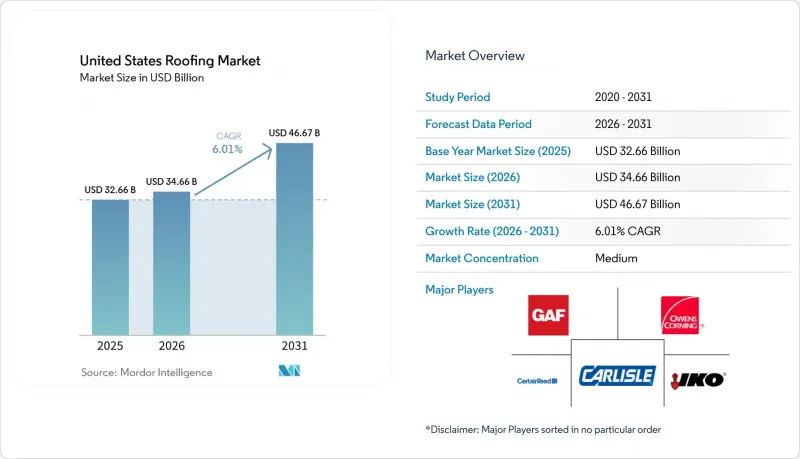
This report is Segmented by Material Type (Asphalt Shingles, Clay & Concrete Tiles, and More), by Construction Type (New Construction, Reroofing, and Replacement), by Application (Residential, Commercial, Industrial, Institutional, Others), and by Geography (North East, Mid West, South East, West, South West). The Market Forecasts are Provided in Terms of Value (USD).
United States Roofing Market Trends and Insights
Aging Roof Stock and Higher Replacement Cycles Sustaining Reroofing Demand
More than one-third of U.S. owner-occupied homes were built before 2000, and the median roof age exceeded 17 years in 2025, moving millions of coverings beyond their typical service life. This demographic swell assures baseline work for contractors even when housing starts slow. Homeowners often upgrade to laminated shingles or metal during tear-offs, lifting ticket values by double digits. Insurers now request roof inspections when policies renew on homes older than 15 years, shortening the lag between failure and action. As a result, consistent replacement volume underpins the United States roofing market .
Storm and Hail Events Increasing Insurance-Funded Roofing Activity
Severe convective storms generated more than USD 15 billion in roof-related claims across Texas, Oklahoma, and Iowa during 2024-2025. Carriers responded by insisting on impact-resistant shingles certified to UL 2218 Class 4 in high-risk zones. These premium products cost around 18% more but earn homeowners sizable premium credits, directing spend toward higher-margin materials. Florida's revised wind codes after Hurricane Ian are also forcing early replacements of non-compliant roofs. Collectively, these conditions accelerate reroof cycles and elevate value per square.
Skilled Labor Shortages Limiting Contractor Capacity and Raising Costs
Roofing firms recorded vacancy rates of 12% in 2025 despite wage hikes to USD 28 per hour. Scarcity is sharpest in colder regions where an aging workforce lacks replacements. Contractors are buying robotic applicators and material lifts to offset head-count gaps, but equipment costs raise overhead. Extended lead times of eight to twelve weeks push some owners to defer projects, trimming near-term volume and tempering growth for the United States roofing market.
Other drivers and restraints analyzed in the detailed report include:
- Energy-Efficiency Upgrades Boosting Demand for Cool Roofs and Better Insulation Systems
- Growth in Logistics Warehouses and Data Centers Expanding Commercial Roofing Installations
- Volatility in Asphalt, Metal, and Insulation Input Prices Pressuring Margins
For complete list of drivers and restraints, kindly check the Table Of Contents.
Segment Analysis
Asphalt shingles held 58.6% of the United States roofing market share in 2025, keeping them firmly in the lead across materials. Their scale reflects a wide installer network, familiar installation methods, strong residential distribution, and a reroofing cycle that still leans heavily toward shingle replacement. Owens Corning stated that the U.S. asphalt shingle market totaled 160 million squares in 2024, with 135 million squares from reroof and repair activity, indicating how much of the material base is tied to recurring replacement work rather than new construction. Owens Corning also noted in 2025 that laminate products accounted for 95% of shingle demand, indicating that the United States roofing market has already shifted away from standard 3-tab products toward higher-value laminated systems. That mix matters because laminates support better selling prices, stronger impact ratings, and better alignment with insurer preferences in hail-prone states.
The United States roofing market for single-ply membranes is forecast to grow at a 7.69% CAGR through 2031, making that group the fastest-growing material category. This expansion reflects stronger code alignment in low-slope commercial work, where reflective Thermoplastic Polyolefin, Ethylene Propylene Diene Monomer, and Polyvinyl Chloride systems better meet efficiency and maintenance requirements than many legacy alternatives. California's current code direction and federal efficiency standards are helping move reroof specifications toward those systems, especially where owners want compliance and lower cooling loads in the same project. GAF's 425,000-square-foot Thermoplastic Polyolefin plant in Valdosta, Georgia, which began production in September 2024, demonstrates that manufacturers are adding real capacity to this shift. Metal, modified bitumen, tile, wood, and other materials remain important in specific regional niches. However, the United States roofing market still relies on asphalt shingles for volume and on membranes for the strongest forward growth.
List of Companies Covered in this Report:
- GAF Materials Corporation
- Owens Corning
- CertainTeed Corporation
- Carlisle Companies Inc.
- IKO Industries Ltd.
- Tamko Building Products
- Johns Manville
- Firestone Building Products (Holcim)
- Sika AG
- Soprema Group
- Atlas Roofing Corporation
- Beacon Building Products
- CentiMark Corporation
- Tecta America
- Flynn Group of Companies
- Baker Roofing Company
- Nations Roof
- IronHead Roofing
- Malarkey Roofing Products
- Best Contracting Services
Additional Benefits:
- The market estimate (ME) sheet in Excel format
- 3 months of analyst support
TABLE OF CONTENTS
1 Introduction
- 1.1 Study Assumptions & Market Definition
- 1.2 Scope of the Study
2 Research Methodology
3 Executive Summary
4 Market Insights & Dynamics
- 4.1 Market Overview
- 4.2 Market Drivers
- 4.2.1 Aging roof stock and higher replacement cycles sustaining reroofing demand
- 4.2.2 Storm and hail events increasing insurance-funded repairs and re-roof activity
- 4.2.3 Energy-efficiency upgrades boosting demand for cool roofs and better insulation systems
- 4.2.4 Growth in logistics warehouses and data centers expanding commercial roofing installations
- 4.2.5 Adoption of solar-ready and rooftop PV-integrated roofing increasing upgrade spending
- 4.3 Market Restraints
- 4.3.1 Skilled labor shortages limiting contractor capacity and raising installation costs
- 4.3.2 Volatility in asphalt shingles, metal, and insulation input prices pressuring margins
- 4.3.3 Permitting, insurance, and warranty requirements extending project timeline
- 4.4 Value / Supply-Chain Analysis
- 4.5 Regulatory Landscape
- 4.6 Technological Outlook
- 4.7 Porter's Five Forces
- 4.7.1 Bargaining Power of Suppliers
- 4.7.2 Bargaining Power of Buyers
- 4.7.3 Threat of New Entrants
- 4.7.4 Threat of Substitutes
- 4.7.5 Intensity of Competitive Rivalry
5 Market Size & Growth Forecasts (Value, USD)
- 5.1 By Material Type
- 5.1.1 Asphalt Shingles
- 5.1.2 Clay & Concrete Tiles
- 5.1.3 Metal Roofing
- 5.1.4 Bituminous / Modified Bitumen Membranes
- 5.1.5 Single-Ply Membranes (TPO, EPDM, and PVC)
- 5.1.6 Wood
- 5.1.7 Others
- 5.2 By Construction Type
- 5.2.1 New Construction
- 5.2.2 Reroofing and Replacement
- 5.3 By Application
- 5.3.1 Residential
- 5.3.2 Commercial
- 5.3.3 Industrial
- 5.3.4 Institutional
- 5.3.5 Others
- 5.4 By Geography
- 5.4.1 North East
- 5.4.2 Mid West
- 5.4.3 South East
- 5.4.4 West
- 5.4.5 South West
6 Competitive Landscape
- 6.1 Strategic Moves
- 6.2 Market Share Analysis
- 6.3 Company Profiles (includes Global-level Overview, Market-level Overview, Core Segments, Financials as available, Strategic Information, Products & Services, and Recent Developments)
- 6.3.1 GAF Materials Corporation
- 6.3.2 Owens Corning
- 6.3.3 CertainTeed Corporation
- 6.3.4 Carlisle Companies Inc.
- 6.3.5 IKO Industries Ltd.
- 6.3.6 Tamko Building Products
- 6.3.7 Johns Manville
- 6.3.8 Firestone Building Products (Holcim)
- 6.3.9 Sika AG
- 6.3.10 Soprema Group
- 6.3.11 Atlas Roofing Corporation
- 6.3.12 Beacon Building Products
- 6.3.13 CentiMark Corporation
- 6.3.14 Tecta America
- 6.3.15 Flynn Group of Companies
- 6.3.16 Baker Roofing Company
- 6.3.17 Nations Roof
- 6.3.18 IronHead Roofing
- 6.3.19 Malarkey Roofing Products
- 6.3.20 Best Contracting Services
7 Market Opportunities & Future Outlook
- 7.1 White-space & Unmet-Need Assessment

