PUBLISHER: Mordor Intelligence | PRODUCT CODE: 2072712

PUBLISHER: Mordor Intelligence | PRODUCT CODE: 2072712
ASEAN Roofing - Market Share Analysis, Industry Trends & Statistics, Growth Forecasts (2026 - 2031)
According to Mordor Intelligence, the ASEAN roofing market size is projected to be USD 5.5 billion in 2025, USD 5.78 billion in 2026, and reach USD 7.46 billion by 2031, growing at a CAGR of 5.24% from 2026 to 2031.
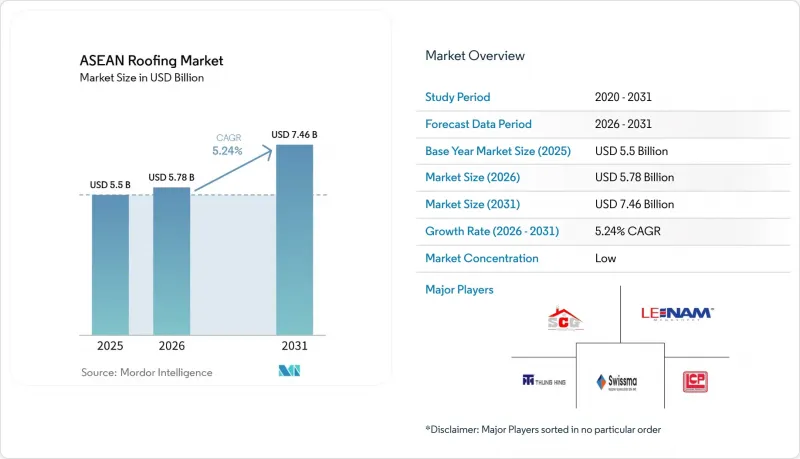
This report is Segmented by Material Type (Asphalt Shingles, Clay & Concrete Tiles, Metal Roofing, Bituminous / Modified Bitumen Membranes, Single-Ply Membranes, Wood, and Others), Construction Type (New Construction, Reroofing and Replacement), Application (Residential, Commercial, Industrial, and More), and Geography (Indonesia, Vietnam, Thailand, and More). The Market Forecasts are Provided in Terms of Value (USD).
ASEAN Roofing Market Trends and Insights
Government Housing and Infrastructure Pipelines Expanding Roofing Demand
Government-backed housing schemes are providing a reliable support base for the ASEAN roofing market as private construction moves unevenly. In Indonesia, the renovation of 2 million substandard dwellings by the end of 2025, backed by Rp 43.6 trillion (USD 2.65 billion), is directly driving roofing replacement demand in provinces with large housing deficits such as West Java, Banten, and Central Java. In Vietnam, more than 102,600 social housing units were completed in 2025, which exceeded the annual plan, and the 2026 target rises to 158,723 units, with stronger public investment disbursement behind it. These programs matter because they sustain roofing volume even when private housing starts slow, and they create clearer order visibility for manufacturers and contractors. They also encourage the use of certified, standardized materials in mass housing, gradually reducing the role of informal or recycled roofing inputs and broadening the formal, addressable base of the ASEAN roofing market.
Green-Building and Thermal-Performance Regulation Tightening Roof Specifications
Regulations around building envelope performance are steadily changing product choice in the ASEAN roofing market. The International Energy Agency (IEA) roadmap for energy-efficient buildings in ASEAN identifies roofs as the critical thermal boundary in tropical climates. It highlights cool roofs, green roofs, and passive ventilation as practical measures to reduce cooling demand. The Passive Cooling Roadmap launched by the ASEAN Centre for Energy (ACE) and the United Nations Environment Programme (UNEP) in April 2026 goes further by recommending mandatory passive cooling requirements in national building codes and identifying reflective roofs as a leading intervention. Once green certification systems become a practical requirement for project financing or public procurement, buyers tend to purchase compliant roof assemblies rather than isolated low-cost components. That dynamic supports reflective, insulated, and integrated roof systems and moves the ASEAN roofing market away from purely commodity purchasing in institutional and commercial projects.
Raw-Material Cost Volatility Compressing Project Economics and Supplier Margins
Input cost volatility is still one of the clearest brakes on the ASEAN roofing market. Bitumen, Polyvinyl Chloride (PVC) resin, Thermoplastic Polyolefin (TPO) compounds, and steel coil are exposed to global commodity cycles that often move out of step with local construction schedules and tender timelines. According to the Organisation for Economic Co-operation and Development's (OECD) 2025 Steel Outlook, fluctuations in pricing for strip and coil buyers, crucial for metal roofing manufacturers in ASEAN, may arise from capacity additions and inconsistent demand growth. In 2024 and 2025, those swings compressed supplier margins and pushed some contractors toward downgraded material choices when protecting bids became difficult. Manufacturers without hedging capacity, long-term sourcing arrangements, or some level of input integration remain more exposed during long project cycles in the ASEAN roofing market.
Other drivers and restraints analyzed in the detailed report include:
- Industrial, Logistics, and Data Centre Build Out Driving Insulated Metal Panel Demand
- Tropical Climate and Monsoon Exposure Reinforcing Premium Waterproofing Specification
- Skilled Installer Shortages Reducing Execution Quality and Slowing Specialized Roof Adoption
For complete list of drivers and restraints, kindly check the Table Of Contents.
Segment Analysis
Metal roofing accounted for 38% of the ASEAN roofing market in 2025, making it the largest material category across the region. Its position is tied to broad use in industrial warehousing, peri-urban housing, and public projects where speed of installation and cost per square meter remain central buying criteria. The category also benefits from the region's manufacturing and logistics build-out, as large-span, low-slope roofs commonly default to profiled metal sheets, sometimes paired with insulated composite layers. The OECD's 2025 steel outlook reinforces this backdrop by identifying ASEAN as one of the few regions where steel demand is expected to grow strongly through 2030. In the ASEAN roofing market, this gives metal roofing manufacturers a material supply base that remains strategically important even when prices are volatile.
Single-ply membranes are projected to grow at a 6.4% CAGR in the ASEAN roofing market through 2031, making them the fastest-growing material group in the forecast period. Their demand is being led by data centers and high-specification commercial roofs in Singapore, Jakarta, and Ho Chi Minh City, where heat-welded systems are chosen for low seam-failure risk and short replacement shutdown windows. Clay and concrete tiles still retain cultural and architectural relevance in Thai and Vietnamese housing. Still, they face pressure to be replaced by lighter fiber-cement and metal options in multi-story applications. Asphalt shingles remain more concentrated in premium residential pockets in Thailand, Malaysia, and the Philippines. At the same time, bituminous membranes continue to serve flat commercial and industrial roofs because they have a familiar installer base and lower equipment needs than welded systems. Wood roofing is declining, while polycarbonate, uPVC, and fiber-cement sheets are gaining traction in affordable housing renovation, especially where certified heat-reflective, low-maintenance products align with state-backed renovation demand.
Complete Report Scope:
- By Material Type
- Asphalt Shingles
- Clay & Concrete Tiles
- Metal Roofing
- Bituminous / Modified Bitumen Membranes
- Single-Ply Membranes (TPO, EPDM, and PVC)
- Wood
- Others
- By Construction Type
- New Construction
- Reroofing and Replacement
- By Application
- Residential
- Commercial
- Industrial
- Institutional
- Others
- By Geography
- Indonesia
- Vietnam
- Thailand
- Philippines
- Rest of ASEAN
List of Companies Covered in this Report:
- SCG Roofing
- Swissma Building Technologies
- Thung Hing
- Le Nam Megasheet
- LCP Group
- Kemudi Sempurna
- Asia Jaya Sepadu
- UGI
- PT. Insulated Panel Indonesia
- Subzero
- PT. Mandiri Mulia Makmur Abadi (MMMA)
- ROOFMAXX
- Kingspan
- Sika
- SOPREMA
Additional Benefits:
- The market estimate (ME) sheet in Excel format
- 3 months of analyst support
TABLE OF CONTENTS
1 Introduction
- 1.1 Study Assumptions & Market Definition
- 1.2 Scope of the Study
2 Research Methodology
3 Executive Summary
4 Market Landscape
- 4.1 Market Overview
- 4.2 Market Drivers
- 4.2.1 Government Housing and Infrastructure Pipelines Expanding Roofing Demand
- 4.2.2 Green Building and Thermal Performance Rules Supporting Cool and Insulated Roofs
- 4.2.3 Industrial, Logistics, Cold Chain, and Data Center Build Out Increasing Demand for Insulated Panels and Membranes
- 4.2.4 Tropical Humidity, Monsoon Exposure, and Leakage Risk Lifting Waterproofing Intensity
- 4.2.5 Green Roofs, Siphonic Drainage, and Stormwater Features Adding Premium Content
- 4.2.6 Lower Intra-ASEAN Trade Barriers Improving Access to Premium Roofing Inputs
- 4.3 Market Restraints
- 4.3.1 Raw Material Cost Volatility in Bitumen, Resin, and Petrochemical Inputs Pressuring Margins
- 4.3.2 Skilled Installer Shortages Reducing Execution Quality and Slowing Specialized Roof Adoption
- 4.3.3 Competition from Lower Cost Substitute Materials Capping Pricing Power
- 4.3.4 Import Dependence and Uneven Regional Standards Complicating Supply Decisions
- 4.4 Value / Supply-Chain Analysis
- 4.5 Regulatory Landscape
- 4.6 Technological Outlook
- 4.7 Cost Structure Analysis
- 4.8 Trend and Impacts of Roofing Replacements
- 4.9 Porter's Five Forces
- 4.9.1 Threat of New Entrants
- 4.9.2 Bargaining Power of Suppliers
- 4.9.3 Bargaining Power of Buyers
- 4.9.4 Threat of Substitutes
- 4.9.5 Intensity of Competitive Rivalry
5 Market Size & Growth Forecasts (Value, USD)
- 5.1 By Material Type
- 5.1.1 Asphalt Shingles
- 5.1.2 Clay & Concrete Tiles
- 5.1.3 Metal Roofing
- 5.1.4 Bituminous / Modified Bitumen Membranes
- 5.1.5 Single-Ply Membranes (TPO, EPDM, and PVC)
- 5.1.6 Wood
- 5.1.7 Others
- 5.2 By Construction Type
- 5.2.1 New Construction
- 5.2.2 Reroofing and Replacement
- 5.3 By Application
- 5.3.1 Residential
- 5.3.2 Commercial
- 5.3.3 Industrial
- 5.3.4 Institutional
- 5.3.5 Others
- 5.4 By Geography
- 5.4.1 Indonesia
- 5.4.2 Vietnam
- 5.4.3 Thailand
- 5.4.4 Philippines
- 5.4.5 Rest of ASEAN
6 Competitive Landscape
- 6.1 Market Concentration
- 6.2 Strategic Moves
- 6.3 Market Share Analysis
- 6.4 Company Profiles (Includes Global Level Overview, Market Level Overview, Core Segments, Financials as Available, Strategic Information, Products & Services, and Recent Developments)
- 6.4.1 SCG Roofing
- 6.4.2 Swissma Building Technologies
- 6.4.3 Thung Hing
- 6.4.4 Le Nam Megasheet
- 6.4.5 LCP Group
- 6.4.6 Kemudi Sempurna
- 6.4.7 Asia Jaya Sepadu
- 6.4.8 UGI
- 6.4.9 PT. Insulated Panel Indonesia
- 6.4.10 Subzero
- 6.4.11 PT. Mandiri Mulia Makmur Abadi (MMMA)
- 6.4.12 ROOFMAXX
- 6.4.13 Kingspan
- 6.4.14 Sika
- 6.4.15 SOPREMA
7 Market Opportunities & Future Outlook
- 7.1 White-Space & Unmet-Need Assessment

