PUBLISHER: Mordor Intelligence | PRODUCT CODE: 2066759

PUBLISHER: Mordor Intelligence | PRODUCT CODE: 2066759
Italy Barbeque Grill - Market Share Analysis, Industry Trends & Statistics, Growth Forecasts (2026 - 2031)
According to Mordor Intelligence, the italy barbeque grill market size is expected to grow from USD 134.63 million in 2025 to USD 141.59 million in 2026 and is forecast to reach USD 180.13 million by 2031, at a CAGR of 4.93% over 2026-2031.
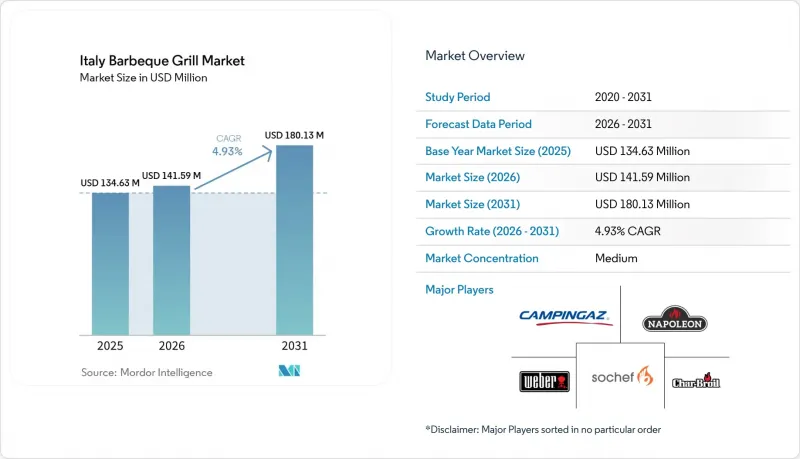
This report is Segmented by Fuel Type (Gas, Charcoal, and Electric), Product Design (Built-In, Freestanding, Portable/Table-top, and Disposable/Single-use), Technology (Conventional and Smart/Connected), End-User (Residential and Commercial), Distribution Channel (B2B/Direct and B2C/Retail), and Geography. Market Forecasts are Provided in Terms of Value (USD).
Italy Barbeque Grill Market Trends and Insights
Tourism Recovery Sustains Commercial Outdoor Cooking Infrastructure
Italy recorded 476.9 million overnight stays in 2025, up 2.3% year over year, while international visitor nights rose 4.3%, supporting capital spending by hotels, agriturismi, and outdoor dining venues that differentiate with upgraded grill stations and outdoor kitchens . The Italy barbeque grill market benefits from strong flows to resort corridors and heritage cities, where operators refresh terraces and garden dining areas to meet guest expectations for al fresco experiences. Commercial operators are aligning fleet choices to uptime and throughput needs, with large-format gas grills favored for fuel logistics and ease of maintenance in peak seasons. Cross-regional travel within Italy channels demand toward rental properties and hospitality venues that standardize on fuel types allowed under local fire-risk rules, further shaping product mix and inventory planning. This demand pulse translates into the fastest expansion in the commercial end-user segment through 2031 as operators pursue consistent, regulation-compliant cooking options.
DIY Retail and E-Commerce Expansion Lower Purchase Barriers
The Italy barbeque grill market continues to rely on B2C retail for discovery and conversion, with specialty stores and home centers anchoring 2025 sales, while online channels add reach, speed, and range to the accessory and replacement parts business. As brands expand direct-to-consumer storefronts, early access to connected modules and software-enabled accessories supports premium attachment rates and improves sell-through of higher-margin SKUs. E-commerce also compresses launch cycles for incremental innovations such as smart controllers, probe kits, and grill-to-app integrations, which are easier to merchandise digitally with content and guided setup. Physical stores retain an edge for tactile validation of ignition systems, build quality, and cooking area, which remains decisive for first-time buyers who plan multi-year use. Together, omnichannel strategies reduce friction for first purchases and accelerate repeat purchases of add-ons that extend unit lifecycles.
Wildfire Restrictions Fragment Charcoal Grill Usage Windows
Seasonal fire-risk rules in regions such as Tuscany impose open-flame limits during high-risk months, which compresses the practical window for charcoal users and nudges households toward gas or pellet options with more consistent availability . Local ordinances often allow braziers and barbecues only in private homes or designated areas during bans, creating uncertainty for owners who rely on public or shared outdoor spaces. Charcoal's peak-season constraints reduce return-on-use for buyers who cook most during summer and prefer spontaneous outdoor gatherings. For retailers and brands, the rules require more precise inventory cycles and responsive merchandising that highlight compliant alternatives during alert periods. These dynamics have a modest but persistent dampening effect on charcoal volumes within the Italy barbeque grill market.
Other drivers and restraints analyzed in the detailed report include:
- EUDR Compliance Costs Accelerate Fuel Substitution Toward Traceable Alternatives
- Premium Outdoor Kitchens Elevate Built-In Grill Demand
- Charcoal Supply Chain Compliance Costs Constrict Availability
For complete list of drivers and restraints, kindly check the Table Of Contents.
Segment Analysis
Gas grills commanded 49.15% of the Italy barbeque grill market share in 2025 as buyers prioritized easy ignition, precise control, and flexible LPG or natural gas connections. Pellet platforms are projected to expand at 5.93% CAGR through 2031, drawing momentum from their compatibility with certified forestry inputs and simpler EUDR compliance narratives than those facing charcoal import chains. Clearer documentation and reliable restocking cycles underpin steady peak-season performance for gas and pellet users who cannot risk disruptions during summer holidays . The Italy barbeque grill market will continue to feature a loyal charcoal base, yet its relative weight softens where seasonal fire-risk limits and due diligence obligations intersect. Electric grills retain a small but stable role in settings that restrict open flames, aided by cleaner operation and compact footprints for urban dwellers.
Pellet innovation improves usability without losing wood-fired appeal, closing the convenience gap with gas while guarding on flavor and smoke control . Feature sets such as integrated controllers, guided cook programs, and pellet sensors now deliver consistent results for time-constrained home cooks who value repeatability. Gas segments focus on burner performance, heat distribution, and durable finishes that withstand outdoor exposure across Italy's varied climates. Hybrid and niche fuels remain enthusiast-driven, with coverage in specialty retail and limited impact on mainstream volumes. The net effect is a steady reweighting toward fuels that ensure legal clarity, supply chain visibility, and dependable summer throughput in the Italy barbeque grill market.
Freestanding models accounted for 58.72% of 2025 demand as their mobility, size, variety, and easy setup met the needs of homes that shift use between primary residences and holiday properties. Portable and table-top grills are projected to grow at 5.46% CAGR through 2031, aligning with tighter urban living and the need for smoke-managed solutions that respect condominium policies and shared spaces. Buyers seeking premium outdoor kitchens still rely on built-in formats that integrate with broader entertaining areas and permanent gas supplies where available. In-store consultation remains important for footprint planning, safety clearances, and accessory fit, which supports specialty retailers that offer design guidance and installation services. The balance of formats reflects Italy's housing mix and outdoor leisure habits, both of which support variety within the Italy barbeque grill market.
Modular systems and planchas support cooking versatility beyond traditional grates, encouraging buyers to assemble stations that match recipes and group sizes through seasons. Premium builders and homeowners value material quality and a coherent look across cabinetry, countertops, and appliances that hold up under salt air and sun exposure. Portable grills gain when shared outdoor areas or code constraints reduce the feasibility of larger installations, keeping entry-level and mid-tier choices active. Retailers leverage display zones and live demos to compare ignition systems, heat zones, and workflow, which influence unit selection in a crowded aisle. These shifts point to a broadening base of configurations within the Italy barbeque grill market that serve both compact city balconies and expansive coastal villas.
List of Companies Covered in this Report:
- Weber
- Campingaz
- Sochef (Sal. Mar s.r.l.)
- Ferraboli
- Napoleon
- Char-Broil
- Broil King
- LotusGrill
- Big Green Egg
- Traeger
- Everdure
- Barbecook
- Outdoorchef
- Naterial (Adeo Group)
- Landmann
- Monolith Grill
- Kamado Joe
- Boretti
- Palazzetti
- OMPAGRILL
Additional Benefits:
- The market estimate (ME) sheet in Excel format
- 3 months of analyst support
TABLE OF CONTENTS
1 Introduction
- 1.1 Study Assumptions & Market Definition
- 1.2 Scope of the Study
2 Research Methodology
3 Executive Summary
4 Market Landscape
- 4.1 Market Overview
- 4.2 Market Drivers
- 4.2.1 Outdoor living investments and garden upgrades (Bonus Verde incentive)
- 4.2.2 Tourism recovery and record visitor nights sustaining commercial demand
- 4.2.3 Expansion of DIY and specialty retail plus online channels for grills
- 4.2.4 Harmonized Euroepan Union Gas Appliances Regulation enabling safer, faster market access
- 4.2.5 EUDR due-diligence pressure on charcoal nudging fuel shift to gas/electric/pellet
- 4.2.6 Premium outdoor kitchens catalyzing demand for built-in and high-end grills
- 4.3 Market Restraints
- 4.3.1 Seasonal wildfire/open-flame restrictions limiting charcoal use periods
- 4.3.2 Elevated household electricity costs affecting electric grill operating cost
- 4.3.3 Charcoal supply compliance costs under EUDR tightening availability/prices
- 4.3.4 Limited natural-gas conversion options for EMEA models constraining installs
- 4.4 Industry Value Chain Analysis
- 4.5 Porter's Five Forces
- 4.5.1 Threat of New Entrants
- 4.5.2 Bargaining Power of Suppliers
- 4.5.3 Bargaining Power of Buyers
- 4.5.4 Threat of Substitutes
- 4.5.5 Competitive Rivalry
- 4.6 Insights into the Latest Trends and Innovations in the Market
- 4.7 Insights on Recent Developments (New Product Launches, Strategic Initiatives, Investments, Partnerships, JVs, Expansion, M&As, etc.) in the Market
5 Market Size & Growth Forecasts
- 5.1 By Fuel Type
- 5.1.1 Gas Grills
- 5.1.2 Charcoal Grills
- 5.1.3 Electric Grills
- 5.1.4 Pellet Grills
- 5.1.5 Hybrid/Alternative Fuel
- 5.1.6 Infrared
- 5.2 By Product Design
- 5.2.1 Built-In
- 5.2.2 Freestanding
- 5.2.3 Portable / Table-top
- 5.2.4 Disposable / Single-use
- 5.3 By Technology
- 5.3.1 Conventional
- 5.3.2 Smart/Connected
- 5.4 By End-User
- 5.4.1 Residential
- 5.4.2 Commercial
- 5.5 By Distribution Channel
- 5.5.1 B2B/Direct from the Manufacturers
- 5.5.2 B2C/Retail - Specialty Stores
- 5.5.2.1 Home Centers & DIY Stores
- 5.5.2.2 Mass Merchandisers
- 5.5.2.3 Online
- 5.5.2.4 Other Distribution Channels
- 5.6 By Geography
- 5.6.1 Northern Italy
- 5.6.2 Central Italy
- 5.6.3 Southern Italy & Islands
6 Competitive Landscape
- 6.1 Market Concentration
- 6.2 Strategic Moves
- 6.3 Market Share Analysis
- 6.4 Company Profiles {(includes Global level Overview, Market level overview, Core Segments, Financials as available, Strategic Information, Market Rank/Share for key companies, Products & Services, and Recent Developments)}
- 6.4.1 Weber
- 6.4.2 Campingaz
- 6.4.3 Sochef (Sal. Mar s.r.l.)
- 6.4.4 Ferraboli
- 6.4.5 Napoleon
- 6.4.6 Char-Broil
- 6.4.7 Broil King
- 6.4.8 LotusGrill
- 6.4.9 Big Green Egg
- 6.4.10 Traeger
- 6.4.11 Everdure
- 6.4.12 Barbecook
- 6.4.13 Outdoorchef
- 6.4.14 Naterial (Adeo Group)
- 6.4.15 Landmann
- 6.4.16 Monolith Grill
- 6.4.17 Kamado Joe
- 6.4.18 Boretti
- 6.4.19 Palazzetti
- 6.4.20 OMPAGRILL
7 Market Opportunities & Future Outlook
- 7.1 Balcony-safe smokeless/low-smoke compact grills for condos and urban terraces
- 7.2 Premium built-in modules and outdoor kitchens tailored to Italian design codes
- 7.3 EUDR-compliant certified charcoal and pellet assortments with traceability

