PUBLISHER: Mordor Intelligence | PRODUCT CODE: 2072457

PUBLISHER: Mordor Intelligence | PRODUCT CODE: 2072457
Cotton Seed - Market Share Analysis, Industry Trends & Statistics, Growth Forecasts (2026 - 2031)
According to Mordor Intelligence, the cotton seed market size is projected to expand from USD 1.56 billion in 2025 and USD 1.65 billion in 2026 to USD 2.19 billion by 2031, registering a CAGR of 5.80% between 2026 and 2031.
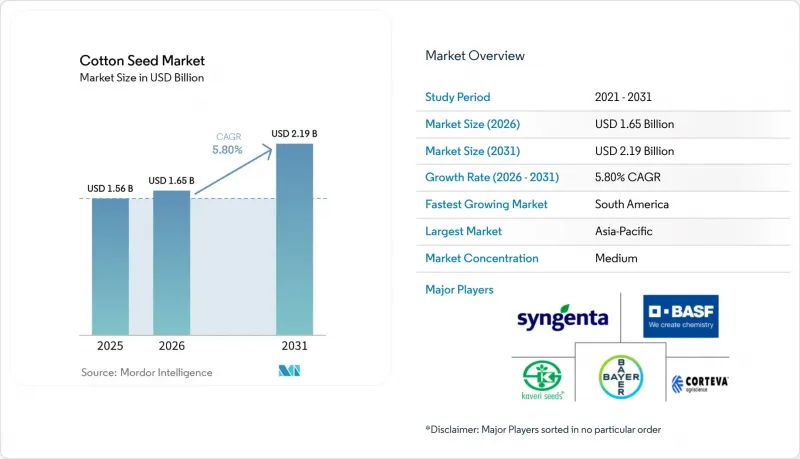
This report is Segmented by Breeding Technology (Hybrids and More) and by Geography (North America, Europe, Asia Pacific, South America, Middle East, and Africa). The Market Forecasts are Provided in Terms of Value (USD) and Volume (Metric Tons).
Global Cotton Seed Market Trends and Insights
Hybrid and Transgenic Seed Adoption
The strongest support for the cotton seed market comes from a change in seed mix rather than a broad increase in cultivated area. Purchased hybrid and transgenic seed has become central to commercial cotton production in major producing countries, keeping the cotton seed market tied to annual repurchase cycles rather than farm-saved seed reuse. That annual repurchase pattern helps seed companies protect both volume and pricing in the cotton seed market, where traited and branded products hold a clear agronomic position. The next stage of competition is moving toward new stacked events, including Vip3A-based traits and gene-edited lines, because older Bt platforms are under pressure from resistance in key markets. BASF SE's January 2026 launch of new Stoneville varieties with Axant Flex herbicide tolerance and TwinLink Plus insect control shows how rapidly trait stacking is now shaping product refresh cycles.
Seed Subsidy and Cotton Mission Support in India
India has become a major policy anchor for the cotton seed market through direct support for seed quality and productivity programs. The Mission for Cotton Productivity carries an outlay of INR 5,659.22 crore, equivalent to USD 669.73 million, for 2026-27 to 2030-31, and aims to lift lint productivity from 440 kg per hectare to 755 kg per hectare. The program covers high-yielding seeds, pest and disease resistance, extra-long staple cotton, and high-density planting systems across 140 districts in 14 states.The Sub-Mission on Seed and Planting Material offers state-level support for certified seed distribution, processing infrastructure, and quality testing. This initiative enhances the operational framework of the cotton seed market in India. It is anticipated to boost branded hybrid volumes, although suppliers unable to demonstrate clear yield or quality differentiation may face pricing pressures.
Pink Bollworm Resistance Reducing Bt Trait Value
Pink bollworm resistance represents a significant biological challenge for the cottonseed market in India. Research published in the Journal of Cotton Research in 2026 reported high resistance ratios to Cry1Ac and Cry2Ab in field populations, with extreme resistance observed in the Nagpur strain. In the same year, India's Minister of State for Agriculture confirmed in Parliament that pink bollworm resistance is prevalent across cotton-growing regions and is becoming a major pest issue. This development has reduced the premium that farmers are willing to pay for older Bt hybrids, as field protection no longer meets expectations. The cottonseed market requires a new trait cycle to regain pricing power, however, the current pipeline remains in pre-commercial stages. As the yield advantage of older Bt platforms diminishes, farmers are less inclined to pay for branded hybrid seeds. This situation creates opportunities for Vip3A-based and stacked-gene products, though their commercial availability is contingent on uncertain regulatory approvals in India and China.
Other drivers and restraints analyzed in the detailed report include:
- Higher Seed Replacement Rates in Branded Hybrids
- Textile Demand Supporting Cotton Acreage
- Cotton Price Volatility and Crop Switching
For complete list of drivers and restraints, kindly check the Table Of Contents.
Segment Analysis
Market share data show that hybrids were the largest breeding technology segment, accounting for 94.6% in 2025, and this segment of the cotton seed market is also the fastest, with a 5.9% CAGR through 2031. That position is self-reinforcing because growers must buy fresh hybrid seed each season to avoid yield loss from saved progeny. Bayer AG advanced fresh Deltapine varieties with Bollgard 3 ThryvOn XtendFlex stacks for the year 2023-2024. India also released 22 new Bt cotton variety notifications in January 2026, which support another round of varietal replacement in the cotton seed industry.
Market growth for non-hybrid breeding technologies will remain modest because open-pollinated varieties are most relevant in regions with less developed commercial distribution and seed storage systems. This residual category still serves parts of Sub-Saharan Africa and some Central Asian markets, but it is losing relevance in the more organized cottonseed market. The performance gap has widened as private companies invest in multi-trait hybrids, while public programs still carry much of the burden for alternative germplasm. Compact-architecture materials suited for high-density planting sit near the boundary between conventional breeding and hybrid development, and that space could gain importance later in the forecast period. For now, the cotton seed industry is moving toward deeper hybrid concentration, while open-pollinated options remain a secondary part of the cotton seed market size.
Complete Report Scope:
- Breeding Technology
- Hybrids
- Open Pollinated Varieties and Hybrid Derivatives
- By Geography
- North America
- United States
- Mexico
- Rest of North America
- South America
- Brazil
- Argentina
- Rest of South America
- Europe
- Greece
- Spain
- Russia
- Rest of Europe
- Asia-Pacific
- China
- India
- Pakistan
- Australia
- Rest of Asia-Pacific
- Middle East
- Turkey
- Israel
- Rest of Middle East
- Africa
- Egypt
- Nigeria
- South Africa
- Rest of Africa
- North America
Geography Analysis
Asia-Pacific held 74.4% of the global total in 2025, but the structure of the cotton seed market differs sharply across the region. China concentrates nearly 90% of its cotton production in Xinjiang, where mechanized harvesting and locally adapted seed programs support a more structured procurement model. China's 2025-26 harvested area is forecast at nearly 3.1 million hectares, with yields of 2,556 kg per hectare, reflecting intensive agronomic management rather than a smallholder replacement story. India's cotton acreage fell, yet the cotton seed market remained resilient, as higher seed replacement and certified hybrid adoption offset the area loss. As per the United States Department of Agriculture (USDA), Pakistan maintained a harvested area of nearly 2 million hectares in 2025-26, which supported stable demand conditions, while Australia's yield levels kept it a smaller but premium mechanized niche.
South America is the fastest-growing region in the cottonseed market, with a projected CAGR of 6.7% through 2031. Brazil stands out due to its large-scale farming operations, extensive use of high-trait seeds, and strong demand for agronomy-supported hybrids. Europe, while smaller in terms of cultivated area, remains significant for compliance-driven product positioning, as cotton production is concentrated in Greece and Spain, where regulatory standards are more stringent. The Middle East and Africa offer long-term growth opportunities for the cotton seed market, driven by Turkey's textile demand, Egypt's niche in extra-long staple cotton, and West Africa's potential for future expansion of hybrid seed supply. Although these regions do not currently rival Asia-Pacific in scale, they offer selective growth opportunities through specialized genetics and improved commercial infrastructure.
North America remains a commercially attractive market due to factors beyond acreage, including a structural shift in licensing and product competition. Corteva, Inc. is set to enter the cotton trait out-licensing market in the United States following its 2026 resolution with Bayer AG, introducing a third significant trait owner to a previously more concentrated market. Concurrently, BASF SE and Bayer AG are enhancing their premium portfolios, increasing the value mix within the regional cotton seed market. Additionally, prospective planting data for 2026 indicates an acreage recovery, providing the region with both volume and pricing support.
- BASF SE
- Bayer AG
- Corteva, Inc.
- Kaveri Seed Company Limited
- Maharashtra Hybrid Seeds Company Private Limited
- Nuziveedu Seeds Limited
- JK Agri Genetics Limited
- Rasi Seeds Private Limited
- DCM Shriram Limited
- Krishak Bharati Cooperative Limited
- Crystal Crop Protection Limited
- VNR Seeds Private Limited
- Olam Group Ltd.
- Rallis India Limited
- Syngenta AG
Additional Benefits:
- The market estimate (ME) sheet in Excel format
- 3 months of analyst support
TABLE OF CONTENTS
1 INTRODUCTION
- 1.1 Study Assumptions and Market Definition
- 1.2 Scope of the Study
- 1.3 Research Methodology
2 REPORT OFFERS
3 EXECUTIVE SUMMARY AND KEY FINDINGS
4 KEY INDUSTRY TRENDS
- 4.1 Area Under Cultivation
- 4.2 Most Popular Traits
- 4.3 Breeding Techniques
- 4.4 Regulatory Framework
- 4.5 Value Chain and Distribution Channel Analysis
- 4.6 Market Drivers
- 4.6.1 Hybrid and transgenic seed adoption
- 4.6.2 Seed subsidy and cotton mission support in India
- 4.6.3 Higher seed replacement rates in branded hybrids
- 4.6.4 Textile demand supporting cotton acreage
- 4.6.5 High-density planting increasing seed use per acre
- 4.6.6 Low-gossypol cottonseed commercialization
- 4.7 Market Restraints
- 4.7.1 Pink bollworm resistance reducing Bt trait value
- 4.7.2 Cotton price volatility and crop switching
- 4.7.3 Illegal herbicide-tolerant seed channels in India
- 4.7.4 Neonicotinoid seed treatment scrutiny
5 MARKET SIZE AND GROWTH FORECASTS (VALUE AND VOLUME)
- 5.1 Breeding Technology
- 5.1.1 Hybrids
- 5.1.2 Open Pollinated Varieties and Hybrid Derivatives
- 5.2 By Geography
- 5.2.1 North America
- 5.2.1.1 United States
- 5.2.1.2 Mexico
- 5.2.1.3 Rest of North America
- 5.2.2 South America
- 5.2.2.1 Brazil
- 5.2.2.2 Argentina
- 5.2.2.3 Rest of South America
- 5.2.3 Europe
- 5.2.3.1 Greece
- 5.2.3.2 Spain
- 5.2.3.3 Russia
- 5.2.3.4 Rest of Europe
- 5.2.4 Asia-Pacific
- 5.2.4.1 China
- 5.2.4.2 India
- 5.2.4.3 Pakistan
- 5.2.4.4 Australia
- 5.2.4.5 Rest of Asia-Pacific
- 5.2.5 Middle East
- 5.2.5.1 Turkey
- 5.2.5.2 Israel
- 5.2.5.3 Rest of Middle East
- 5.2.6 Africa
- 5.2.6.1 Egypt
- 5.2.6.2 Nigeria
- 5.2.6.3 South Africa
- 5.2.6.4 Rest of Africa
- 5.2.1 North America
6 COMPETITIVE LANDSCAPE
- 6.1 Key Strategic Moves
- 6.2 Market Share Analysis
- 6.3 Company Landscape
- 6.4 Company Profiles (Includes Global Level Overview, Market Level Overview, Core Segments, Financials as Available, Strategic Information, Market Rank/Share for Key Companies, Products and Services, and Recent Developments)
- 6.4.1 BASF SE
- 6.4.2 Bayer AG
- 6.4.3 Corteva, Inc.
- 6.4.4 Kaveri Seed Company Limited
- 6.4.5 Maharashtra Hybrid Seeds Company Private Limited
- 6.4.6 Nuziveedu Seeds Limited
- 6.4.7 JK Agri Genetics Limited
- 6.4.8 Rasi Seeds Private Limited
- 6.4.9 DCM Shriram Limited
- 6.4.10 Krishak Bharati Cooperative Limited
- 6.4.11 Crystal Crop Protection Limited
- 6.4.12 VNR Seeds Private Limited
- 6.4.13 Olam Group Ltd.
- 6.4.14 Rallis India Limited
- 6.4.15 Syngenta AG
7 KEY STRATEGIC QUESTIONS FOR SEEDS CEOS

