PUBLISHER: Mordor Intelligence | PRODUCT CODE: 2100720

PUBLISHER: Mordor Intelligence | PRODUCT CODE: 2100720
India Cotton Seed for Sowing - Market Share Analysis, Industry Trends & Statistics, Growth Forecasts (2026 - 2031)
According to Mordor Intelligence, the India cotton seed market size for sowing is expected to grow from USD 0.86 billion in 2025 to USD 0.91 billion in 2026 and is forecast to reach USD 1.19 billion by 2031 at 5.62% CAGR over 2026-2031.
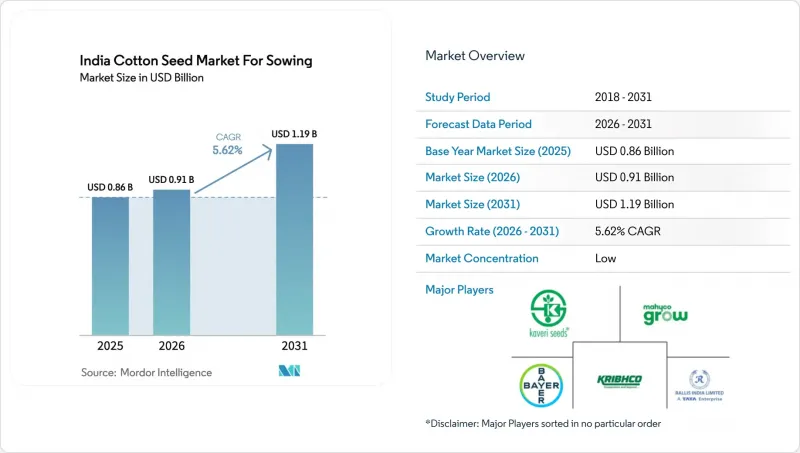
This report is Segmented by Breeding Technology (Hybrids and Open Pollinated Varieties and Hybrid Derivatives) and by State (Andhra Pradesh, Gujarat, Haryana, Karnataka, and More). The Market Forecasts are Provided in Terms of Value (USD) and Volume (Metric Tons).
India Cotton Seed for Sowing Market Trends and Insights
High Adoption of Bt Cotton Hybrids
Bt hybrids dominate 98.7% of national sales, yet pink bollworm resistance has reduced trait efficacy from initial near-total control to levels that now require integrated pest management. The Central Institute for Cotton Research has approved 619 Bt hybrids, underscoring both genetic diversity and the relentless shift toward stacks that combine multiple Cry proteins with herbicide tolerance. Persistent farmer preference for cost-effective insect control ensures Bt cotton remains essential to the India cotton seed (seed for sowing) market. Companies are responding by accelerating breeding cycles, strengthening refuge seed distribution, and preparing next-generation constructs such as Bayer's IP4 lines, which promise broader spectrum control.
Government Minimum Support Price Incentives
Cotton Corporation of India procured 42.11 lakh bales in 2024 under the minimum support price program, disbursing significant value directly to 775,000 growers via Aadhaar-authenticated payments. The assured floor price limits downside risk, enabling smallholders to allocate a larger share of working capital to certified hybrid seed rather than farm-saved seed. Real-time SMS payment confirmations and stricter quality audit protocols have elevated farmer confidence, though global price softness keeps profit margins tight and limits willingness to pay steep premiums for advanced traits. Predictable income from MSP procurement enables farmers to purchase certified hybrid seed instead of relying on farm-saved seed.
Regulatory Uncertainty Around GM (Genetically Modified) Approvals
The Genetic Engineering Appraisal Committee's (GEAC) prolonged evaluation process for new GM traits creates strategic uncertainty that constrains long-term R&D investments and market planning. Bayer's BG-II RRF herbicide-tolerant cotton application exemplifies this bottleneck, where regulatory delays enable illegal seed proliferation while formal companies cannot commercialize approved technologies. The Seeds Act (1966) and state-specific regulations such as Maharashtra's Cotton Seeds Act (2009) create multiple approval layers that extend commercialization timelines and reduce competitiveness. This regulatory fragmentation particularly impacts multinational companies with global trait pipelines, as India-specific approval delays can render technologies obsolete by the time they reach farmers . The uncertainty also affects venture capital investment in agricultural biotechnology startups, limiting innovation ecosystem development.
Other drivers and restraints analyzed in the detailed report include:
- Rising Export Demand for Cotton Lint
- Pipeline of Herbicide-Tolerant Trait Approvals
- Seed Price Caps Eroding Breeder Margins
For complete list of drivers and restraints, kindly check the Table Of Contents.
Segment Analysis
Hybrids held 98.55% market share of India Cotton Seed for Sowing Market size in 2025, this overwhelming dominance is attributed to the superior characteristics of hybrid seeds, including higher productivity, enhanced insect resistance, improved stress tolerance, and superior fiber quality. Within the hybrids segment, transgenic hybrids, particularly those with Bt technology, hold the majority share, while non-transgenic hybrids comprise the remainder. The segment's leadership position is further strengthened by the widespread adoption of Bt cotton technology among Indian farmers, who recognize its benefits in terms of pest resistance and yield enhancement. The segment is also experiencing the fastest growth in the market, driven by continuous innovation in seed technology, increasing demand for high-yielding varieties, and the development of seeds with multiple beneficial traits such as drought tolerance and disease resistance.
The hybrid segment's 5.78% CAGR (2026-2031) reflects continued investment in trait development and breeding programs, despite pink bollworm resistance challenges that are driving companies toward trait stacking and next-generation technologies. Non-transgenic hybrids maintain relevance in export-oriented cotton where GM-free certification commands premiums, particularly for organic and specialty fiber markets. Insect-resistant hybrids within the transgenic category are undergoing technological evolution as single-gene Bt traits give way to multi-gene constructs designed to delay resistance development.
Complete Report Scope:
- Breeding Technology
- Hybrids
- Non-Transgenic Hybrids
- Transgenic Hybrids
- Insect Resistant Hybrids
- Open Pollinated Varieties and Hybrid Derivatives
- Hybrids
- State
- Andhra Pradesh
- Gujarat
- Haryana
- Karnataka
- Madhya Pradesh
- Maharashtra
- Odisha
- Punjab
- Rajasthan
- Telangana
- Other States
List of Companies Covered in this Report:
- Kaveri Seeds
- Maharashtra Hybrid Seeds Co. (Mahyco)
- Bayer AG
- Krishak Bharati Co-Op Limited (KRIBHCO)
- Rallis India Limited
- Nuziveedu Seeds Ltd
- Rasi Seeds Private Limited
- SeedWorks International Pvt. Ltd
- Corteva Agriscience India Pvt. Ltd
- Advanta Seeds
- DCM Shriram Ltd (Bioseed)
- Ankur Seeds Pvt. Ltd
Additional Benefits:
- The market estimate (ME) sheet in Excel format
- 3 months of analyst support
TABLE OF CONTENTS
1 INTRODUCTION
- 1.1 Study Assumptions and Market Definition
- 1.2 Scope of the Study
- 1.3 Research Methodology
2 REPORT OFFERS
3 EXECUTIVE SUMMARY & KEY FINDINGS
4 KEY INDUSTRY TRENDS
- 4.1 Area Under Cultivation
- 4.2 Most Popular Traits
- 4.3 Breeding Techniques
- 4.4 Regulatory Framework
- 4.5 Value Chain and Distribution Channel Analysis
- 4.6 Market Drivers
- 4.6.1 High adoption of Bt cotton hybrids
- 4.6.2 Government minimum support price incentives
- 4.6.3 Rising export demand for cotton lint
- 4.6.4 Pipeline of herbicide-tolerant trait approvals
- 4.6.5 Digital ag-advisory platforms boosting seed replacement
- 4.6.6 Climate-resilient short-duration hybrids for rain-fed areas
- 4.7 Market Restraints
- 4.7.1 Regulatory uncertainty around genetically modified (GM) approvals
- 4.7.2 Seed price caps eroding breeder margins
- 4.7.3 Pink bollworm resistance dampening yield gains
- 4.7.4 Informal seed trade fragmenting certified demand
5 MARKET SIZE AND GROWTH FORECASTS (VALUE AND VOLUME)
- 5.1 Breeding Technology
- 5.1.1 Hybrids
- 5.1.1.1 Non-Transgenic Hybrids
- 5.1.1.2 Transgenic Hybrids
- 5.1.1.2.1 Insect Resistant Hybrids
- 5.1.2 Open Pollinated Varieties and Hybrid Derivatives
- 5.1.1 Hybrids
- 5.2 State
- 5.2.1 Andhra Pradesh
- 5.2.2 Gujarat
- 5.2.3 Haryana
- 5.2.4 Karnataka
- 5.2.5 Madhya Pradesh
- 5.2.6 Maharashtra
- 5.2.7 Odisha
- 5.2.8 Punjab
- 5.2.9 Rajasthan
- 5.2.10 Telangana
- 5.2.11 Other States
6 COMPETITIVE LANDSCAPE
- 6.1 Key Strategic Moves
- 6.2 Market Share Analysis
- 6.3 Company Landscape
- 6.4 Company Profiles (Includes Global Level Overview, Market Level Overview, Core Segments, Financials as Available, Strategic Information, Market Rank/Share for Key Companies, Products and Services, and Recent Developments)
- 6.4.1 Kaveri Seeds
- 6.4.2 Maharashtra Hybrid Seeds Co. (Mahyco)
- 6.4.3 Bayer AG
- 6.4.4 Krishak Bharati Co-Op Limited (KRIBHCO)
- 6.4.5 Rallis India Limited
- 6.4.6 Nuziveedu Seeds Ltd
- 6.4.7 Rasi Seeds Private Limited
- 6.4.8 SeedWorks International Pvt. Ltd
- 6.4.9 Corteva Agriscience India Pvt. Ltd
- 6.4.10 Advanta Seeds
- 6.4.11 DCM Shriram Ltd (Bioseed)
- 6.4.12 Ankur Seeds Pvt. Ltd
7 KEY STRATEGIC QUESTIONS FOR SEEDS CEOS

