PUBLISHER: Mordor Intelligence | PRODUCT CODE: 2100719

PUBLISHER: Mordor Intelligence | PRODUCT CODE: 2100719
Asia-Pacific Cotton Seed for Sowing - Market Share Analysis, Industry Trends & Statistics, Growth Forecasts (2026 - 2031)
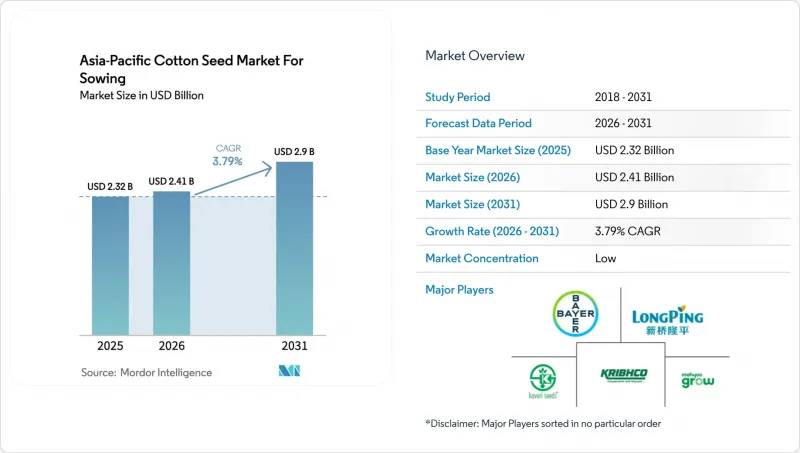
According to Mordor Intelligence, Asia-Pacific cotton seed market size for sowing market size in 2026 is estimated at USD 2.41 billion, growing from 2025 value of USD 2.32 billion with 2031 projections showing USD 2.9 billion, growing at 3.79% CAGR over 2026-2031.
This report is Segmented by Breeding Technology (Hybrids, and Open Pollinated Varieties and Hybrid Derivatives) and by Geography (Australia, Bangladesh, China, India, Indonesia, Japan, Myanmar, Pakistan, Philippines, Thailand, Vietnam, and More). The Market Forecasts are Provided in Terms of Value (USD) and Volume (Metric Tons).
Asia-Pacific Cotton Seed for Sowing Market Trends and Insights
Rising Adoption of Bt (Bacillus Thuringiensis) and Stacked-Trait Hybrids
Biotechnology adoption accelerates across Asia-Pacific as farmers confront evolving pest pressures and yield plateau challenges in conventional varieties. China's Ministry of Agriculture approved 12 new Bt (Bacillus Thuringiensis) cotton varieties in 2024, expanding the trait portfolio beyond single-gene Bollgard to stacked constructs combining herbicide tolerance and multiple insect resistance mechanisms . India's experience with pink bollworm resistance to Cry1Ac has accelerated the adoption of dual-gene Bollgard II technology, with stacked-trait varieties now representing 78% of certified hybrid sales. The shift creates substantial revenue opportunities for trait developers and licensed seed companies, as stacked hybrids command 30-40% price premiums over conventional varieties. Regulatory compliance frameworks under OECD (Organization for Economic Co-operation and Development) guidelines ensure trait efficacy validation and resistance management protocols across participating countries.
Government Seed Subsidies and Minimum-Support Pricing Programs
Policy interventions increasingly target seed quality improvement as governments recognize the multiplier effects of genetic potential on agricultural productivity and rural incomes. India's National Food Security Mission allocated INR 3,400 crore (USD 408 million) for seed distribution programs in 2024, with 35% earmarked specifically for cotton seed subsidies in major producing states. Pakistan's Prime Minister Agriculture Emergency Program provides 50% subsidies on certified cotton seeds, driving adoption rates from 23% in 2022 to 41% in 2024 among smallholder farmers. Bangladesh's Cotton Development Board expanded its seed multiplication program to cover 85,000 hectares, targeting 60% certified seed adoption by 2026. These interventions create artificial demand floors that stabilize seed company revenues while accelerating technology diffusion. The programs particularly benefit companies with strong government relationships and distribution capabilities in rural markets.
Volatile Farm-Gate Cotton Prices Discouraging Seed Purchase
Price volatility fundamentally undermines farmer investment decisions in premium seed technologies, as uncertain returns discourage upfront expenditures on higher-cost genetic materials. Cotton futures on the Intercontinental Exchange fluctuated between 68-89 cents per pound during 2024, creating 31% price volatility that exceeded historical averages and complicated planting decisions for the 2025 season. This uncertainty particularly impacts smallholder farmers who lack hedging mechanisms and rely on spot market prices for revenue planning. Indian cotton prices declined 18% between March and August 2024 due to global supply adjustments, causing many farmers to defer premium seed purchases in favor of saved seeds or lower-cost alternatives. The volatility creates cyclical demand patterns that complicate seed company production planning and inventory management.
Other drivers and restraints analyzed in the detailed report include:
- Rapid Expansion of Textile Spinning Capacity
- Xinjiang's Shift to Ultra-High-Density Sowing Driving Seed Volume Growth
- Stringent Biotech Regulations
For complete list of drivers and restraints, kindly check the Table Of Contents.
Segment Analysis
Hybrids maintain their commanding 69.52% market share in 2025, reflecting superior agronomic performance and integrated pest management capabilities that justify premium pricing structures across diverse farming systems. The segment's growth trajectory benefits from continuous trait stacking innovations, with companies like Bayer introducing triple-stacked varieties combining Bollgard 3, Roundup Ready Flex, and ThryvOn technologies that deliver 22-28% yield advantages over conventional alternatives in 2023. Transgenic hybrids within this category represent the fastest-growing subsegment, driven by regulatory approvals for new trait combinations and farmer adoption of integrated weed management systems. Non-transgenic hybrids maintain relevance in markets with biotech restrictions, particularly Japan and Indonesia, where conventional breeding achievements in fiber quality and disease resistance support premium positioning.
Open Pollinated Varieties and Hybrid Derivatives project the strongest growth at 4.04% CAGR through 2031, concentrated primarily in Australia, where water-efficient varieties command premium prices amid irrigation constraints. This segment benefits from farmer cost management strategies and seed-saving practices that reduce per-hectare input expenses while maintaining acceptable yield levels. The growth reflects increasing sophistication in conventional breeding programs that incorporate molecular marker technologies and genomic selection methods to accelerate variety development.
Complete Report Scope:
- Breeding Technology
- Hybrids
- Non-Transgenic Hybrids
- Transgenic Hybrids
- Herbicide Tolerant Hybrids
- Insect Resistant Hybrids
- Open Pollinated Varieties and Hybrid Derivatives
- Hybrids
- Geography
- Australia
- Bangladesh
- China
- India
- Indonesia
- Japan
- Myanmar
- Pakistan
- Philippines
- Thailand
- Vietnam
- Rest of Asia-Pacific
List of Companies Covered in this Report:
- Anhui Tsuen Yin Hi-Tech Seed Industry Co. Ltd
- Krishak Bharati Co-Op Limited (KRIBHCO)
- Maharashtra Hybrid Seeds Co. (Mahyco)
- Bayer AG
- Kaveri Seed Company Ltd
- Corteva Agriscience
- DCM Shriram Ltd
- Rasi Seeds Pvt Ltd
- JK Organisation
- UPL Ltd
- Beidahuang Group
- SeedWorks International Pvt Ltd
- Nuziveedu Seeds Ltd
- Rallis India Ltd (Tata Chemicals Ltd)
Additional Benefits:
- The market estimate (ME) sheet in Excel format
- 3 months of analyst support
TABLE OF CONTENTS
1 EXECUTIVE SUMMARY AND KEY FINDINGS
2 REPORT OFFERS
3 INTRODUCTION
- 3.1 Study Assumptions and Market Definition
- 3.2 Scope of the Study
- 3.3 Research Methodology
4 KEY INDUSTRY TRENDS
- 4.1 Area Under Cultivation
- 4.2 Most Popular Traits
- 4.3 Breeding Techniques
- 4.4 Regulatory Framework
- 4.5 Value Chain & Distribution Channel Analysis
- 4.6 Market Drivers
- 4.6.1 Rising adoption of Bt (Bacillus thuringiensis) and stacked-trait hybrids
- 4.6.2 Government seed subsidies and minimum-support pricing programs
- 4.6.3 Rapid expansion of textile spinning capacity
- 4.6.4 Xinjiang's shift to ultra-high-density sowing driving seed volume growth
- 4.6.5 Surge in e-commerce seed sales platforms lowering channel costs for smallholders
- 4.6.6 Climate-smart seed certification schemes linked to ESG (Environmental, Social, and Governance)-driven apparel sourcing
- 4.7 Market Restraints
- 4.7.1 Volatile farm-gate cotton prices discouraging seed purchase
- 4.7.2 Stringent biotech regulations
- 4.7.3 Counterfeit seed proliferation through informal cross-border trade
- 4.7.4 Water-allocation caps in Australia limiting seed-based area expansion
5 MARKET SIZE AND GROWTH FORECASTS (VALUE AND VOLUME)
- 5.1 Breeding Technology
- 5.1.1 Hybrids
- 5.1.1.1 Non-Transgenic Hybrids
- 5.1.1.2 Transgenic Hybrids
- 5.1.1.2.1 Herbicide Tolerant Hybrids
- 5.1.1.2.2 Insect Resistant Hybrids
- 5.1.2 Open Pollinated Varieties and Hybrid Derivatives
- 5.1.1 Hybrids
- 5.2 Geography
- 5.2.1 Australia
- 5.2.2 Bangladesh
- 5.2.3 China
- 5.2.4 India
- 5.2.5 Indonesia
- 5.2.6 Japan
- 5.2.7 Myanmar
- 5.2.8 Pakistan
- 5.2.9 Philippines
- 5.2.10 Thailand
- 5.2.11 Vietnam
- 5.2.12 Rest of Asia-Pacific
6 COMPETITIVE LANDSCAPE
- 6.1 Key Strategic Moves
- 6.2 Market Share Analysis
- 6.3 Company Landscape
- 6.4 Company Profiles (Includes Global Level Overview, Market Level Overview, Core Segments, Financials As Available, Strategic Information, Market Rank/Share for Key Companies, Products and Services, and Recent Developments)
- 6.4.1 Anhui Tsuen Yin Hi-Tech Seed Industry Co. Ltd
- 6.4.2 Krishak Bharati Co-Op Limited (KRIBHCO)
- 6.4.3 Maharashtra Hybrid Seeds Co. (Mahyco)
- 6.4.4 Bayer AG
- 6.4.5 Kaveri Seed Company Ltd
- 6.4.6 Corteva Agriscience
- 6.4.7 DCM Shriram Ltd
- 6.4.8 Rasi Seeds Pvt Ltd
- 6.4.9 JK Organisation
- 6.4.10 UPL Ltd
- 6.4.11 Beidahuang Group
- 6.4.12 SeedWorks International Pvt Ltd
- 6.4.13 Nuziveedu Seeds Ltd
- 6.4.14 Rallis India Ltd (Tata Chemicals Ltd)
7 KEY STRATEGIC QUESTIONS FOR SEEDS CEOS

