PUBLISHER: Mordor Intelligence | PRODUCT CODE: 2072467

PUBLISHER: Mordor Intelligence | PRODUCT CODE: 2072467
China Property and Casualty Insurance - Market Share Analysis, Industry Trends & Statistics, Growth Forecasts (2026 - 2031)
According to Mordor Intelligence, the china property and casualty insurance market size in terms of premium value is expected to increase from USD 302.71 billion in 2025 to USD 334.08 billion in 2026 and reach USD 547.32 billion by 2031, growing at a CAGR of 10.36% over 2026-2031.
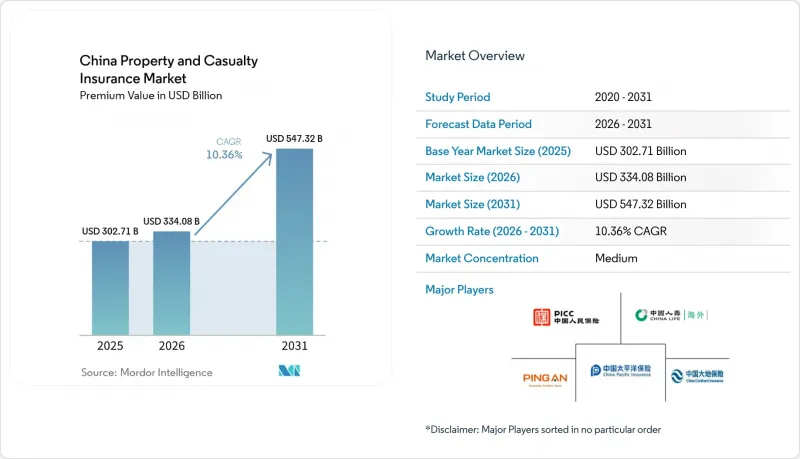
This report is Segmented by Lines of Business (Motor, Property, Homeowners, Liability, Agriculture, Marine and Cargo, Engineering and Construction, and More), Customer Type (Individuals, SMEs, Large Corporates and More), Distribution Channel (Direct Sales, Agency, Brokers, Bancassurance and More), and Region. The Market Forecasts are Provided in Terms of Value (USD)
China Property and Casualty Insurance Market Trends and Insights
Economic Growth & Rising Risk-Awareness
China's macro-recovery after the 2022-2024 slowdown lifts household purchasing power, enabling more families and firms to buy coverage. A 2024 State Council directive calls for broader disaster, health, and pension protection, signalling durable policy support for the China property and casualty insurance market. Urbanisation boosts asset density in flood-prone localities; floods caused USD 32 billion in economic losses in 2024, yet only 5% of that total was insured, pointing to latent demand. Infrastructure tied to the Belt and Road Initiative heightens exposure to construction delays and political violence, pushing corporates toward multiperil programmes. Government-sponsored catastrophe pools such as the China Residential Earthquake Insurance Pool show public commitment to risk transfer. Despite 79% of insurance executives citing economic-slowdown worries, long-term optimism prevails because risk awareness outpaces GDP growth.
Mandatory Insurance Expansion (Auto, Liability)
Compulsory motor liability limits rose to USD 27,778 in death-and-injury cover, expanding premium intake and reinforcing near-term momentum for the China property and casualty insurance market. Claims-free drivers can now receive discounts of up to 50%, spurring intense price rivalry yet keeping penetration high. Sector-specific liability mandates, for instance, in construction and manufacturing, diversify premium sources beyond motor. New-energy vehicle (NEV) cover stands out as it already forms around 11.5% of motor premiums despite the fleet share being 4.7%. Loss ratios above 105% for household NEVs trigger actuarial refinements; proposed coefficient tweaks should give actuaries more latitude to price risk accurately.
Price Competition and Margin Compression
Rate freedom introduced in 2024 lets players undercut rivals by up to 50% for low-claim motorists, eroding margins across the China property and casualty insurance market. Repair-part inflation and NEV battery costs keep claims severity elevated, lifting combined ratios even when volumes grow. Digital comparison portals intensify price transparency; customers switch quickly, undercutting brand loyalty. Smaller insurers often exit money-losing lines to preserve capital, concentrating risk into a few dominant players. Planned coefficient reforms could stabilise premium adequacy, yet timing remains unclear, and competition remains fierce.
Other drivers and restraints analyzed in the detailed report include:
- Motor-Vehicle Parc Growth
- Super-App Embedded-Insurance Ecosystems
- Tightening Solvency-II-Style Capital Rules
For complete list of drivers and restraints, kindly check the Table Of Contents.
Segment Analysis
Motor insurance generated 50.55% of premiums in 2025, equal to USD 153.03 billion of China property and casualty insurance market size. Rapid NEV uptake shapes claims dynamics: household NEV combined ratios exceed 105% and commercial NEV ratios approach 200%, challenging underwriting resilience. Telematics discounts attract safer drivers, skewing risk pools, while AI-supported image recognition truncates inspection time and curbs fraud. Collision-avoidance systems lower frequency but raise parts cost, pushing actuaries to remodel loss triangles. Over the outlook, liability may shift from drivers to automakers as autonomous features mature, potentially shrinking traditional third-party premiums but opening technology-error covers. Property lines tied to transport infrastructure, such as group accident and engineering policies for charging-station networks, rise in parallel, adding diversification.
Liability insurance, recording a 12.05% CAGR to 2031, gains from compulsory schemes imposed on construction, manufacturing, and professional services firms. Construction-all-risk policies now embed environmental liability clauses to meet Belt and Road lender standards. Marine and cargo covers protect China's export engines, while parametric offerings trialed in Shenzhen ports shorten claims cycles. Catastrophe pools underwrite flood and quake exposures, yet low penetration suggests sustained upside for the China property and casualty insurance market.
Complete Report Scope:
- By Line of Business
- Motor
- Enterprise Property
- Homeowners
- Liability
- Marine & Cargo
- Agriculture
- Engineering & Construction
- Credit & Surety
- Accident & Short-term Health
- Other Non-Life
- By Customer Type
- Individuals
- Small & Medium Enterprises
- Large Corporates
- Government / SOE
- By Distribution Channel
- Direct Sales
- Agency
- Brokers
- Bancassurance
- Digital Platforms / Super-Apps
- Affinity & Partnerships
- By Region
- East China
- North China
- Western
- Central
List of Companies Covered in this Report:
- PICC Property & Casualty Co., Ltd.
- Ping An Property & Casualty Insurance
- China Pacific Property Insurance Co., Ltd.
- China Life Property & Casualty Insurance Co.
- China Continent Property & Casualty Insurance
- Sunshine Insurance Group
- China Taiping Insurance Group
- China Export & Credit Insurance Corp.
- China United Insurance Service Inc.
- Tian An Property Insurance
- Huatai Property & Casualty Insurance
- AXA Tianping Property & Casualty Insurance
- Allianz Jingdong General Insurance
- ZhongAn Online P&C Insurance
- Yong An Insurance
- Anxin Agricultural Insurance
- Guolian Property Insurance
- Tai Kang Online P&C Insurance
- Tokio Marine & Nichido Fire (China)
- Sompo Japan (China)
Additional Benefits:
- The market estimate (ME) sheet in Excel format
- 3 months of analyst support
TABLE OF CONTENTS
1 Introduction
- 1.1 Study Assumptions & Market Definition
- 1.2 Scope of the Study
2 Research Methodology
3 Executive Summary
4 Market Landscape
- 4.1 Market Overview
- 4.2 Market Drivers
- 4.2.1 Economic growth & rising risk-awareness
- 4.2.2 Mandatory insurance expansion (auto, liability)
- 4.2.3 Motor-vehicle parc growth
- 4.2.4 Super-app embedded-insurance ecosystems
- 4.2.5 Climate-linked catastrophe & agri-cover demand
- 4.2.6 Commercial-space launch liability needs
- 4.3 Market Restraints
- 4.3.1 Price competition & margin compression
- 4.3.2 Tightening solvency?II-style capital rules
- 4.3.3 Telematics-driven adverse-selection risk
- 4.3.4 Autonomous-vehicle impact on motor premiums
- 4.4 Value / Supply-Chain Analysis
- 4.5 Regulatory Landscape
- 4.6 Technological Outlook
- 4.7 Porter's Five Forces
- 4.7.1 Bargaining Power of Suppliers
- 4.7.2 Bargaining Power of Buyers
- 4.7.3 Threat of New Entrants
- 4.7.4 Threat of Substitutes
- 4.7.5 Intensity of Competitive Rivalry
- 4.8 Impact of 2022-24 economic slowdown
5 Market Size & Growth Forecasts
- 5.1 By Line of Business
- 5.1.1 Motor
- 5.1.2 Enterprise Property
- 5.1.3 Homeowners
- 5.1.4 Liability
- 5.1.5 Marine & Cargo
- 5.1.6 Agriculture
- 5.1.7 Engineering & Construction
- 5.1.8 Credit & Surety
- 5.1.9 Accident & Short-term Health
- 5.1.10 Other Non-Life
- 5.2 By Customer Type
- 5.2.1 Individuals
- 5.2.2 Small & Medium Enterprises
- 5.2.3 Large Corporates
- 5.2.4 Government / SOE
- 5.3 By Distribution Channel
- 5.3.1 Direct Sales
- 5.3.2 Agency
- 5.3.3 Brokers
- 5.3.4 Bancassurance
- 5.3.5 Digital Platforms / Super-Apps
- 5.3.6 Affinity & Partnerships
- 5.4 By Region
- 5.4.1 East China
- 5.4.2 North China
- 5.4.3 Western
- 5.4.4 Central
6 Competitive Landscape
- 6.1 Market Concentration
- 6.2 Strategic Moves
- 6.3 Market Share Analysis
- 6.4 Company Profiles (includes Global level Overview, Market level overview, Core Segments, Financials as available, Strategic Information, Market Rank/Share for key companies, Products & Services, and Recent Developments)
- 6.4.1 PICC Property & Casualty Co., Ltd.
- 6.4.2 Ping An Property & Casualty Insurance
- 6.4.3 China Pacific Property Insurance Co., Ltd.
- 6.4.4 China Life Property & Casualty Insurance Co.
- 6.4.5 China Continent Property & Casualty Insurance
- 6.4.6 Sunshine Insurance Group
- 6.4.7 China Taiping Insurance Group
- 6.4.8 China Export & Credit Insurance Corp.
- 6.4.9 China United Insurance Service Inc.
- 6.4.10 Tian An Property Insurance
- 6.4.11 Huatai Property & Casualty Insurance
- 6.4.12 AXA Tianping Property & Casualty Insurance
- 6.4.13 Allianz Jingdong General Insurance
- 6.4.14 ZhongAn Online P&C Insurance
- 6.4.15 Yong An Insurance
- 6.4.16 Anxin Agricultural Insurance
- 6.4.17 Guolian Property Insurance
- 6.4.18 Tai Kang Online P&C Insurance
- 6.4.19 Tokio Marine & Nichido Fire (China)
- 6.4.20 Sompo Japan (China)
7 Market Opportunities & Future Outlook
- 7.1 White-space & Unmet-need Assessment

