PUBLISHER: Mordor Intelligence | PRODUCT CODE: 2072477

PUBLISHER: Mordor Intelligence | PRODUCT CODE: 2072477
Asia-Pacific Hair Colorants - Market Share Analysis, Industry Trends & Statistics, Growth Forecasts (2026 - 2031)
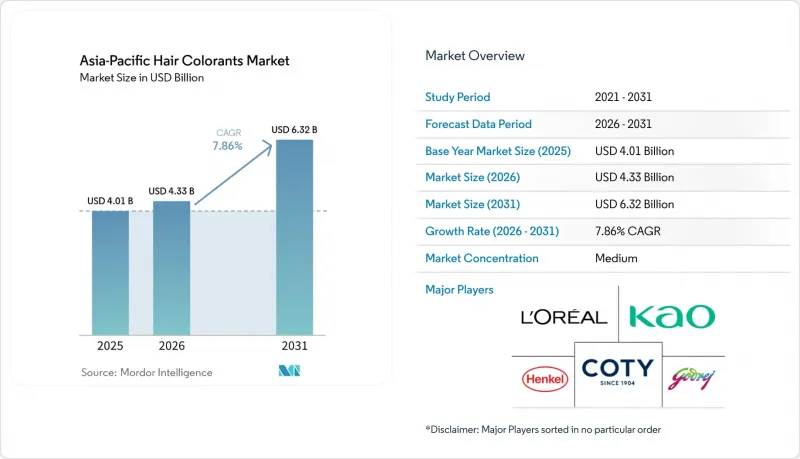
According to Mordor Intelligence, the asia-Pacific hair colorants market size is expected to grow from USD 4.01 billion in 2025 to USD 4.33 billion in 2026 and is forecast to reach USD 6.32 billion by 2031 at 7.86% CAGR over 2026-2031.
This report is Segmented by Type (Bleachers, Highlighters, Permanent Colorants, and More), Category (Mass, Premium), Distribution Channel (Health and Beauty Stores, Supermarkets/Hypermarkets, Online Retail Stores, Other Distribution Channels), and Geography (Australia, China, India, Indonesia, Japan, Malaysia, and More). The Market Forecasts are Provided in Terms of Value (USD).
Asia-Pacific Hair Colorants Market Trends and Insights
Rising disposable income and beauty consciousness
In 2024, key Asia-Pacific economies saw per-capita disposable income rise between 2.1% and 7.6%, giving beauty shoppers more discretionary funds. In Japan and South Korea, consumers earning over USD 30,000 are increasingly investing in gray-coverage products that also serve as scalp-care treatments, reflecting a growing preference for multi-functional beauty solutions. Meanwhile, younger buyers in Indonesia and Vietnam are entering the market with budget-friendly sachets, which provide an accessible entry point for first-time users. A regional consumer study revealed that over 50% of respondents would consider switching brands for products with enhanced hair-health benefits, highlighting the rising importance of innovation in product attributes. This signals to manufacturers the importance of maintaining a diverse pricing strategy: offering premium SKUs for affluent seniors who prioritize quality and efficacy, while also providing affordable, multi-benefit options for newcomers seeking value. As retailers push for localized product ranges that align with city-specific income levels, efficient assortment planning has become essential to meet the varied demands of these diverse consumer segments.
Shift toward ammonia-free and natural formulations
Brands, responding to consumer concerns over ammonia's scalp irritation and its strong odor, are reformulating their products across both premium and mass tiers. In 2024, Godrej Professional Probio made its debut, offering 100% gray coverage in 43 shades without ammonia, specifically catering to salons prioritizing comfort and safety for their clients. Wella Professionals rolled out Illumina Color, leveraging microlight technology to lighten the chemical load while maintaining color brilliance, appealing to professionals seeking high-performance yet gentle solutions. Japan has enacted a new labeling law, emphasizing patch-test warnings for products with p-phenylenediamine, further driving the industry's shift towards blends with fewer irritants to meet regulatory compliance and consumer demand for safer alternatives. In India, supply chains for henna, indigo, and amla are now adopting ISO and organic certifications, signaling a maturation in the use of botanical raw materials and ensuring higher quality and traceability standards. However, the industry faces a looming challenge: weather-related shocks that can diminish crop yields, potentially pushing a temporary reliance on synthetic substitutes, which may impact the market's focus on natural and organic formulations.
Stringent chemical-safety regulations
In 2024, Japan amended its Pharmaceutical and Medical Device Act, mandating prominent front-of-pack warnings for dyes like p-phenylenediamine and toluene-2,5-diamine. This change also extended the lead times for compliance labeling. Meanwhile, South Korea imposed a ban on 15 additional ingredients, pushing local brands to swiftly reformulate their products. In China, brands must now provide in-vivo efficacy data before they can make anti-gray or anti-hair-loss claims on their packaging. This requirement can inflate launch budgets by an additional USD 50,000-200,000 per SKU and delay the process by six to 12 months. While ASEAN has introduced a harmonized directive for mutual recognition of safety assessments, discrepancies in language-specific labeling rules continue to disrupt supply chains. Furthermore, smaller firms, often without dedicated regulatory teams, are increasingly collaborating with contract manufacturers. This shift allows them to distribute documentation costs across a broader client base.
Other drivers and restraints analyzed in the detailed report include:
- Expansion of e-commerce and social commerce
- Aging population seeking gray-coverage solutions
- Counterfeit and grey-market colorants
For complete list of drivers and restraints, kindly check the Table Of Contents.
Segment Analysis
In 2025, the Asia-Pacific hair colorants market saw permanent dyes leading the charge, accounting for 46.72% of the total revenue. Their widespread appeal can be attributed to a strong preference for long-lasting gray coverage and consistent shade retention, especially among salon-goers. Brands like Wella are at the forefront, introducing advanced formulations like Illumina Color, which reduce chemical stress and offer fade resistance for up to eight weeks. This segment thrives on its durability and the trust of mature consumers, who often prioritize reliability and quality over experimentation. Innovations in this category are increasingly emphasizing safety and sensory experiences, such as minimizing scalp irritation and enhancing the overall application process. Yet, with mid-tier competitors exerting pricing pressures, market players are compelled to invest heavily in research and development to uphold their premium status and differentiate their offerings in a competitive landscape.
Semi-permanent colorants are emerging as the region's fastest-growing segment, with projections indicating a robust 9.08% CAGR. Their rising popularity is largely fueled by Gen Z's penchant for frequent color changes, often inspired by social media trends favoring pastel and neon shades. These colorants cater to a younger demographic that values self-expression and flexibility, making them a preferred choice for temporary transformations. Moreover, lighter compliance regulations and reduced entry barriers have made these colorants more accessible, especially to younger consumers and those coloring at home. In Japan, stricter allergen labeling standards, particularly impacting oxidative dyes, are redirecting innovation budgets. Brands are now pivoting towards softer, non-sensitizing wash-out tints. Godrej and Hoyu are leading this shift, offering ammonia-free and quick-application formats. These innovations not only prioritize user comfort and time efficiency but also enhance purchase frequency through bundled aftercare products, which include conditioners and treatments designed to prolong color vibrancy and maintain hair health.
Complete Report Scope:
- By Type
- Bleachers
- Highlighters
- Permanent Colorants
- Semi-Permanent Colorants
- Temporary Colorants
- By Category
- Mass
- Premium
- By Distribution Channel
- Health and Beauty Stores
- Supermarkets/Hypermarkets
- Online Retail Stores
- Other Distribution Channels
- Country
- Australia
- China
- India
- Indonesia
- Japan
- Malaysia
- South Korea
- Thailand
- Vietnam
- Rest of Asia-Pacific
List of Companies Covered in this Report:
- L'Oreal SA
- Henkel AG & Co. KGaA
- Kao Corporation
- Coty Inc.
- Procter & Gamble Co.
- Shiseido Company, Limited
- Hoyu Co., Ltd.
- Godrej Consumer Products Ltd.
- Amorepacific Corporation
- Revlon Inc.
- Unilever PLC
- Mandom Corporation
- Natura & Co Holding S.A.
- Shanghai Zhanghua Health Care Cosmetics Sales Co., Ltd.
- Henna Industries Pvt Ltd.
- Wella Company
- Estee Lauder Companies Inc.
- Dabur India Ltd.
- Khadi Natural
- Radico
- Tints of Nature
- Manic Panic
- Liese (Kao)
- World Hair Cosmetics (Asia) Ltd.
Additional Benefits:
- The market estimate (ME) sheet in Excel format
- 3 months of analyst support
TABLE OF CONTENTS
1 INTRODUCTION
- 1.1 Study Assumptions and Market Definition
- 1.2 Scope of the Study
2 RESEARCH METHODOLOGY
3 EXECUTIVE SUMMARY
4 MARKET LANDSCAPE
- 4.1 Market Overview
- 4.2 Market Drivers
- 4.2.1 Rising disposable income and beauty consciousness
- 4.2.2 Shift toward ammonia-free and natural formulations
- 4.2.3 Expansion of e-commerce and social commerce
- 4.2.4 Aging population seeking gray-coverage solutions
- 4.2.5 AI/AR virtual try-on accelerating online sales
- 4.2.6 Govt-led "Make-in-India" herbal push
- 4.3 Market Restraints
- 4.3.1 Stringent chemical-safety regulations
- 4.3.2 Allergy and sensitivity concerns
- 4.3.3 Counterfeit/grey-market colorants
- 4.3.4 Climate-driven plant-pigment supply shocks
- 4.4 Consumer Behaviour Analysis
- 4.5 Regulatory Landscape
- 4.6 Porter's Five Forces
- 4.6.1 Bargaining Power of Suppliers
- 4.6.2 Bargaining Power of Buyers
- 4.6.3 Threat of New Entrants
- 4.6.4 Threat of Substitutes
- 4.6.5 Competitive Rivalry
5 MARKET SIZE AND GROWTH FORECASTS (VALUE)
- 5.1 By Type
- 5.1.1 Bleachers
- 5.1.2 Highlighters
- 5.1.3 Permanent Colorants
- 5.1.4 Semi-Permanent Colorants
- 5.1.5 Temporary Colorants
- 5.2 By Category
- 5.2.1 Mass
- 5.2.2 Premium
- 5.3 By Distribution Channel
- 5.3.1 Health and Beauty Stores
- 5.3.2 Supermarkets/Hypermarkets
- 5.3.3 Online Retail Stores
- 5.3.4 Other Distribution Channels
- 5.4 Country
- 5.4.1 Australia
- 5.4.2 China
- 5.4.3 India
- 5.4.4 Indonesia
- 5.4.5 Japan
- 5.4.6 Malaysia
- 5.4.7 South Korea
- 5.4.8 Thailand
- 5.4.9 Vietnam
- 5.4.10 Rest of Asia-Pacific
6 COMPETITIVE LANDSCAPE
- 6.1 Market Concentration
- 6.2 Strategic Moves
- 6.3 Market Share Analysis
- 6.4 Company Profiles (includes Global level Overview, Market level overview, Core Segments, Financials as available, Strategic Information, Market Rank/Share for key companies, Products and Services, and Recent Developments)
- 6.4.1 L'Oreal SA
- 6.4.2 Henkel AG & Co. KGaA
- 6.4.3 Kao Corporation
- 6.4.4 Coty Inc.
- 6.4.5 Procter & Gamble Co.
- 6.4.6 Shiseido Company, Limited
- 6.4.7 Hoyu Co., Ltd.
- 6.4.8 Godrej Consumer Products Ltd.
- 6.4.9 Amorepacific Corporation
- 6.4.10 Revlon Inc.
- 6.4.11 Unilever PLC
- 6.4.12 Mandom Corporation
- 6.4.13 Natura & Co Holding S.A.
- 6.4.14 Shanghai Zhanghua Health Care Cosmetics Sales Co., Ltd.
- 6.4.15 Henna Industries Pvt Ltd.
- 6.4.16 Wella Company
- 6.4.17 Estee Lauder Companies Inc.
- 6.4.18 Dabur India Ltd.
- 6.4.19 Khadi Natural
- 6.4.20 Radico
- 6.4.21 Tints of Nature
- 6.4.22 Manic Panic
- 6.4.23 Liese (Kao)
- 6.4.24 World Hair Cosmetics (Asia) Ltd.
7 MARKET OPPORTUNITIES AND FUTURE OUTLOOK

