PUBLISHER: Mordor Intelligence | PRODUCT CODE: 2072521

PUBLISHER: Mordor Intelligence | PRODUCT CODE: 2072521
Asia-Pacific Venture Capital - Market Share Analysis, Industry Trends & Statistics, Growth Forecasts (2026 - 2031)
According to Mordor Intelligence, asia-Pacific venture capital market size in 2026 is estimated at USD 296.78 billion, growing from 2025 value of USD 290.75 billion with 2031 projections showing USD 328.74 billion, growing at 2.07% CAGR over 2026-2031.
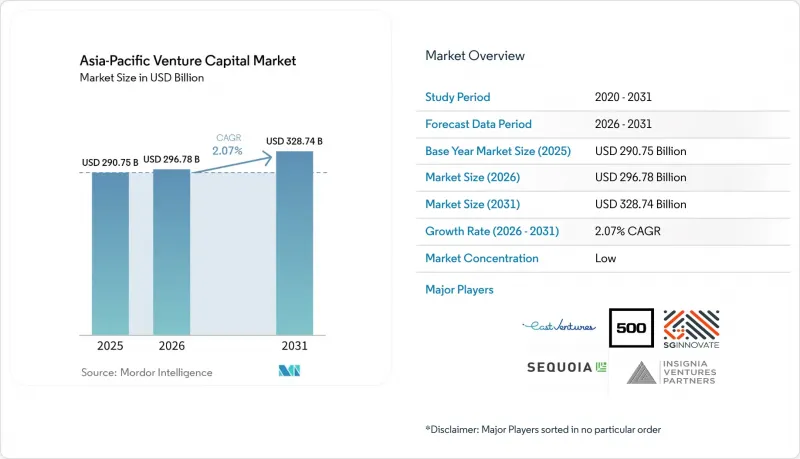
This report is Segmented by Industry Type (Fintech, Pharma and Biotech, Consumer Goods, Industrial/Energy, Other Industries), Startup Stage (Angel/Seed Investing, Early Stage Investing, Later Stage Investing), Investor Type (Local, International), and Geography (India, China, Japan, Australia, South Korea, Southeast Asia). The Market Forecasts are Provided in Terms of Value (USD).
Asia-Pacific Venture Capital Market Trends and Insights
Surge in Digital Adoption & Fintech Funding Boom
Mobile-centric behavior in Southeast Asia and India continues to elevate venture appetite as digital-payment penetration surpasses 85% in Singapore and Thailand, allowing fintech valuations to remain resilient despite global fundraising moderation . Corporate investors such as DBS Bank and OCBC spearhead strategic rounds to embed financial services in e-commerce and ride-hailing platforms, resulting in USD 12.3 billion of fintech investment during 2024. Regulatory sandboxes operating in Singapore, Hong Kong, and Malaysia accelerate experimentation by lowering compliance hurdles for early-stage firms. Central-bank digital-currency pilots further catalyze infrastructure spending that attracts venture attention. Neo-bank adoption in India and Indonesia strengthens the pipeline for credit-scoring and micro-lending solutions. Collectively, these dynamics explain why fintech captured 34% of regional deal count in 2024, reinforcing its structural prominence within the Asia-Pacific venture capital market.
Government-Backed Startup Stimulus Funds
Sovereign vehicles deployed USD 45 billion into startups across Asia-Pacific during 2024, with Singapore's Temasek expanding venture exposure by 23% and India's National Investment and Infrastructure Fund announcing a USD 2.3 billion deep-tech mandate. Japan's Innovation Network Corporation steered USD 1.8 billion toward AI and quantum computing, while Korea Development Bank created a USD 900 million climate-tech facility. Tax incentives for angel investors and fast-track visa programs complement direct capital infusions, lowering risk premiums for private funds that co-invest alongside the state. Because objectives focus on semiconductors, biotechnology, and cybersecurity, stimulus funds trim early-stage financing gaps and shorten commercialization cycles. Over the long term, such public-private alignment lifts the Asia-Pacific venture capital market by expanding investable opportunities across strategic sectors.
Regulatory Crack-downs on Tech Sectors
China's technology sector regulations impose data localization requirements and antitrust enforcement that reduce late-stage venture capital deployment by 35% during 2024, as investors reassess regulatory risk in platform businesses and consumer internet companies. The Cybersecurity Law and Personal Information Protection Law create compliance costs that disproportionately impact early-stage startups lacking dedicated legal resources, while cross-border data transfer restrictions limit international expansion opportunities for venture-backed companies. Vietnam's new securities law introduces stricter foreign ownership limits and disclosure requirements that complicate venture capital structuring, particularly for cross-border funds seeking portfolio diversification across Southeast Asian markets. Regulatory uncertainty extends investment decision timelines as venture firms conduct enhanced due diligence on regulatory compliance and government relations capabilities of potential portfolio companies.
Other drivers and restraints analyzed in the detailed report include:
- Record VC Returns Versus Public Equities
- Emergence of Secondary Markets for LP Liquidity
- Exit Bottlenecks Amid Valuation Corrections
For complete list of drivers and restraints, kindly check the Table Of Contents.
Segment Analysis
Fintech maintains dominance with a 36.20% market share in 2025, supported by digital payment infrastructure expansion and regulatory sandbox programs across Southeast Asia and India. However, pharma and biotech emerge as the fastest-growing segment at 16.09% CAGR through 2031, driven by aging demographics and government healthcare digitization initiatives. Consumer goods capture steady institutional interest through direct-to-consumer brand development, while industrial and energy sectors benefit from sustainability mandates and supply chain digitization trends. IT hardware and services experience consolidation pressure as cloud infrastructure matures, though edge computing and AI chip development create specialized investment opportunities.
The healthcare segment's acceleration reflects structural demand shifts following pandemic-driven adoption of telemedicine and digital therapeutics. EQT's Asian healthcare report identifies USD 12 billion in unmet funding needs across biotech R&D and medical device innovation, creating opportunities for specialized life sciences funds. Regulatory frameworks like Japan's PMDA fast-track approval processes and Singapore's Health Sciences Authority digital health guidelines provide clearer pathways for healthcare startup commercialization. Climate-tech investments within the industrial sector surge as corporate sustainability mandates create demand for venture-backed solutions in carbon capture, renewable energy storage, and circular economy technologies.
Complete Report Scope:
- By Industry Type
- Fintech
- Pharma and Biotech
- Consumer Goods
- Industrial/Energy
- IT/Hardware and Services
- Other Industries
- By Startup Stage
- Angel/Seed Investing
- Early Stage Investing
- Later Stage Investing
- By Investor Type
- Local
- International
- By Geography
- India
- China
- Japan
- Australia
- South Korea
- South East Asia
- Singapore
- Malaysia
- Thailand
- Indonesia
- Vietnam
- Philippines
- Rest of Asia-Pacific
List of Companies Covered in this Report:
- SoftBank Vision Fund
- Granite Asia
- Peak XV Partners (Sequoia India & SEA)
- Temasek Holdings
- Tiger Global Management
- Lightspeed Venture Partners
- Accel
- IDG Capital
- Matrix Partners China
- Shunwei Capital
- 500 Global
- Antler
- East Ventures
- SBI Investment
- NAB Ventures
- Telstra Ventures
- Samsung Ventures
- JAFCO
- Mitsui & Co. Venture Partners
- Wavemaker Partners
- Qiming Venture Partners
Additional Benefits:
- The market estimate (ME) sheet in Excel format
- 3 months of analyst support
TABLE OF CONTENTS
1 Introduction
- 1.1 Study Assumptions & Market Definition
- 1.2 Scope of the Study
2 Research Methodology
3 Executive Summary
4 Market Landscape
- 4.1 Market Overview
- 4.2 Market Drivers
- 4.2.1 Surge in digital adoption & fintech funding boom
- 4.2.2 Government-backed startup stimulus funds
- 4.2.3 Record VC returns versus public equities
- 4.2.4 Emergence of secondary markets for LP liquidity
- 4.2.5 Rise of climate-tech & sustainability funds
- 4.2.6 Cross-border syndication via ASEAN CIS & other pacts
- 4.3 Market Restraints
- 4.3.1 Regulatory crack-downs on tech sectors
- 4.3.2 Exit bottlenecks amid valuation corrections
- 4.3.3 Deep-tech talent scarcity
- 4.3.4 FX volatility for USD-denominated funds
- 4.4 Value / Supply-Chain Analysis
- 4.5 Regulatory Landscape
- 4.6 Technological Outlook
- 4.7 Porter's Five Forces
- 4.7.1 Bargaining Power of Limited Partners
- 4.7.2 Bargaining Power of Start-ups
- 4.7.3 Threat of New VC Entrants
- 4.7.4 Threat of Substitute Financing
- 4.7.5 Competitive Rivalry
5 Market Size & Growth Forecasts (Value)
- 5.1 By Industry Type
- 5.1.1 Fintech
- 5.1.2 Pharma and Biotech
- 5.1.3 Consumer Goods
- 5.1.4 Industrial/Energy
- 5.1.5 IT/Hardware and Services
- 5.1.6 Other Industries
- 5.2 By Startup Stage
- 5.2.1 Angel/Seed Investing
- 5.2.2 Early Stage Investing
- 5.2.3 Later Stage Investing
- 5.3 By Investor Type
- 5.3.1 Local
- 5.3.2 International
- 5.4 By Geography
- 5.4.1 India
- 5.4.2 China
- 5.4.3 Japan
- 5.4.4 Australia
- 5.4.5 South Korea
- 5.4.6 South East Asia
- 5.4.6.1 Singapore
- 5.4.6.2 Malaysia
- 5.4.6.3 Thailand
- 5.4.6.4 Indonesia
- 5.4.6.5 Vietnam
- 5.4.6.6 Philippines
- 5.4.7 Rest of Asia-Pacific
6 Competitive Landscape
- 6.1 Market Concentration
- 6.2 Strategic Moves
- 6.3 Market Share Analysis
- 6.4 Company Profiles (includes Global level Overview, Market level overview, Core Segments, Financials as available, Strategic Information, Market Rank/Share for key companies, Products & Services, and Recent Developments)
- 6.4.1 SoftBank Vision Fund
- 6.4.2 Granite Asia
- 6.4.3 Peak XV Partners (Sequoia India & SEA)
- 6.4.4 Temasek Holdings
- 6.4.5 Tiger Global Management
- 6.4.6 Lightspeed Venture Partners
- 6.4.7 Accel
- 6.4.8 IDG Capital
- 6.4.9 Matrix Partners China
- 6.4.10 Shunwei Capital
- 6.4.11 500 Global
- 6.4.12 Antler
- 6.4.13 East Ventures
- 6.4.14 SBI Investment
- 6.4.15 NAB Ventures
- 6.4.16 Telstra Ventures
- 6.4.17 Samsung Ventures
- 6.4.18 JAFCO
- 6.4.19 Mitsui & Co. Venture Partners
- 6.4.20 Wavemaker Partners
- 6.4.21 Qiming Venture Partners
7 Market Opportunities & Future Outlook
- 7.1 Sustainable & Impact VC Funds
- 7.2 Web3 & Metaverse Early-stage Bets

