PUBLISHER: Mordor Intelligence | PRODUCT CODE: 2072588

PUBLISHER: Mordor Intelligence | PRODUCT CODE: 2072588
Africa Management Consulting Services - Market Share Analysis, Industry Trends & Statistics, Growth Forecasts (2026 - 2031)
According to Mordor Intelligence, the africa management consulting services market size in 2026 is estimated at USD 3.89 billion, growing from 2025 value of USD 3.76 billion with 2031 projections showing USD 4.58 billion, growing at 3.34% CAGR over 2026-2031.
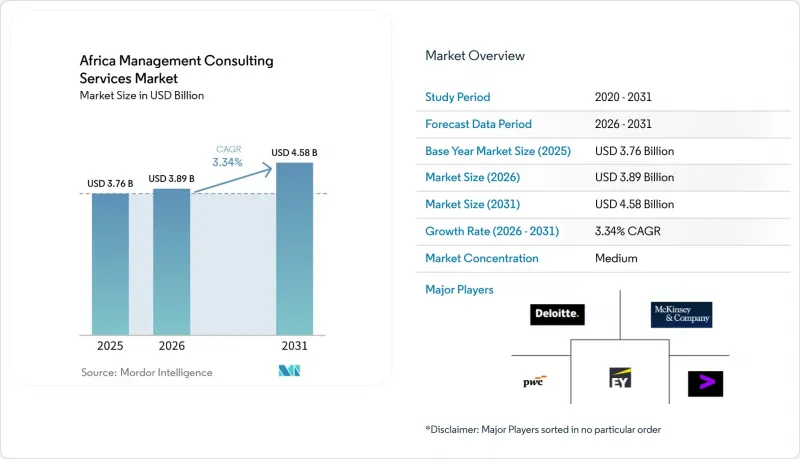
This report is Segmented by Organization Size (Large Enterprises, and Small and Medium-Sized Enterprises), Service Type (Strategy Consulting, and More), Delivery Model (On-Site Consulting, and Remote/Virtual Consulting), End-User Industry (IT and Telecommunications, Healthcare and Life Sciences, and More), and Geography. The Market Forecasts are Provided in Terms of Value (USD).
Africa Management Consulting Services Market Trends and Insights
Digital-transformation spend surge
Governments and enterprises are scaling digital-public-infrastructure projects such as identity platforms and instant-payment systems, pushing the Africa management consulting services market toward high-value technology engagements. The African tech economy is expected to reach USD 1.5 trillion by 2030, stimulating demand for AI, cloud, and cybersecurity advisory mandates. Flagship initiatives include Ghana's USD 1 billion UAE-backed tech hub and Cassava Technologies' AI factory in South Africa, each generating multi-disciplinary consulting opportunities. Mobile penetration heading toward 88% by 2030 expands the client base for digital-strategy advisory, while ethical-AI guidance anchored in the AU Continental AI Strategy heightens governance consulting needs.
Privatization and SOE restructuring wave
Large-scale unbundling of utilities, rail, and telecom assets fuels recurring consulting contracts in market-design, regulatory, and operational optimization. Eskom's separation into transmission, distribution, and generation entities underscores the complexity of these programs. Nigeria's banking reforms and South Africa's USD 1.5 billion World Bank-backed structural-reform loan further enlarge the advisory pipeline.
Talent shortage and high consultant churn
A widening skills gap pushes firms to spend heavily on recruitment and upskilling as demand for AI, cybersecurity, and ESG expertise outpaces supply. OECD analysis flags mismatches between curricula and market needs, prompting consulting engagements in vocational-training design. Elevated turnover rates further erode project continuity, increasing delivery costs and compressing margins.
Other drivers and restraints analyzed in the detailed report include:
- Supply-chain efficiency mandates
- Expanding ESG and data-privacy regulations
- Currency volatility across key economies
For complete list of drivers and restraints, kindly check the Table Of Contents.
Segment Analysis
The Africa management consulting services market size for large enterprises accounted for 78.92% market share in 2025, equating to a 78.92% Africa management consulting services market share. These corporations undertake complex restructuring, digital integration, and ESG-alignment projects that demand multidisciplinary advisory support. Ethiopian Airlines' USD 7.8 billion Bishoftu airport expansion exemplifies the scale and sophistication of engagements in this segment.
Small and medium-sized enterprises contribute a modest portion of current revenue yet represent the fastest-growing cohort, advancing at 4.73% CAGR to 2031. UNDP programs that coached more than 12,000 MSMEs on AfCFTA readiness illustrate the rising appetite for affordable, outcome-based consulting assignments. Digital self-service toolkits and modular deliverables are enabling consultancies to tap this long-tail opportunity profitably.
Operations consulting continues to dominate spend, driven by ongoing process-optimization needs in logistics, mining, and utilities. Yet technology consulting is scaling fastest, delivering a 6.58% CAGR as clients migrate to AI-enabled operating models. The launch of Africa's first AI factory by Cassava Technologies and Nvidia is set to produce knock-on advisory work in data-center design, edge-compute strategy, and regulatory alignment.
Cybersecurity, cloud migration, and data governance engagements form the core of technology pipelines, complementing broader digital strategy road-mapping. Sustainability and impact-investment advisory is emerging as an adjunct capability as enterprises embed climate-resilience metrics into digital-transformation charters.
Complete Report Scope:
- By Organization Size
- Large Enterprises
- Small and Medium-sized Enterprises
- By Service Type
- Strategy Consulting
- Operations Consulting
- HR Consulting
- Technology Consulting
- Other Service Types
- By Delivery Model
- On-site Consulting
- Remote / Virtual Consulting
- By End-user Industry
- IT and Telecommunications
- Healthcare and Life Sciences
- Financial Services (BFSI)
- Manufacturing and Industrial
- Energy and Utilities
- Government and Public Sector
- Real Estate and Construction
- Retail and Consumer Goods
- Media, Entertainment and Sports
- Hospitality and Travel
- Other Industries
- By Geography
- South Africa
- Nigeria
- Egypt
- Rest of Africa
List of Companies Covered in this Report:
- Accenture plc
- McKinsey & Company, Inc.
- Boston Consulting Group, Inc.
- Bain & Company, Inc.
- Deloitte Consulting LLP
- PricewaterhouseCoopers International Ltd (PwC)
- Ernst & Young Global Ltd (EY)
- KPMG International Ltd
- A.T. Kearney, Inc.
- Oliver Wyman Group
- Roland Berger GmbH
- Monitor Deloitte
- IQbusiness Group (Pty) Ltd
- Dalberg Global Development Advisors
- Frost & Sullivan, Inc.
- BDO South Africa Inc.
- Alexander Proudfoot Consulting LLC
- Korn Ferry
- Mercer LLC
- HKA Global Ltd
Additional Benefits:
- The market estimate (ME) sheet in Excel format
- 3 months of analyst support
TABLE OF CONTENTS
1 INTRODUCTION
- 1.1 Study Assumptions and Market Definition
- 1.2 Scope of the Study
2 RESEARCH METHODOLOGY
3 EXECUTIVE SUMMARY
4 MARKET LANDSCAPE
- 4.1 Market Overview
- 4.2 Market Drivers
- 4.2.1 Digital-transformation spend surge
- 4.2.2 Privatization and SOE restructuring wave
- 4.2.3 Supply-chain efficiency mandates
- 4.2.4 Expanding ESG and data-privacy regulations
- 4.2.5 AfCFTA-led cross-border consulting demand
- 4.2.6 Rise of impact-investment advisory
- 4.3 Market Restraints
- 4.3.1 Talent shortage and high consultant churn
- 4.3.2 Currency volatility across key economies
- 4.3.3 Cyber-risk in remote consulting delivery
- 4.3.4 Growth of internal consulting units
- 4.4 Supply-Chain Analysis
- 4.5 Regulatory Landscape
- 4.6 Technological Outlook
- 4.7 Porter's Five Forces Analysis
- 4.7.1 Threat of New Entrants
- 4.7.2 Bargaining Power of Suppliers
- 4.7.3 Bargaining Power of Buyers
- 4.7.4 Threat of Substitutes
- 4.7.5 Competitive Rivalry
5 MARKET SIZE AND GROWTH FORECASTS (VALUE)
- 5.1 By Organization Size
- 5.1.1 Large Enterprises
- 5.1.2 Small and Medium-sized Enterprises
- 5.2 By Service Type
- 5.2.1 Strategy Consulting
- 5.2.2 Operations Consulting
- 5.2.3 HR Consulting
- 5.2.4 Technology Consulting
- 5.2.5 Other Service Types
- 5.3 By Delivery Model
- 5.3.1 On-site Consulting
- 5.3.2 Remote / Virtual Consulting
- 5.4 By End-user Industry
- 5.4.1 IT and Telecommunications
- 5.4.2 Healthcare and Life Sciences
- 5.4.3 Financial Services (BFSI)
- 5.4.4 Manufacturing and Industrial
- 5.4.5 Energy and Utilities
- 5.4.6 Government and Public Sector
- 5.4.7 Real Estate and Construction
- 5.4.8 Retail and Consumer Goods
- 5.4.9 Media, Entertainment and Sports
- 5.4.10 Hospitality and Travel
- 5.4.11 Other Industries
- 5.5 By Geography
- 5.5.1 South Africa
- 5.5.2 Nigeria
- 5.5.3 Egypt
- 5.5.4 Rest of Africa
6 COMPETITIVE LANDSCAPE
- 6.1 Market Concentration
- 6.2 Strategic Moves
- 6.3 Market Share Analysis
- 6.4 Company Profiles (includes Global level Overview, Market level overview, Core Segments, Financials as available, Strategic Information, Market Rank/Share for key companies, Products and Services, and Recent Developments)
- 6.4.1 Accenture plc
- 6.4.2 McKinsey & Company, Inc.
- 6.4.3 Boston Consulting Group, Inc.
- 6.4.4 Bain & Company, Inc.
- 6.4.5 Deloitte Consulting LLP
- 6.4.6 PricewaterhouseCoopers International Ltd (PwC)
- 6.4.7 Ernst & Young Global Ltd (EY)
- 6.4.8 KPMG International Ltd
- 6.4.9 A.T. Kearney, Inc.
- 6.4.10 Oliver Wyman Group
- 6.4.11 Roland Berger GmbH
- 6.4.12 Monitor Deloitte
- 6.4.13 IQbusiness Group (Pty) Ltd
- 6.4.14 Dalberg Global Development Advisors
- 6.4.15 Frost & Sullivan, Inc.
- 6.4.16 BDO South Africa Inc.
- 6.4.17 Alexander Proudfoot Consulting LLC
- 6.4.18 Korn Ferry
- 6.4.19 Mercer LLC
- 6.4.20 HKA Global Ltd
7 MARKET OPPORTUNITIES AND FUTURE OUTLOOK
- 7.1 White-space and Unmet-Need Assessment

