PUBLISHER: Mordor Intelligence | PRODUCT CODE: 2072716

PUBLISHER: Mordor Intelligence | PRODUCT CODE: 2072716
Europe Combine Harvesters - Market Share Analysis, Industry Trends & Statistics, Growth Forecasts (2026 - 2031)
According to Mordor Intelligence, the europe combine harvesters market size was valued at USD 1.22 billion in 2025 to USD 1.28 billion in 2026, and reach USD 1.59 billion by 2031, growing at a CAGR of 4.50% over the forecast period (2026-2031).
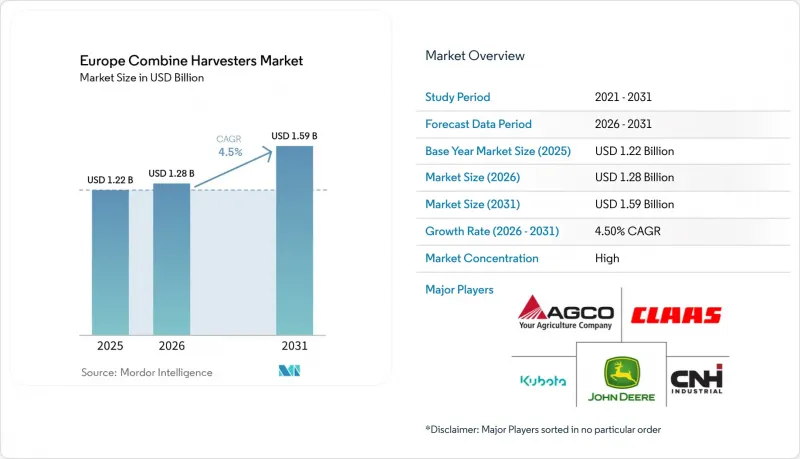
This report is Segmented by Type (Self-Propelled Combine, Tractor-Pulled Combine, and PTO-Powered Combine), by Power Output (Less Than 150 HP, 151 - 300 HP, 301 - 450 HP, and Above 450 HP), and by Geography (Germany, France, The United Kingdom, Italy, and More). The Market Forecasts are Provided in Terms of Value (USD).
Europe Combine Harvesters Market Trends and Insights
Labor Shortage and Rising Farm-Labor Costs
Increasing agricultural labor costs and ongoing worker shortages are driving the adoption of mechanization in the European combine harvesters market. In Northern Ireland, agricultural wage rates are due to rise from 1 April 2026, with official minimum hourly rates set at (£8.00 to £14.44), about USD 10.80 to USD 19.49 depending on age and grade, according to the Agricultural Wages Board . These revised rates apply to agricultural workers covered under the Agricultural Wages (Regulation) Order in Northern Ireland. Additionally, Eurostat reported continued labor-cost inflation across Europe in 2025, with labor costs increasing by 8.8% in Poland and 10.6% in Romania, as wages in Eastern Europe gradually align with those in Western Europe. These developments are prompting farmers to invest in combine harvesters to improve harvesting efficiency, reduce reliance on seasonal labor, and ensure timely crop harvesting in large-scale farming operations.
EU Common Agricultural Policy Subsidies for Mechanization
Financial support programs under the Common Agricultural Policy are reducing purchasing barriers for combine harvesters in several European countries by subsidizing a significant portion of machinery investment costs in developing agricultural regions. Poland expanded its agricultural machinery financing programs in 2025, facilitating increased equipment purchases and fleet modernization among medium- and large-scale farms. Similarly, Romania increased grant approvals for agricultural machinery investments. However, lengthy administrative processing timelines have led many farmers to rely on bridge financing and commercial loans before receiving subsidies. Variations in subsidy timing, financing access, and loan availability continue to influence short-term machinery purchasing cycles and replacement demand patterns in the European combine harvesters market.
Commodity Price Volatility Dampening Capital Expenditure
Fluctuating grain and wheat prices across Europe are creating uncertainty in farm profitability and cash flows, prompting farmers to delay investments in new combine harvesters. According to the European Commission's Short-Term Outlook, EU cereal production is projected to reach approximately 280 million tonnes in 2025/26, up around 4.1% year-over-year. This growth is projected to improve supply conditions but will also continue to exert pressure on grain prices. Despite a recovery in production volumes, lower commodity prices and uncertainty about farm returns have weakened purchasing confidence in high-value harvesting equipment. Consequently, many farmers are focusing on managing operational costs rather than replacing machinery, leading to reduced order activity and postponed capital expenditure decisions in the European combine harvesters market.
Other drivers and restraints analyzed in the detailed report include:
- Stage V Emission Norms Accelerating Fleet Replacement
- Precision-Farming and Telematics Integration
- Shortage of Service Technicians for Advanced Electronics
For complete list of drivers and restraints, kindly check the Table Of Contents.
Segment Analysis
Self-propelled combines are projected to account for 78.3% of the Europe combine harvesters market share in 2025. This dominance is driven by their widespread adoption on medium- and large-scale farms, where they enhance harvesting efficiency by combining harvesting, threshing, and grain cleaning into a single operation. Leading manufacturers, including Deere & Company and Claas KGaA mbH, are continuously improving self-propelled combines with features such as GPS steering, precision farming technologies, and real-time yield monitoring systems. In contrast, the PTO-powered segment is projected to achieve the fastest CAGR of 7.9% during 2026-2031. This growth is attributed to increasing demand from small- and medium-sized farms in Eastern European countries like Poland and Romania, where farmers prioritize lower capital investment and compatibility with existing tractor infrastructure.
The market is also experiencing rising demand for compact and mid-range combine harvesters, which cater to smaller farm operations seeking mechanized harvesting solutions at reduced ownership costs. PTO-powered combines remain attractive to price-sensitive farmers due to their simpler maintenance requirements and operational flexibility with existing tractors. However, their adoption among large commercial farming operations across Europe is limited by lower harvesting productivity and the lack of advanced automation technologies.
Complete Report Scope:
- By Type
- Self-Propelled Combine
- Tractor-Pulled Combine
- PTO-Powered Combine
- By Power Output
- Less Than 150 HP
- 151 - 300 HP
- 301 - 450 HP
- Above 450 HP
- By Geography
- Germany
- France
- United Kingdom
- Italy
- Poland
- Spain
- Rest of Europe
List of Companies Covered in this Report:
- Deere & Company
- CNH Industrial N.V.
- AGCO Corporation
- Claas KGaA mbH
- SDF S.p.A.
- Kubota Corporation
- Mahindra&Mahindra Ltd.
- Rostselmash
- Yanmar Holdings Co., Ltd.
- Gomselmash
- ISEKI & CO.,LTD.
- Tera YatIrIm Teknoloji Holding A.S. (Sampo Rosenlew)
- Weichai Lovol Intelligent Agricultural Technology CO., LTD (SDHI Group)
- YTO Group Corporation
Additional Benefits:
- The market estimate (ME) sheet in Excel format
- 3 months of analyst support
TABLE OF CONTENTS
1 Introduction
- 1.1 Study Assumptions and Market Definition
- 1.2 Scope of the Study
2 Research Methodology
3 Executive Summary
4 Market Landscape
- 4.1 Market Overview
- 4.2 Market Drivers
- 4.2.1 Labor shortage and rising farm-labor costs
- 4.2.2 EU Common Agricultural Policy subsidies for mechanization
- 4.2.3 Stage V emission norms accelerating fleet replacement
- 4.2.4 Precision-farming and telematics integration
- 4.2.5 Adoption of track-based combines to cut soil compaction
- 4.2.6 Rise of machinery-sharing cooperatives in Eastern Europe
- 4.3 Market Restraints
- 4.3.1 High purchase and maintenance costs
- 4.3.2 Commodity-price volatility dampening capital expenditure
- 4.3.3 Shortage of service technicians for advanced electronics
- 4.3.4 Grid limitations slowing electric and hybrid uptake
- 4.4 Regulatory Landscape
- 4.5 Technological Outlook
- 4.6 Porter's Five Forces Analysis
- 4.6.1 Threat of New Entrants
- 4.6.2 Bargaining Power of Suppliers
- 4.6.3 Bargaining Power of Buyers
- 4.6.4 Threat of Substitutes
- 4.6.5 Intensity of Competitive Rivalry
5 Market Size and Growth Forecasts (Value)
- 5.1 By Type
- 5.1.1 Self-Propelled Combine
- 5.1.2 Tractor-Pulled Combine
- 5.1.3 PTO-Powered Combine
- 5.2 By Power Output
- 5.2.1 Less Than 150 HP
- 5.2.2 151 - 300 HP
- 5.2.3 301 - 450 HP
- 5.2.4 Above 450 HP
- 5.3 By Geography
- 5.3.1 Germany
- 5.3.2 France
- 5.3.3 United Kingdom
- 5.3.4 Italy
- 5.3.5 Poland
- 5.3.6 Spain
- 5.3.7 Rest of Europe
6 Competitive Landscape
- 6.1 Market Concentration
- 6.2 Strategic Moves
- 6.3 Market Share Analysis
- 6.4 Company Profiles (Includes Global Level Overview, Market Level Overview, Core Segments, Financials as Available, Strategic Information, Market Rank/Share for Key Companies, Products and Services, and Recent Developments)
- 6.4.1 Deere & Company
- 6.4.2 CNH Industrial N.V.
- 6.4.3 AGCO Corporation
- 6.4.4 Claas KGaA mbH
- 6.4.5 SDF S.p.A.
- 6.4.6 Kubota Corporation
- 6.4.7 Mahindra&Mahindra Ltd.
- 6.4.8 Rostselmash
- 6.4.9 Yanmar Holdings Co., Ltd.
- 6.4.10 Gomselmash
- 6.4.11 ISEKI & CO.,LTD.
- 6.4.12 Tera YatIrIm Teknoloji Holding A.S. (Sampo Rosenlew)
- 6.4.13 Weichai Lovol Intelligent Agricultural Technology CO., LTD (SDHI Group)
- 6.4.14 YTO Group Corporation
7 Market Opportunities and Future Outlook

