PUBLISHER: Mordor Intelligence | PRODUCT CODE: 2072804

PUBLISHER: Mordor Intelligence | PRODUCT CODE: 2072804
Germany Combine Harvesters - Market Share Analysis, Industry Trends & Statistics, Growth Forecasts (2026 - 2031)
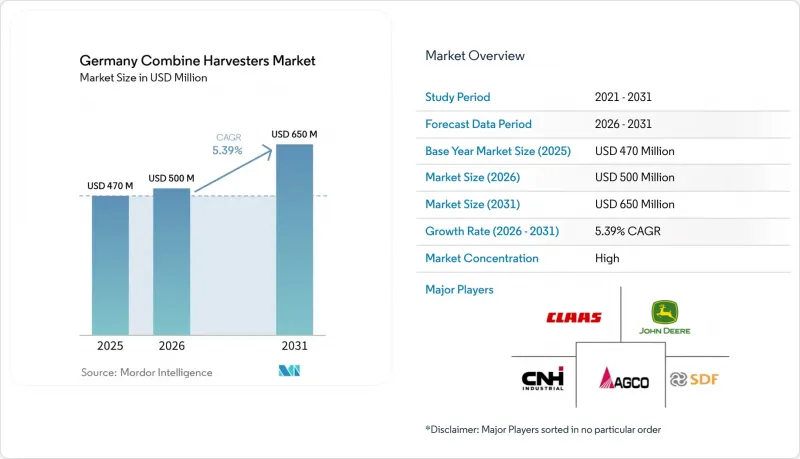
According to Mordor Intelligence, the germany combine harvesters market size was valued at USD 470 million in 2025 and is projected to reach USD 500 million in 2026 and USD 650 million by 2031, registering a CAGR of 5.39% between 2026 and 2031.
This report is Segmented by Product Type ( Wheel Combine Harvesters, Track Combine Harvesters, and Hybrid Combine Harvesters), and by Power Rating (Below 200 HP, 200 To 300 HP, and More). The Market Forecasts are Provided in Terms of Value (USD).
Germany Combine Harvesters Market Trends and Insights
European Union Stage V Emission Norms Triggering Fleet Renewal
New particulate matter and nitrogen oxide thresholds that became mandatory in 2025 rendered older combines uneconomical to retrofit. CLAAS responded by factory-filling all Stage V combine manufactured at its Harsewinkel and Le Mans plants with Hydrotreated Vegetable Oil (HVO) 100 from October 2023, enabling operators to achieve up to 90% CO2 reduction compared to fossil diesel while maintaining warranty coverage . Tight North American output has limited the pool of compliant imports, sustaining residual values and encouraging buyers to secure new inventory quickly. Stage V norms serve as a long-term driver of demand by accelerating replacement cycles, promoting the adoption of advanced technology, and supporting growth in Germany's combine harvester market.
Labor Scarcity Accelerating Demand for Automation
An aging farm workforce and fewer seasonal operators have pushed automation to the top of procurement criteria. Preliminary data for 2025 indicates that employment in Germany's agriculture, forestry, and fishing sector declined by 3,000 individuals, representing a 0.5% decrease to a total of 562,000. This reduction highlights a long-term structural decline in the sector's workforce. Cooperative farms in Eastern Germany, which consolidated large landholdings following reunification, face staffing challenges during multi-shift harvest periods. Deere's Predictive Ground Speed Automation and CNH's autonomous grain cart system enable less-experienced staff to achieve consistent throughput, offsetting labor tightness in large eastern cooperatives.
High Upfront Capital Outlay
High upfront capital requirements remain a significant restraint on Germany's combine harvesters market, as they increase the purchase barrier, extend payback periods, and delay fleet renewal, particularly for small and medium-sized farms. While Germany continues to lead Europe's combine harvesters market, the high cost burden slows replacement demand and encourages buyers to explore financing, leasing, or shared-use models instead of outright ownership. For example, in 2025, combine harvesters prices in Germany vary significantly depending on the model and specifications, with listings ranging from USD 675,648 for a John Deere S7900 to USD 318,435 for a John Deere T5500. For a 150-hectare farm, ownership costs can equate to three to five years of net income, prompting many buyers to opt for rental contracts priced at EUR 200 (USD 210) per hour, which also compresses contractor margins.
Other drivers and restraints analyzed in the detailed report include:
- Subsidized Financing from Landwirtschaftliche Rentenbank
- Precision-Agriculture Adoption Improving Return of Investment (ROI) on High-Capacity Combine
- Grain-Price Volatility Squeezing Farm Cash Flow
For complete list of drivers and restraints, kindly check the Table Of Contents.
Segment Analysis
Wheel combine harvesters accounted for the largest segment, 52% of the Germany combine harvesters market share in 2025. The dominance of wheel combine is attributed to their versatility across various soil conditions and ease of movement between fields and public roads. Their suitability for mixed farming operations and relatively straightforward mobility make them a practical choice for many German farmers. Track combine harvesters hold a smaller market share, primarily concentrated in Southern Germany's hilly terrain. For instance, CLAAS's Lexion 8500, introduced in July 2025, features a 549 HP engine and advanced suspension systems designed to reduce soil compaction in sensitive areas.
Hybrid combine harvesters are the fastest-growing segment, forecast to grow at a 9.2% CAGR from 2026 to 2031. Hybrid adoption also benefits rental fleets because lower fuel burn improves hourly margins. As battery prices drop, Original Equipment Manufacturers (OEMs) plan mid-decade rollouts that could lift the Germany combine harvesters market share for hybrids to double digits by 2031. Stricter emissions regulations and the demand for more efficient harvesting solutions are projected to drive adoption. Enhanced performance in high-output operations may also make hybrids more appealing to large commercial farms.
Complete Report Scope:
- By Product Type
- Wheel Combine Harvesters
- Track Combine Harvesters
- Hybrid Combine Harvesters
- By Power Rating
- Below 200 HP
- 200 to 300 HP
- 300 to 400 HP
- Above 400 HP
List of Companies Covered in this Report:
- CLAAS KGaA mbH
- Deere & Company
- CNH Industrial N.V.
- AGCO Corporation
- SDF S.p.A.
- Kubota Corporation
- Rostselmash Joint-Stock Company
- Lovol Heavy Industry Co., Ltd.
- Yanmar Holdings Co., Ltd.
- Sampo-Rosenlew Oy
- Arbos Group S.p.A.
- Buhler Industries Inc.
- Open Joint-Stock Company Gomselmash
- Zoomlion Heavy Industry Science & Technology Co., Ltd
- ISEKI & Co., Ltd.
Additional Benefits:
- The market estimate (ME) sheet in Excel format
- 3 months of analyst support
TABLE OF CONTENTS
1 Introduction
- 1.1 Study Assumption and Market Definition
- 1.2 Scope of the Study
2 Research Methodology
3 Executive Summary
4 Market Landscape
- 4.1 Market Overview
- 4.2 Market Drivers
- 4.2.1 European Union Stage V emission norms triggering fleet renewal
- 4.2.2 Labor scarcity accelerating demand for automation
- 4.2.3 Subsidized financing from Landwirtschaftliche Rentenbank
- 4.2.4 Precision-agriculture adoption is improving Return of Investment (ROI) on high-capacity combines
- 4.2.5 Rising biofuel-feedstock acreage needs specialty headers
- 4.2.6 Hydrotreated Vegetable Oil (HVO) ready engines lower lifecycle fuel costs
- 4.3 Market Restraints
- 4.3.1 High upfront capital outlay
- 4.3.2 Grain-price volatility is squeezing farm cash flow
- 4.3.3 Emerging state-level neonics restrictions
- 4.3.4 Shortage of dealer technicians for advanced electronics
- 4.4 Regulatory Landscape
- 4.5 Technological Outlook
- 4.6 Porter's Five Forces Analysis
- 4.6.1 Bargaining Power of Suppliers
- 4.6.2 Bargaining Power of Buyers
- 4.6.3 Threat of New Entrants
- 4.6.4 Threat of Substitute Products
- 4.6.5 Intensity of Competitive Rivalry
5 Market Size and Growth Forecasts (Value, USD)
- 5.1 By Product Type
- 5.1.1 Wheel Combine Harvesters
- 5.1.2 Track Combine Harvesters
- 5.1.3 Hybrid Combine Harvesters
- 5.2 By Power Rating
- 5.2.1 Below 200 HP
- 5.2.2 200 to 300 HP
- 5.2.3 300 to 400 HP
- 5.2.4 Above 400 HP
6 Competitive Landscape
- 6.1 Market Concentration
- 6.2 Strategic Moves
- 6.3 Market Share Analysis
- 6.4 Company Profiles (Includes Global level Overview, Market-Level Overview, Core Segments, Financials as Available, Strategic Information, Market Rank/Share for Key Companies, Products and Services, and Recent Developments)
- 6.4.1 CLAAS KGaA mbH
- 6.4.2 Deere & Company
- 6.4.3 CNH Industrial N.V.
- 6.4.4 AGCO Corporation
- 6.4.5 SDF S.p.A.
- 6.4.6 Kubota Corporation
- 6.4.7 Rostselmash Joint-Stock Company
- 6.4.8 Lovol Heavy Industry Co., Ltd.
- 6.4.9 Yanmar Holdings Co., Ltd.
- 6.4.10 Sampo-Rosenlew Oy
- 6.4.11 Arbos Group S.p.A.
- 6.4.12 Buhler Industries Inc.
- 6.4.13 Open Joint-Stock Company Gomselmash
- 6.4.14 Zoomlion Heavy Industry Science & Technology Co., Ltd
- 6.4.15 ISEKI & Co., Ltd.
7 Market Opportunities and Future Outlook

