PUBLISHER: Mordor Intelligence | PRODUCT CODE: 2072733

PUBLISHER: Mordor Intelligence | PRODUCT CODE: 2072733
United States Sex Reassignment Surgery - Market Share Analysis, Industry Trends & Statistics, Growth Forecasts (2026 - 2031)
According to Mordor Intelligence, the united states sex reassignment surgery market size is expected to grow from USD 1.64 billion in 2025 to USD 1.75 billion in 2026 and is forecast to reach USD 2.51 billion by 2031 at 7.46% CAGR over 2026-2031.
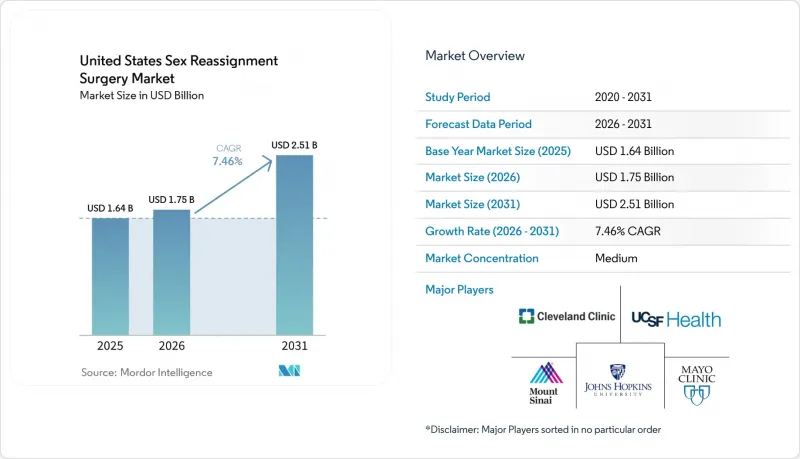
This report is Segmented by Gender Transition (FTM, MTF), Procedure (Mastectomy, Vaginoplasty, Phalloplasty, Augmentation Mammoplasty, FFS, and Others), Technology (Traditional Open Surgery, Minimally Invasive, Robotic-Assisted), End User (Hospitals, Specialty Clinics, Ascs, Others), and Distribution Channel (Public, Private Healthcare). Market Forecasts are Provided in Terms of Value (USD).
United States Sex Reassignment Surgery Market Trends and Insights
Rapid Adoption of Robotics and 3D Imaging in Complex Reconstructive Planning
Robotic platforms are raising the procedural ceiling in the United States sex reassignment surgery market by improving access, visualization, and precision in deep pelvic reconstruction. A 2025 review covering 500 robotic-assisted peritoneal vaginoplasty cases using the da Vinci Xi system reported a median neovaginal depth of 14.5 cm, a major complication rate of 4%, and a revision rate of 12%. The same review showed robotic-assisted hysterectomy in transmasculine patients produced 30 mL to 90 mL of blood loss, far below the 225 mL reported for open abdominal methods, while hospital stay remained close to laparoscopic surgery at 2.5 to 3.15 days. A 2025 paper on AI-enhanced 3D CAD/CAM guides for facial feminization reported that the digital cutting workflow was 10.2 times faster than manual planning for trained users, which points to shorter preparation time and better operating room throughput. As these methods spread through training programs, the United States sex reassignment surgery market is becoming better positioned to expand surgeon productivity without waiting for a comparable rise in highly experienced reconstructive specialists.
Persistent Growth in Gender Dysphoria Diagnoses and Care Seeking
Demand in the United States sex reassignment surgery market remains anchored in a large adult care pipeline that has continued to build even as public debate has focused heavily on minors. A 2024 cross-sectional study using 2023 insurance claims data found that gender-affirming patients generated 87% more insurance claims than non-gender-affirming patients, showing how medically active this patient group is once it enters formal care pathways. That high utilization matters because it supports recurring contact with endocrinology, mental health, primary care, and surgical programs, which increases the likelihood of patients progressing toward operative consultation. The United States sex reassignment surgery market is also less exposed than public rhetoric suggests because adult reconstructive demand is distinct from the youth-focused restrictions that have dominated policy action. This separation of demand streams keeps the core adult opportunity intact even when provider behavior becomes more cautious in contested states.
High Out-of-Pocket Cost Burden for Multi-Step Surgical Pathways
Financial exposure remains one of the clearest limits on volume realization in the United States sex reassignment surgery market. A 2025 PubMed-indexed study found that patients paying fully out of pocket for facial feminization surgery faced an average cost of USD 10,092 per procedure, versus USD 462 when insurance contributed even partially. The 2026 removal of essential health benefit treatment for gender-affirming care in ACA-compliant plans increases the risk that patients in non-mandate states will face higher deductibles, weaker protections, and tighter benefit design. That cost pressure is especially damaging in multi-step pathways because patients may begin treatment, complete early clinical requirements, and then postpone surgery when financing breaks down. The result is a larger pool of partially served patients, longer waiting lists, and fewer completed procedures converted into recognized revenue within the United States sex reassignment surgery market.
Other drivers and restraints analyzed in the detailed report include:
- Expanding Insurance Coverage and Employer Health Plan Inclusion
- Expansion of Integrated Mental Health, Hormone, and Surgical Care Pathways
- Policy Volatility Across States and Payer Authorization Friction
For complete list of drivers and restraints, kindly check the Table Of Contents.
Segment Analysis
Female-to-male procedures held 61.23% of the United States sex reassignment surgery market share in 2025, which reflected the stronger uptake of chest masculinization as an early surgical step. This part of the United States sex reassignment surgery market moved faster from diagnosis to consultation because mastectomy usually carries lower procedural complexity than genital reconstruction and broader insurer acceptance. Procedure volume for transmasculine patients was concentrated in the 25 to 34 age cohort, which accounted for 41% of surgeries, and points to patients entering care after securing more stable employment and insurance. That age profile also supports steady conversion because it aligns with the period when patients are more likely to pursue irreversible surgical steps.
Male-to-female procedures are projected to grow at 9.58% CAGR through 2031, making them the fastest-expanding transition category in the United States sex reassignment surgery market. Augmentation mammoplasty supports that growth because it offers a lower-complexity, more accessible first surgery for many patients. Transfeminine care also carries a higher average revenue per case once patients move into facial feminization, voice surgery, and vaginoplasty, which helps lift value growth even when case volumes remain tighter. WPATH SOC8 has refined candidacy standards across major programs, which has preserved a measured gap between FTM and MTF procedural flow while still supporting long-term access for both groups.
Mastectomy accounted for 21.72% share of the United States sex reassignment surgery market size in 2025, making it the leading single procedure by revenue. Its role goes beyond first-year revenue because it often opens the broader FTM pathway into hysterectomy, scrotoplasty, and phalloplasty. Broad insurance acceptance has reinforced that gateway position within the United States sex reassignment surgery market. Augmentation mammoplasty is projected to expand at 8.85% CAGR through 2031 because it combines lower complexity, shorter recovery, and wider suitability for ambulatory settings.
Vaginoplasty remains the highest-revenue procedure per case, but its expansion is still limited by the small number of surgeons and centers with deep experience. Mount Sinai completed its 1,000th gender-affirming surgery in September 2025 and scheduled more than 300 procedures in 2025 alone, which illustrates both institutional scale and the intensity of demand at top centers. Phalloplasty still carries the heaviest complication burden, and a 2024 retrospective analysis reported that 30-day complications in complex staged cases could approach 76.5%, with longer operating time standing out as the strongest predictor of major events. Mount Sinai also reported abdominal phalloplasty outcomes showing 68.3% complete tactile sensitivity and 76.1% combined satisfaction in a 63-patient cohort, which suggests that newer techniques could gradually improve adoption outside a small tertiary-care circle.
Complete Report Scope:
- By Gender Transition
- Female-to-Male
- Male-to-Female
- By Procedure
- Mastectomy
- Vaginoplasty
- Scrotoplasty
- Hysterectomy
- Phalloplasty
- Augmentation Mammoplasty
- Facial Feminization Procedures
- Voice Feminization Surgery
- Reduction Thyrochondroplasty
- Orchiectomy
- Metoidioplasty
- Chest Masculinization Surgery
- By Technology
- Traditional Open Surgery
- Minimally Invasive Techniques
- Robotic-Assisted Surgery
- By End User
- Hospitals
- Specialty Clinics
- Ambulatory Surgical Centers
- Other Healthcare Facilities
- By Distribution Channel
- Public Healthcare Systems
- Private Healthcare Providers
List of Companies Covered in this Report:
- Alignment Surgical Associates Inc.
- Boston Medical Center
- Cedars-Sinai
- Cleveland Clinic
- CNY Cosmetic and Reconstructive Surgery
- Crane Center for Transgender Surgery
- Denver Health
- Icahn School of Medicine at Mount Sinai
- Kaiser Permanente
- Mayo Clinic
- Moein Surgical Arts
- Mount Sinai Health System
- New York Presbyterian Hospital
- NYU Langone Hospitals
- Plastic Surgery Group of Rochester
- Regents of the University of Michigan
- The International Center for Transgender Care
- Transgender Surgery Institute
- UCSF Health
- University of California, San Francisco Center of Excellence for Transgender Health
- The Johns Hopkins University
Additional Benefits:
- The market estimate (ME) sheet in Excel format
- 3 months of analyst support
TABLE OF CONTENTS
1 Introduction
- 1.1 Study Assumptions & Market Definition
- 1.2 Scope of the Study
2 Research Methodology
3 Executive Summary
4 Market Landscape
- 4.1 Market Overview
- 4.2 Market Drivers
- 4.2.1 Expanding Insurance Coverage and Employer Health Plan Inclusion
- 4.2.2 Persistent Growth in Gender Dysphoria Diagnoses and Care Seeking
- 4.2.3 Greater Patient Migration to Specialized Gender-Affirming Surgery Centers
- 4.2.4 Rapid Adoption of Robotics and 3D Imaging in Complex Reconstructive Planning
- 4.2.5 U.S. State-Level Safe-Haven and Coverage Policies for Gender-Affirming Care
- 4.2.6 Expansion of Integrated Mental Health, Hormone, and Surgical Care Pathways
- 4.3 Market Restraints
- 4.3.1 High Out-of-Pocket Cost Burden for Multi-Step Surgical Pathways
- 4.3.2 Surgeon and Facility Capacity Constraints in Accredited Centers
- 4.3.3 Policy Volatility Across States and Payer Authorization Friction
- 4.3.4 Revision-Surgery Risk and Post-Operative Complication Management Burden
- 4.4 Value / Supply-Chain Analysis
- 4.5 Regulatory Landscape
- 4.6 Technological Outlook
- 4.7 Porter's Five Forces Analysis
- 4.7.1 Threat of New Entrants
- 4.7.2 Bargaining Power of Suppliers
- 4.7.3 Bargaining Power of Buyers
- 4.7.4 Threat of Substitutes
- 4.7.5 Industry Rivalry
5 Market Size & Growth Forecasts
- 5.1 By Gender Transition
- 5.1.1 Female-to-Male
- 5.1.2 Male-to-Female
- 5.2 By Procedure
- 5.2.1 Mastectomy
- 5.2.2 Vaginoplasty
- 5.2.3 Scrotoplasty
- 5.2.4 Hysterectomy
- 5.2.5 Phalloplasty
- 5.2.6 Augmentation Mammoplasty
- 5.2.7 Facial Feminization Procedures
- 5.2.8 Voice Feminization Surgery
- 5.2.9 Reduction Thyrochondroplasty
- 5.2.10 Orchiectomy
- 5.2.11 Metoidioplasty
- 5.2.12 Chest Masculinization Surgery
- 5.3 By Technology
- 5.3.1 Traditional Open Surgery
- 5.3.2 Minimally Invasive Techniques
- 5.3.3 Robotic-Assisted Surgery
- 5.4 By End User
- 5.4.1 Hospitals
- 5.4.2 Specialty Clinics
- 5.4.3 Ambulatory Surgical Centers
- 5.4.4 Other Healthcare Facilities
- 5.5 By Distribution Channel
- 5.5.1 Public Healthcare Systems
- 5.5.2 Private Healthcare Providers
6 Competitive Landscape
- 6.1 Market Concentration
- 6.2 Market Share Analysis
- 6.3 Company Profiles (includes Global level Overview, Market-level Overview, Core Segments, Financials, Strategic Information, Market Rank/Share, Products & Services, Recent Developments)
- 6.3.1 Alignment Surgical Associates Inc.
- 6.3.2 Boston Medical Center
- 6.3.3 Cedars-Sinai
- 6.3.4 Cleveland Clinic
- 6.3.5 CNY Cosmetic and Reconstructive Surgery
- 6.3.6 Crane Center for Transgender Surgery
- 6.3.7 Denver Health
- 6.3.8 Icahn School of Medicine at Mount Sinai
- 6.3.9 Kaiser Permanente
- 6.3.10 Mayo Clinic
- 6.3.11 Moein Surgical Arts
- 6.3.12 Mount Sinai Health System
- 6.3.13 New York Presbyterian Hospital
- 6.3.14 NYU Langone Hospitals
- 6.3.15 Plastic Surgery Group of Rochester
- 6.3.16 Regents of the University of Michigan
- 6.3.17 The International Center for Transgender Care
- 6.3.18 Transgender Surgery Institute
- 6.3.19 UCSF Health
- 6.3.20 University of California, San Francisco Center of Excellence for Transgender Health
- 6.3.21 The Johns Hopkins University
7 Market Opportunities & Future Outlook
- 7.1 White-space & Unmet-need Assessment

