PUBLISHER: Mordor Intelligence | PRODUCT CODE: 2072876

PUBLISHER: Mordor Intelligence | PRODUCT CODE: 2072876
United States Fencing - Market Share Analysis, Industry Trends & Statistics, Growth Forecasts (2026 - 2031)
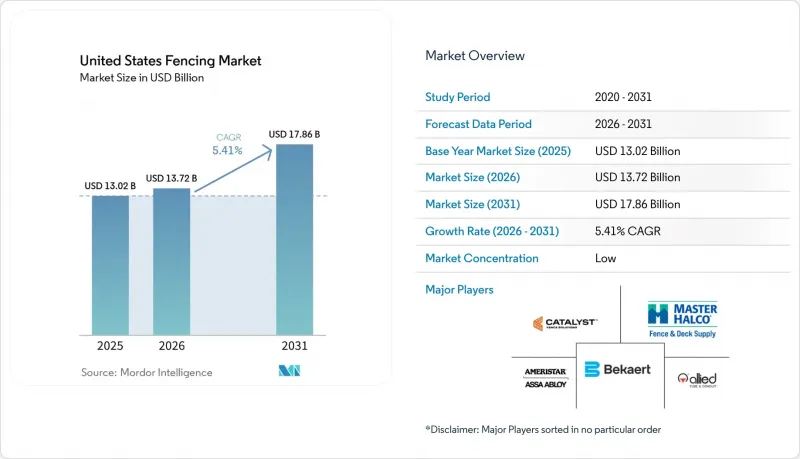
According to Mordor Intelligence, the united states fencing market size is expected to grow from USD 13.02 billion in 2025 to USD 13.72 billion in 2026 and is forecast to reach USD 17.86 billion by 2031 at 5.41% CAGR over 2026-2031.
This report is Segmented by Material (Metal, Wood, Plastic & Composite, Concrete, Others), by End-User (Residential, Agricultural, Military & Defense, and More), by Installation Type (Fixed/Permanent, Temporary/Mobile), by Installation Channel (Professional Contractor, Fabricators/DIY), and by State (Texas, California, Florida, New York, Illinois, Rest of US). Forecasts are in Value (USD)
United States Fencing Market Trends and Insights
Increasing Demand for Residential Privacy and Security Fencing Across Suburban Housing Developments
Suburban growth across Sun Belt states has created a durable base of demand for residential fencing in the United States. New single-family communities in areas such as Dallas-Fort Worth, Phoenix, and Tampa often include fencing as standard with the property rather than an optional add-on. Hybrid work patterns have also kept attention on backyard use, which supports both first-time installations and replacement demand in established neighborhoods. Homeowners are moving toward vinyl, composite, and powder-coated aluminum because long-term upkeep matters more than initial purchase price in many projects. Homeowner association rules in fast-growing communities also steer buyers toward approved designs and certified suppliers, which supports higher-value installations and steadier margins.
Growth in Commercial and Industrial Construction Driving Perimeter Security Fencing Adoption
Commercial and industrial construction pipelines continued to support perimeter security demand entering 2026 in the United States fencing market. Logistics sites, data centers, energy assets, and manufacturing facilities all require fencing that can handle higher security standards than standard residential systems. This is lifting demand for anti-climb steel panels, welded mesh, crash-rated barriers, and integrated gate systems across nonresidential projects. Solar farms, battery storage locations, and electric vehicle charging sites are adding another layer of site-specific perimeter demand, especially where owners want both physical protection and controlled access. As project scopes become more complex, fencing suppliers are being pushed toward bundled products that combine barriers, access points, and monitoring features.
High Labor and Installation Costs Increasing Overall Fencing Project Expenses
Labor availability remains a major operating challenge across the United States fencing market. Fence installation still depends heavily on skilled crews for post setting, alignment, gate placement, and finish work, especially in permanent systems. When trained crews are scarce, installers can extend lead times and bid at higher labor rates, which pushes up total project costs across residential, commercial, and agricultural jobs. That cost pressure is encouraging more interest in modular panels and pre-assembled gate units that reduce on-site work time. It also supports consolidation, as larger contractors with better crew access can take on projects that smaller local firms may struggle to staff.
Other drivers and restraints analyzed in the detailed report include:
- Rising Demand for Automated and Smart Fencing Systems in High-Security Applications
- Increasing Cross-Border Migration from Neighboring Countries Driving Demand for Border Security Fencing Infrastructure
- Fluctuating Prices of Raw Materials Such as Steel, Aluminum, and Wood Impacting Product Costs
For complete list of drivers and restraints, kindly check the Table Of Contents.
Segment Analysis
Metal fencing held 45.1% of the United States fencing market share in 2025, maintaining its leading position across material categories. That lead reflects strong demand from industrial perimeter, military, and government applications where strength, anti-climb performance, and crash resistance carry more weight than decorative value. Steel remains the primary material for agricultural and industrial work, while aluminum is more commonly used in residential and light commercial projects that require lower maintenance and cleaner finishes. Plastic and composite fencing is the fastest-growing material segment, with a projected 6.21% CAGR through 2031, as more buyers move away from wood toward materials with lower lifecycle maintenance costs.
Composite suppliers are using product longevity and premium positioning to widen their role in the United States fencing industry. Trex highlighted its outdoor living portfolio and reinforced the long-life positioning of composite products at the 2026 International Builders' Show, which supports the appeal of composite fencing in higher-value residential projects. Wood still holds a place in budget residential and rural installations because its upfront cost stays lower, and many homeowners can handle simpler installation work themselves. Concrete remains a niche option for applications such as noise barriers and high-security perimeters. In contrast, other materials, such as recycled polymer mesh and bamboo, remain limited to small, sustainability-focused pockets. The main change in this segment is not the disappearance of metal, but rather the steady shift in premium toward coated, composite, and longer-life products.
Residential end users accounted for 38.7% of the United States fencing market in 2025, making housing-related demand the largest end-use segment. This position reflects the direct link between single-family housing turnover, suburban construction, privacy upgrades, and backyard improvement spending. Many new homeowners install fencing soon after purchase, while established households continue to replace aging systems as part of outdoor renovation programs. Agricultural fencing is the fastest-growing end-use segment, with a 6.34% CAGR through 2031, supported by conservation-linked installation support and by wider use of smart electric fencing across large-acreage livestock operations.
The agricultural push matters because it broadens the United States fencing market beyond consumer-led demand. The U.S. Department of Agriculture reported a cattle inventory of 94.4 million head in 2024, indicating a large installed base of fencing across livestock operations and a recurring need for repair and replacement. Military and defense users remain important premium buyers because they require crash-rated barriers, taller anti-climb panels, and integrated monitoring systems. Government, mining, petroleum and chemicals, and energy and power users add another layer of non-discretionary demand because fencing in those settings is tied to safety and asset protection rather than appearance. This spread of end users helps the United States fencing industry remain more resilient than markets tied to a single construction category.
Complete Report Scope:
- By Material
- Metal
- Steel
- Aluminium
- Wood
- Plastic & Composite
- Concrete
- Other Materials
- Metal
- By End-User
- Residential
- Agricultural
- Military & Defense
- Government
- Mining
- Petroleum & Chemicals
- Energy & Power
- Other End-Users
- By Installation Type
- Fixed / Permanent Fencing
- Temporary / Mobile Fencing
- By Installation Channel
- Professional Contractor
- Others - Fabricators, DIY / Modular Kits
- By State
- Texas
- California
- Florida
- New York
- Illinois
- Rest of US
List of Companies Covered in this Report:
- Catalyst Fence Solutions
- Master Halco
- Ameristar Perimeter Security
- Bekaert Fencing
- Allied Tube & Conduit
- Fortress Building Products
- Merchants Metals
- Gregory Industries
- Eastern Wholesale Fence
- SpecRail
- Long Fence
- Stephens Pipe & Steel
- Ultra Aluminum Mfg.
- Jamieson Fence Supply
- Jerith Manufacturing LLC
- Ametco Manufacturing
- Pexco LLC (PDS Fence Products)
- Wheatland Tube
- Sharon Fence
- Ply Gem Residential Solutions
Additional Benefits:
- The market estimate (ME) sheet in Excel format
- 3 months of analyst support
TABLE OF CONTENTS
1 Introduction
- 1.1 Study Assumptions & Market Definition
- 1.2 Scope of the Study
2 Research Methodology
3 Executive Summary
4 Market Insights and Dynamics
- 4.1 Market Overview
- 4.2 Market Drivers
- 4.2.1 Increasing demand for residential privacy and security fencing across suburban housing developments
- 4.2.2 Growth in commercial and industrial construction driving perimeter security fencing adoption
- 4.2.3 Rising demand for automated and smart fencing systems in high-security applications
- 4.2.4 Increasing cross-border migration from neighboring countries driving demand for border security fencing infrastructure
- 4.2.5 Growing agricultural fencing needs for livestock management and land protection
- 4.2.6 Increasing focus on wildlife conservation and highway safety driving installation of wildlife fencing
- 4.3 Market Restraints
- 4.3.1 High labor and installation costs increasing overall fencing project expenses
- 4.3.2 Fluctuating prices of raw materials such as steel, aluminum, and wood impacting product costs
- 4.3.3 Strict zoning laws and local regulations limiting fencing installations in certain areas
- 4.4 Value / Supply-Chain Analysis
- 4.5 Regulatory Landscape
- 4.6 Technology & Innovation Trends
- 4.7 Porter's Five Forces
- 4.7.1 Bargaining Power of Suppliers
- 4.7.2 Bargaining Power of Consumers
- 4.7.3 Threat of New Entrants
- 4.7.4 Threat of Substitutes
- 4.7.5 Intensity of Competitive Rivalry
- 4.8 Pricing Analysis
- 4.9 Sustainability & Eco-Friendly Material Trends
- 4.10 Border Security Framework & Deployment Trends
5 Market Size & Growth Forecasts (Value, USD)
- 5.1 By Material
- 5.1.1 Metal
- 5.1.1.1 Steel
- 5.1.1.2 Aluminium
- 5.1.2 Wood
- 5.1.3 Plastic & Composite
- 5.1.4 Concrete
- 5.1.5 Other Materials
- 5.1.1 Metal
- 5.2 By End-User
- 5.2.1 Residential
- 5.2.2 Agricultural
- 5.2.3 Military & Defense
- 5.2.4 Government
- 5.2.5 Mining
- 5.2.6 Petroleum & Chemicals
- 5.2.7 Energy & Power
- 5.2.8 Other End-Users
- 5.3 By Installation Type
- 5.3.1 Fixed / Permanent Fencing
- 5.3.2 Temporary / Mobile Fencing
- 5.4 By Installation Channel
- 5.4.1 Professional Contractor
- 5.4.2 Others - Fabricators, DIY / Modular Kits
- 5.5 By State
- 5.5.1 Texas
- 5.5.2 California
- 5.5.3 Florida
- 5.5.4 New York
- 5.5.5 Illinois
- 5.5.6 Rest of US
6 Competitive Landscape
- 6.1 Market Concentration
- 6.2 Strategic Moves
- 6.3 Market Share Analysis
- 6.4 Company Profiles {(includes Global level Overview, Market level overview, Core Segments, Financials as available, Strategic Information, Products & Services, and Recent Developments)}
- 6.4.1 Catalyst Fence Solutions
- 6.4.2 Master Halco
- 6.4.3 Ameristar Perimeter Security
- 6.4.4 Bekaert Fencing
- 6.4.5 Allied Tube & Conduit
- 6.4.6 Fortress Building Products
- 6.4.7 Merchants Metals
- 6.4.8 Gregory Industries
- 6.4.9 Eastern Wholesale Fence
- 6.4.10 SpecRail
- 6.4.11 Long Fence
- 6.4.12 Stephens Pipe & Steel
- 6.4.13 Ultra Aluminum Mfg.
- 6.4.14 Jamieson Fence Supply
- 6.4.15 Jerith Manufacturing LLC
- 6.4.16 Ametco Manufacturing
- 6.4.17 Pexco LLC (PDS Fence Products)
- 6.4.18 Wheatland Tube
- 6.4.19 Sharon Fence
- 6.4.20 Ply Gem Residential Solutions
7 Market Opportunities & Future Outlook
- 7.1 White-space & Unmet-need Assessment

