PUBLISHER: Mordor Intelligence | PRODUCT CODE: 2072901

PUBLISHER: Mordor Intelligence | PRODUCT CODE: 2072901
South America Insect Feed - Market Share Analysis, Industry Trends & Statistics, Growth Forecasts (2026 - 2031)
According to Mordor Intelligence, the south america insect feed market size was valued at USD 86.49 million in 2025 and is estimated to grow from USD 100.50 million in 2026 to reach USD 189.30 million by 2031, at a CAGR of 13.50% during the forecast period (2026-2031).
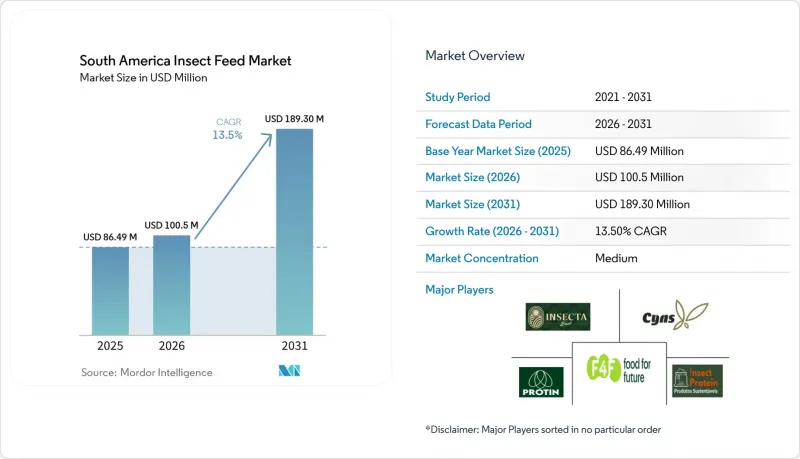
This report is Segmented by Insect Species (Black Soldier Fly, Mealworm, Housefly, and Others), by Product Form (Protein Meal, Whole Dried Larvae, Insect Oil, and Frass Fertilizer), by Animal Type (Aquaculture, Poultry, Swine, Ruminants, and Pets), and by Geography (Brazil, Argentina, Chile, Colombia, and Rest of South America). The Report Offers the Market Size and Forecasts in Terms of Value (USD).
South America Insect Feed Market Trends and Insights
Aquaculture Feed Formulators Seeking Fishmeal Replacement
The South America insect feed market is getting one of its strongest boosts from aquaculture, as salmon, shrimp, and tilapia producers all face periodic pressure on fishmeal prices. Peru's anchoveta catch variability continues to affect feed economics across the region, keeping alternative proteins in active evaluation by formulators. Production growth matters for the South America insect feed market because each step up in shrimp, salmon, and tilapia output increases the need for reliable protein inputs less exposed to marine raw material swings. BioMar, InnovaFeed, and Auchan moved this issue closer to commercial scale in September 2025 through a partnership with Ecuador's shrimp feed chain, demonstrating that insect meal is being positioned as a practical ingredient rather than a trial concept. The South America insect feed market also benefits when insect meal delivers both protein and functional value, as this reduces the effective gap with conventional ingredients in aquafeed formulas.
Pet Food Premiumization and Hypoallergenic Protein Demand
Pet food is driving a different type of demand in the South America insect feed market, as buyers in this channel are less sensitive to commodity protein pricing. Insect protein fits well into elimination diets and sensitive-digestion formulas because it is a novel protein for many pets and can support premium positioning. Hill's Pet Nutrition launched its Sensitive Stomach and Skin line in Brazil in February 2025, and the launch showed that insect protein had moved into a mainstream retail setting instead of remaining a niche experiment. Special Dog followed in August 2025 with Bionatural Sensitive, and Circular Pet launched a hypoallergenic insect-protein dog food in Chile in October 2025, confirming that the demand pattern was spreading across multiple countries. This matters for the South America insect feed market because premium pet food can absorb higher ingredient costs more easily than poultry or swine feed, making it an important early revenue stream for regional producers. The pace is still linked to regulatory progress, but the commercial signal from these launches is already clear.
Price Gap Versus Soybean Meal and Fishmeal
The biggest commercial restraint on the South America insect feed market is still price. Soybean meal remains deeply embedded in regional feed formulas, and it is supported by large domestic production systems that insect producers have not yet matched in scale. The gap narrows when fishmeal markets tighten, but it widens again when conventional protein markets stabilize, making demand more cyclical than steady in some applications. Production systems have improved between 2020 and 2025, but many South American plants are still operating at a scale where automated rearing and processing cannot drive a major cost reset. That keeps the South America insect feed market strongest in premium applications and controlled inclusion rates rather than broad commodity adoption.
Other drivers and restraints analyzed in the detailed report include:
- Circular Use of Agro-Industrial Byproducts for Larvae Substrate
- Poultry and Swine Feed Diversification Away from Soy Dependence
- Regulatory Inconsistency Across Feed and Organic Waste Rules
For complete list of drivers and restraints, kindly check the Table Of Contents.
Segment Analysis
Black Soldier Fly held 61.6% of the South America insect feed market share in 2025, reflecting its lead in scale, feed conversion, and adaptability to local organic side streams. Mealworm is the fastest-growing species segment, with a 12.9% CAGR through 2031, and its momentum is mainly driven by premium pet food and other higher-value nutrition applications. The South America insect feed market has favored black soldier fly so far because it fits the region's main applications in aquaculture, poultry, and swine more directly than other species. That lead is also supported by the fact that regional producers such as Cyns and Bioconversion have built their commercial positioning around black soldier fly-based ingredients.
Mealworm is expanding its presence by targeting demand areas that do not directly compete with the primary volume applications of black soldier fly. Insecta Brasil has positioned mealworm-based products for use in fish, bird, swine, and pet nutrition, indicating that this species is carving out a niche in specialized nutrition rather than attempting to replace black soldier fly in bulk feed markets. Crickets continue to occupy a niche role in the South America insect feed market, with greater relevance in pet and novelty products compared to mainstream feed formulations. Houseflies and other insect species remain in the early stages of commercialization, with most advancements limited to pilot projects and selective product development rather than widespread market supply. Consequently, the South America insect feed market is projected to remain focused on black soldier fly for high-volume applications, while mealworm continues to grow in segments where premium buyers can sustain its pricing.
Complete Report Scope:
- By Insect Species
- Black Soldier Fly
- Mealworm
- Housefly
- Others
- By Product Form
- Protein Meal
- Whole Dried Larvae
- Insect Oil
- Frass Fertilizer
- By Animal Type
- Aquaculture
- Poultry
- Swine
- Ruminants
- Pets
- By Geography
- Brazil
- Argentina
- Chile
- Colombia
- Rest of South America
List of Companies Covered in this Report:
- Cyns
- Protin Biotech
- !nsect Protein
- Insecta Brasil
- Food for the Future
- BIOPROT
- Buzz Fly
- Insectius
- Protix B.V.
- InnovaFeed SAS
- Entobel
- HiProMine S.A.
- Hexafly
- Beta Hatch
- Sentara Group
Additional Benefits:
- The market estimate (ME) sheet in Excel format
- 3 months of analyst support
TABLE OF CONTENTS
1 Introduction
- 1.1 Study Assumptions and Market Definition
- 1.2 Scope of the Study
2 Research Methodology
3 Executive Summary
4 Market Landscape
- 4.1 Market Overview
- 4.2 Market Drivers
- 4.2.1 Aquaculture feed formulators seeking fishmeal replacement
- 4.2.2 Pet food premiumization and hypoallergenic protein demand
- 4.2.3 Circular use of agro-industrial byproducts for larvae substrate
- 4.2.4 Poultry and swine feed diversification away from soy dependence
- 4.2.5 Export decarbonization audits favoring low-footprint feed inputs
- 4.2.6 Frass monetization improving insect plant unit economics
- 4.3 Market Restraints
- 4.3.1 Price gap versus soybean meal and fishmeal
- 4.3.2 Regulatory inconsistency across feed and organic waste rules
- 4.3.3 Seasonal inconsistency in compliant pre-consumer feedstock streams
- 4.3.4 Limited drying and oil-stabilization infrastructure for scale
- 4.4 Regulatory Landscape
- 4.5 Technological Outlook
- 4.6 Porter's Five Forces
- 4.6.1 Threat of New Entrants
- 4.6.2 Bargaining Power of Suppliers
- 4.6.3 Bargaining Power of Buyers
- 4.6.4 Threat of Substitutes
- 4.6.5 Intensity of Competitive Rivalry
5 Market Size and Growth Forecasts (Value)
- 5.1 By Insect Species
- 5.1.1 Black Soldier Fly
- 5.1.2 Mealworm
- 5.1.3 Housefly
- 5.1.4 Others
- 5.2 By Product Form
- 5.2.1 Protein Meal
- 5.2.2 Whole Dried Larvae
- 5.2.3 Insect Oil
- 5.2.4 Frass Fertilizer
- 5.3 By Animal Type
- 5.3.1 Aquaculture
- 5.3.2 Poultry
- 5.3.3 Swine
- 5.3.4 Ruminants
- 5.3.5 Pets
- 5.4 By Geography
- 5.4.1 Brazil
- 5.4.2 Argentina
- 5.4.3 Chile
- 5.4.4 Colombia
- 5.4.5 Rest of South America
6 Competitive Landscape
- 6.1 Market Concentration
- 6.2 Strategic Moves
- 6.3 Market Share Analysis
- 6.4 Company Profiles (Includes Global Level Overview, Market Level Overview, Core Segments, Financials as Available, Strategic Information, Market Rank/Share for Key Companies, Products and Services, and Recent Developments)
- 6.4.1 Cyns
- 6.4.2 Protin Biotech
- 6.4.3 !nsect Protein
- 6.4.4 Insecta Brasil
- 6.4.5 Food for the Future
- 6.4.6 BIOPROT
- 6.4.7 Buzz Fly
- 6.4.8 Insectius
- 6.4.9 Protix B.V.
- 6.4.10 InnovaFeed SAS
- 6.4.11 Entobel
- 6.4.12 HiProMine S.A.
- 6.4.13 Hexafly
- 6.4.14 Beta Hatch
- 6.4.15 Sentara Group
7 Market Opportunities and Future Outlook

