PUBLISHER: Mordor Intelligence | PRODUCT CODE: 2073038

PUBLISHER: Mordor Intelligence | PRODUCT CODE: 2073038
Bourbon - Market Share Analysis, Industry Trends & Statistics, Growth Forecasts (2026 - 2031)
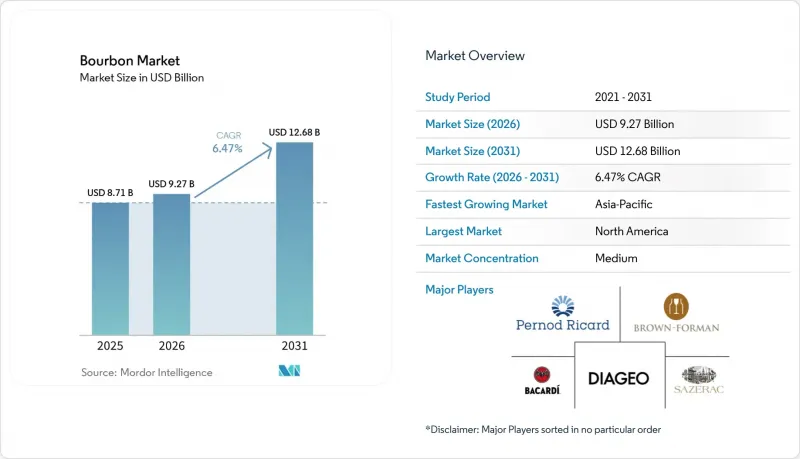
According to Mordor Intelligence, the bourbon market size is expected to grow from USD 8.71 billion in 2025 to USD 9.27 billion in 2026 and is forecast to reach USD 12.68 billion by 2031 at 6.5% CAGR over 2026-2031.
This report is Segmented by Product Type (Straight Bourbon, Small Batch Bourbon, Single Barrel Bourbon, Flavored Bourbon, Other Bourbons), Distribution Channel (On-Trade and Off-Trade), and Geography (North America, Europe, Asia-Pacific, South America, Middle East and Africa). The Market Forecasts are Provided in Terms of Value (USD) and Volume (Litres).
Global Bourbon Market Trends and Insights
Growing global demand for premium and super-premium spirits
The increasing consumer inclination toward premium and super-premium alcoholic beverages is a major factor supporting the growth of the bourbon market. Consumers are increasingly willing to spend more on high-quality spirits that offer superior craftsmanship, distinctive flavor profiles, and authentic heritage. This shift is particularly evident among younger legal-age drinkers and affluent consumers who prioritize quality and unique drinking experiences over volume consumption. Premium bourbons, including small-batch, single-barrel, and aged expressions, have gained popularity due to their perceived exclusivity and artisanal production methods. In addition, the growing culture of spirit appreciation, whiskey tasting events, and collector interest has further elevated demand for premium bourbon products. Distillers are responding by expanding their portfolios with limited-edition and high-end offerings to capture evolving consumer preferences.
Rising popularity of bourbon-based cocktails
The rising popularity of bourbon-based cocktails is supporting strong growth in the bourbon market. Consumers are increasingly embracing classic cocktails such as Old Fashioneds, Manhattans, and Whiskey Sours, driving greater bourbon consumption across bars and restaurants. The expansion of cocktail culture, coupled with growing interest in premium spirits, has enhanced bourbon's appeal among younger consumers. Hospitality venues are also broadening their bourbon-focused beverage offerings to meet evolving consumer preferences. For instance, the Australian Bureau of Statistics reported that 6,961 bars, pubs, and taverns were operating across Australia in 2024, providing a strong foundation for the country's expanding cocktail scene. As cocktail consumption continues to increase globally, demand for bourbon is expected to benefit from greater on-premise consumption and consumer experimentation.
Stringent alcohol regulations and advertising restrictions
Stringent alcohol regulations and advertising restrictions present a challenge to the growth of the bourbon market. Governments across many countries impose strict rules governing alcohol production, labeling, marketing, distribution, and sales to address public health concerns and promote responsible consumption. Restrictions on advertising across television, digital media, sponsorships, and public events can limit brand visibility and reduce opportunities for consumer engagement. In addition, varying regulatory frameworks across regions increase compliance costs and operational complexity for bourbon producers seeking international expansion. Higher excise duties, licensing requirements, and sales restrictions may also impact product affordability and market accessibility. These regulatory barriers can slow market penetration and constrain growth opportunities, particularly in emerging markets where alcohol regulations are becoming increasingly stringent.
Other drivers and restraints analyzed in the detailed report include:
- Expansion of craft distilleries and small-batch bourbon offerings
- Growing disposable incomes supporting premium alcohol purchases
- Rising excise taxes on alcoholic beverages
For complete list of drivers and restraints, kindly check the Table Of Contents.
Segment Analysis
Straight Bourbon held a 48.71% share of the bourbon market in 2025, driven by its strong brand equity, adherence to clear legal standards, and consistent collector interest in its single-barrel and barrel-proof releases. The segment remains central to the bourbon market because producers age Straight Bourbon for at least two years and exclude additives, which solidifies its quality position and sets it apart from lower-tier formats. Small Batch and Single Barrel Bourbons strengthen the premium segment by providing consumers with a clear upgrade path from standard labels. These premium offerings also enable major producers to maintain pricing, as consumers who choose these formats focus more on character and scarcity than on price. Sazerac's strategic positioning at Buffalo Trace post-expansion highlights the strong demand for premium labels, justifying significant long-term capacity investments.
Flavored Bourbon are projected to grow at a 7.83% CAGR through 2031, making it the fastest-growing segment in the bourbon market. Newer drinkers seeking approachable taste profiles and bars incorporating flavored variants into popular mixed drinks drive this growth. The 2025 TTB update introduced container fill standards for formats like 180mL, 300mL, and 473mL, which enhance the marketability of smaller flavored expressions and trial packs in retail and hospitality. Meanwhile, Other Bourbons, including blended and wheated styles, serve entry-level bourbon enthusiasts but face increased competition from low-alcohol alternatives and ready-to-drinks (RTDs).
Complete Report Scope:
- By Product Type
- Straight Bourbon
- Small Batch Bourbon
- Single Barrel Bourbon
- Flavored Product Types
- Other Bourbons
- By Distribution Channel
- On-Trade
- Off-Trade
- Specialty/Liquor Stores
- Supermarkets/Hypermarkets
- Other Off Trade Channels
- By Geography
- North America
- United States
- Canada
- Mexico
- Rest of North America
- Europe
- United Kingdom
- Germany
- France
- Italy
- Spain
- Netherlands
- Sweden
- Belgium
- Poland
- Rest of Europe
- Asia-Pacific
- China
- Japan
- India
- South Korea
- Australia
- Indonesia
- Thailand
- Singapore
- Rest of Asia-Pacific
- South America
- Brazil
- Argentina
- Chile
- Colombia
- Peru
- Rest of South America
- Middle East and Africa
- United Arab Emirates
- South Africa
- Saudi Arabia
- Nigeria
- Egypt
- Morocco
- Turkey
- Rest of Middle East and Africa
- North America
Geography Analysis
North America dominated the global bourbon market in 2025, accounting for 68.11% of total revenue. The region's leadership is primarily driven by the United States, which is both the birthplace and largest producer of bourbon whiskey. Strong consumer familiarity with bourbon, a well-established distilling industry, and a rich heritage associated with American whiskey continue to support high consumption levels. Premiumization trends, growing interest in craft and small-batch bourbons, and strong brand loyalty among consumers have further strengthened market demand. The presence of major bourbon producers, extensive distribution networks, and a vibrant on-trade culture also contribute to the region's substantial market share.
Asia-Pacific is projected to be the fastest-growing regional market for bourbon, registering a CAGR of 8.27% through 2031. Rapid urbanization, rising disposable incomes, and evolving consumer preferences toward premium alcoholic beverages are driving bourbon consumption across the region. Younger consumers in countries such as China, India, Japan, South Korea, and Australia are increasingly exploring international spirits and cocktail culture, creating favorable conditions for bourbon brands. The expansion of premium bars, restaurants, and hospitality establishments has also enhanced product visibility and accessibility.
Europe's bourbon market grows steadily, driven by strong consumer demand for premium spirits, a thriving cocktail culture, and imported American whiskey. The UK, Germany, France, and Spain report rising interest in premium and craft bourbon. In South America, urbanization, a growing middle class, and increasing demand for premium alcoholic beverages drive growth, particularly in Brazil, Argentina, and Chile. The Middle East & Africa region, though smaller, is gaining momentum due to expanding tourism, hospitality, and luxury dining sectors. Exposure to global beverage trends and premium spirit brands creates new opportunities in these regions.
- Brown-Forman Corporation
- Sazerac Company, Inc.
- Beam Suntory Inc.
- Diageo plc
- Campari Group (Davide Campari-Milano N.V.)
- Ross & Squibb Distillery, LLC
- Pernod Ricard SA
- Bacardi Limited
- Luxco, Inc.
- Heaven Hill Distilleries, Inc.
- The Edrington Group Limited
- Kirin Holdings Company, Limited
- Constellation Brands, Inc.
- Stock Spirits Group PLC
- Mast-Jagermeister SE
- Deutsch Family Wine & Spirits, Inc.
- Stoli Group S.a r.l.
- Castle Brands Inc.
- Wilderness Trail Distillery, LLC
- Garrison Brothers Distillery, LLC
Additional Benefits:
- The market estimate (ME) sheet in Excel format
- 3 months of analyst support
TABLE OF CONTENTS
1 INTRODUCTION
- 1.1 Study Assumptions and Market Definition
- 1.2 Scope of the Study
2 RESEARCH METHODOLOGY
3 EXECUTIVE SUMMARY
4 MARKET LANDSCAPE
- 4.1 Market Overview
- 4.2 Market Drivers
- 4.2.1 Growing global demand for premium and super-premium spirits
- 4.2.2 Rising popularity of bourbon-based cocktails
- 4.2.3 Increasing consumer interest in American whiskey products
- 4.2.4 Expansion of craft distilleries and small-batch bourbon offerings
- 4.2.5 Growing disposable incomes supporting premium alcohol purchases
- 4.2.6 Rising demand for aged and limited-edition bourbons
- 4.3 Market Restraints
- 4.3.1 Stringent alcohol regulations and advertising restrictions
- 4.3.2 Rising excise taxes on alcoholic beverages
- 4.3.3 Increasing health concerns related to alcohol consumption
- 4.3.4 Growing popularity of low-alcohol and non-alcoholic alternatives
- 4.4 Consumer Behaviour Analysis
- 4.5 Regulatory Outlook
- 4.6 Porter's Five Forces Analysis
- 4.6.1 Bargaining Power of Suppliers
- 4.6.2 Bargaining Power of Buyers
- 4.6.3 Threat of New Entrants
- 4.6.4 Threat of Substitutes
- 4.6.5 Intensity of Competitive Rivalry
5 MARKET SIZE AND GROWTH FORECASTS (VALUE AND VOLUME)
- 5.1 By Product Type
- 5.1.1 Straight Bourbon
- 5.1.2 Small Batch Bourbon
- 5.1.3 Single Barrel Bourbon
- 5.1.4 Flavored Product Types
- 5.1.5 Other Bourbons
- 5.2 By Distribution Channel
- 5.2.1 On-Trade
- 5.2.2 Off-Trade
- 5.2.2.1 Specialty/Liquor Stores
- 5.2.2.2 Supermarkets/Hypermarkets
- 5.2.2.3 Other Off Trade Channels
- 5.3 By Geography
- 5.3.1 North America
- 5.3.1.1 United States
- 5.3.1.2 Canada
- 5.3.1.3 Mexico
- 5.3.1.4 Rest of North America
- 5.3.2 Europe
- 5.3.2.1 United Kingdom
- 5.3.2.2 Germany
- 5.3.2.3 France
- 5.3.2.4 Italy
- 5.3.2.5 Spain
- 5.3.2.6 Netherlands
- 5.3.2.7 Sweden
- 5.3.2.8 Belgium
- 5.3.2.9 Poland
- 5.3.2.10 Rest of Europe
- 5.3.3 Asia-Pacific
- 5.3.3.1 China
- 5.3.3.2 Japan
- 5.3.3.3 India
- 5.3.3.4 South Korea
- 5.3.3.5 Australia
- 5.3.3.6 Indonesia
- 5.3.3.7 Thailand
- 5.3.3.8 Singapore
- 5.3.3.9 Rest of Asia-Pacific
- 5.3.4 South America
- 5.3.4.1 Brazil
- 5.3.4.2 Argentina
- 5.3.4.3 Chile
- 5.3.4.4 Colombia
- 5.3.4.5 Peru
- 5.3.4.6 Rest of South America
- 5.3.5 Middle East and Africa
- 5.3.5.1 United Arab Emirates
- 5.3.5.2 South Africa
- 5.3.5.3 Saudi Arabia
- 5.3.5.4 Nigeria
- 5.3.5.5 Egypt
- 5.3.5.6 Morocco
- 5.3.5.7 Turkey
- 5.3.5.8 Rest of Middle East and Africa
- 5.3.1 North America
6 COMPETITIVE LANDSCAPE
- 6.1 Market Concentration
- 6.2 Strategic Moves
- 6.3 Market Share Analysis
- 6.4 Company Profiles (Includes Company Highlights, Strategic Information, Core Segments, Financials, Products & Services, Recent Developments)
- 6.4.1 Brown-Forman Corporation
- 6.4.2 Sazerac Company, Inc.
- 6.4.3 Beam Suntory Inc.
- 6.4.4 Diageo plc
- 6.4.5 Campari Group (Davide Campari-Milano N.V.)
- 6.4.6 Ross & Squibb Distillery, LLC
- 6.4.7 Pernod Ricard SA
- 6.4.8 Bacardi Limited
- 6.4.9 Luxco, Inc.
- 6.4.10 Heaven Hill Distilleries, Inc.
- 6.4.11 The Edrington Group Limited
- 6.4.12 Kirin Holdings Company, Limited
- 6.4.13 Constellation Brands, Inc.
- 6.4.14 Stock Spirits Group PLC
- 6.4.15 Mast-Jagermeister SE
- 6.4.16 Deutsch Family Wine & Spirits, Inc.
- 6.4.17 Stoli Group S.a r.l.
- 6.4.18 Castle Brands Inc.
- 6.4.19 Wilderness Trail Distillery, LLC
- 6.4.20 Garrison Brothers Distillery, LLC
7 MARKET OPPORTUNITIES AND FUTURE OUTLOOK

