PUBLISHER: Mordor Intelligence | PRODUCT CODE: 2073057

PUBLISHER: Mordor Intelligence | PRODUCT CODE: 2073057
Middle East and Africa Agriculture Drones - Market Share Analysis, Industry Trends & Statistics, Growth Forecasts (2026 - 2031)
According to Mordor Intelligence, the middle east and Africa agriculture drones market size is projected to expand from USD 195.5 million in 2025 and USD 226.8 million in 2026 to USD 476.3 million by 2031, registering a CAGR of 16.0% between 2026 and 2031.
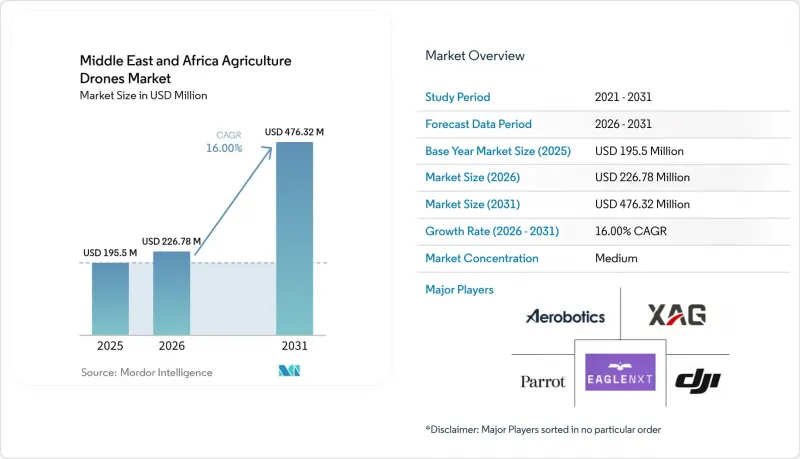
This report is Segmented by Platform (Rotary Wing, Fixed Wing, and More), by Component (Hardware, Software, and More), by Farming Environment (Outdoor and Indoor), by Application (Crop Monitoring, Field Mapping, Crop Spraying, and More), by Farm Size (Large-Scale Commercial and More), and by Geography ( Middle East and Africa). The Market Forecasts are Provided in Terms of Value (USD).
Middle East and Africa Agriculture Drones Market Trends and Insights
Water-Stress Driven Precision Irrigation
Freshwater scarcity remains a significant long-term growth driver for the agriculture drones market in the Middle East and Africa, as governments and farm operators increasingly focus on precision irrigation and resource optimization. Countries such as Saudi Arabia and the United Arab Emirates (UAE) heavily depend on non-renewable water sources, driving demand for drone-based technologies such as thermal imaging, multispectral monitoring, and precision field assessment to enhance water management and crop monitoring . National food security initiatives and agricultural modernization programs are further promoting the adoption of drones, particularly among large commercial farms and institutional farming projects capable of deploying drone fleets at scale. Consequently, precision irrigation and water-use optimization are transitioning from productivity-enhancing tools to essential operational requirements within the regional agriculture market.
Farm Labor Shortages and Spray-Cost Inflation
The agriculture drones market in the Middle East and Africa is being driven by labor shortages and rising field-spraying costs, which enhance the economic feasibility of drone-based operations in commercial farming systems. Precision drone spraying is gaining popularity among growers and farming cooperatives for its ability to reduce per-hectare spraying costs, improve application efficiency, and optimize chemical use compared to traditional spraying methods. The demand is particularly robust in high-value crop cultivation, where growers prioritize better spray timing, improved canopy penetration, and accurate dosage application while reducing reliance on manual labor. Consequently, recurring drone-based agriculture service models are becoming increasingly significant in key commercial farming areas across the region.
Fragmented Beyond Visual Line of Sight (BVLOS) and Aerial Spray Rules
Regulation remains a significant structural challenge in the Middle East and Africa agriculture drones market, as differing certification and flight rules across countries hinder seamless scaling for operators. In January 2026, Saudi Arabia updated the General Authority of Civil Aviation Regulations (GACAR) Part 107, introducing European Union Aviation Safety Agency (EASA)-aligned risk-based Standard Scenarios for commercial Beyond Visual Line of Sight (BVLOS) operations. These updates have the potential to significantly reduce approval timelines for compliant operators. This development is crucial, as service providers need predictable regulatory frameworks to establish regional drone fleets rather than operating on a fragmented, country-specific basis. Additionally, CropLife Africa Middle East published a regional framework for drone-based pesticide application in 2025 to address the lack of clear, enforceable spraying standards in many African markets . However, until more countries harmonize regulations on licensing, pilot certification, and spraying standards, the agriculture drones market in the Middle East and Africa will continue to impose additional operating costs on regional drone service providers.
Other drivers and restraints analyzed in the detailed report include:
- Food-Security Programs and Smart-Farming Incentives
- Return on Investment (ROI) on High-Value Crops and Plantation Monitoring
- High Upfront Cost and Weak Farm Financing
For complete list of drivers and restraints, kindly check the Table Of Contents.
Segment Analysis
Rotary-wing drones accounted for the largest 65.0% share of the Middle East and Africa agriculture drones market in 2025, driven by their hover capability, low-altitude precision, and operational flexibility across spraying, crop surveillance, and livestock monitoring applications. Their adoption remains particularly strong in orchard, vineyard, and date-farming operations where precise low-level maneuverability is essential. In contrast, the fixed-wing platforms market is projected to grow at the fastest CAGR of 16.5% from 2026 to 2031, supported by rising adoption among large plantation operators seeking wider field coverage, longer flight endurance, and lower per-hectare surveying costs.
Hybrid-wing systems currently contribute less to overall revenue but are attracting interest from buyers seeking vertical takeoff capabilities combined with improved cruising efficiency for larger agricultural areas. In the Middle East and Africa agriculture drones market, rotary-wing systems dominate deployment volumes due to their suitability for spraying and short-range monitoring. However, fixed-wing and hybrid platforms are gradually gaining traction in applications requiring longer survey distances, broader field coverage, and higher operational efficiency, where hover performance is less critical. Over time, platform adoption is anticipated to become more application-specific, with rotary-wing drones maintaining dominance in precision spraying, while fixed-wing systems expand their role in plantation mapping and large-scale field intelligence operations.
Hardware accounted for the largest market share, 63.0%, in the Middle East and Africa agriculture drones market in 2025. This reflects the market's current emphasis on fleet deployment and core operational infrastructure. Growers across the region are prioritizing investments in aircraft platforms, payload systems, batteries, and supporting equipment before expanding into advanced analytics capabilities. In contrast, the services market is projected to grow at the fastest CAGR of nearly 17.2% from 2026 to 2031, driven by the increasing adoption of Drone-as-a-Service (DaaS) models. These models appeal to growers seeking lower upfront investment requirements and outsourced operational support.
The market is gradually transitioning from hardware-focused purchasing to recurring revenue models centered on analytics, agronomic advisory, operator training, and managed spraying services. This shift is enhancing the importance of software integration, field intelligence capabilities, regulatory support, and reliable execution quality in commercial farming operations. Consequently, companies that can integrate drone platforms with agronomic services and precision agriculture insights are projected to strengthen their competitive position in the Middle East and Africa agriculture drones market.
Complete Report Scope:
- By Platform
- Rotary Wing
- Fixed Wing
- Hybrid Wing
- By Component
- Hardware
- Software
- Services
- By Farming Environment
- Outdoor Farming
- Indoor Farming
- By Application
- Crop Monitoring and Field Surveillance
- Field Mapping and Soil Analysis
- Crop Spraying and Spreading
- Variable Rate Application
- Livestock Monitoring
- By Farm Size
- Large-scale Commercial Farms
- Small and Medium-sized Farms
- By Geography
- Middle East
- Saudi Arabia
- United Arab Emirates (UAE)
- Rest of Middle East
- Africa
- South Africa
- Egypt
- Rest of Africa
- Middle East
List of Companies Covered in this Report:
- SZ DJI Technology Co., Ltd.
- XAG Co., Ltd.
- EagleNXT
- Parrot Drone SAS
- Aerobotics, (Pty) LTD
- Yamaha Motor Co., Ltd.
- AeroVironment, Inc.
- Trimble Inc.
- DroneDeploy, Inc.
- Hylio, Inc.
- DELair SAS
- Autel Robotics
- Sentera, Inc.
- Wingtra AG
Additional Benefits:
- The market estimate (ME) sheet in Excel format
- 3 months of analyst support
TABLE OF CONTENTS
1 Introduction
- 1.1 Study Assumptions and Market Definition
- 1.2 Scope of the Study
2 Research Methodology
3 Executive Summary
4 Market Landscape
- 4.1 Market Overview
- 4.2 Market Drivers
- 4.2.1 Water-stress driven precision irrigation
- 4.2.2 Farm labor shortages and spray-cost inflation
- 4.2.3 Food-security programs and smart-farming incentives
- 4.2.4 Return on Investment (ROI) on high-value crops and plantation monitoring
- 4.2.5 Drone-as-a-service expansion for grower clusters
- 4.2.6 Export-traceability and carbon-data requirements
- 4.3 Market Restraints
- 4.3.1 Fragmented Beyond Visual Line of Sight (BVLOS) and aerial spray rules
- 4.3.2 High upfront cost and weak farm financing
- 4.3.3 Rural charging, Real-Time Kinematic (RTK), and spare-parts gaps
- 4.3.4 Limited agronomic prescription data and pilot skills
- 4.4 Regulatory Landscape
- 4.5 Technological Outlook
- 4.6 Porter's Five Forces
- 4.6.1 Threat of New Entrants
- 4.6.2 Bargaining Power of Suppliers
- 4.6.3 Bargaining Power of Buyers
- 4.6.4 Threat of Substitutes
- 4.6.5 Intensity of Competitive Rivalry
5 Market Size and Growth Forecasts (Value)
- 5.1 By Platform
- 5.1.1 Rotary Wing
- 5.1.2 Fixed Wing
- 5.1.3 Hybrid Wing
- 5.2 By Component
- 5.2.1 Hardware
- 5.2.2 Software
- 5.2.3 Services
- 5.3 By Farming Environment
- 5.3.1 Outdoor Farming
- 5.3.2 Indoor Farming
- 5.4 By Application
- 5.4.1 Crop Monitoring and Field Surveillance
- 5.4.2 Field Mapping and Soil Analysis
- 5.4.3 Crop Spraying and Spreading
- 5.4.4 Variable Rate Application
- 5.4.5 Livestock Monitoring
- 5.5 By Farm Size
- 5.5.1 Large-scale Commercial Farms
- 5.5.2 Small and Medium-sized Farms
- 5.6 By Geography
- 5.6.1 Middle East
- 5.6.1.1 Saudi Arabia
- 5.6.1.2 United Arab Emirates (UAE)
- 5.6.1.3 Rest of Middle East
- 5.6.2 Africa
- 5.6.2.1 South Africa
- 5.6.2.2 Egypt
- 5.6.2.3 Rest of Africa
- 5.6.1 Middle East
6 Competitive Landscape
- 6.1 Market Concentration
- 6.2 Strategic Moves
- 6.3 Market Share Analysis
- 6.4 Company Profiles (Includes Global Level Overview, Market Level Overview, Core Segments, Financials as Available, Strategic Information, Market Rank/Share for Key Companies, Products and Services, and Recent Developments)
- 6.4.1 SZ DJI Technology Co., Ltd.
- 6.4.2 XAG Co., Ltd.
- 6.4.3 EagleNXT
- 6.4.4 Parrot Drone SAS
- 6.4.5 Aerobotics, (Pty) LTD
- 6.4.6 Yamaha Motor Co., Ltd.
- 6.4.7 AeroVironment, Inc.
- 6.4.8 Trimble Inc.
- 6.4.9 DroneDeploy, Inc.
- 6.4.10 Hylio, Inc.
- 6.4.11 DELair SAS
- 6.4.12 Autel Robotics
- 6.4.13 Sentera, Inc.
- 6.4.14 Wingtra AG
7 Market Opportunities and Future Outlook

