PUBLISHER: Mordor Intelligence | PRODUCT CODE: 2064531

PUBLISHER: Mordor Intelligence | PRODUCT CODE: 2064531
Europe Agricultural Drones - Market Share Analysis, Industry Trends & Statistics, Growth Forecasts (2025 - 2031)
According to Mordor Intelligence, the europe agricultural drones market size is projected to grow from USD 1.05 billion in 2025 and USD 1.29 billion in 2026 to USD 3.75 billion by 2031, registering a CAGR of 23.79% between 2026 and 2031.
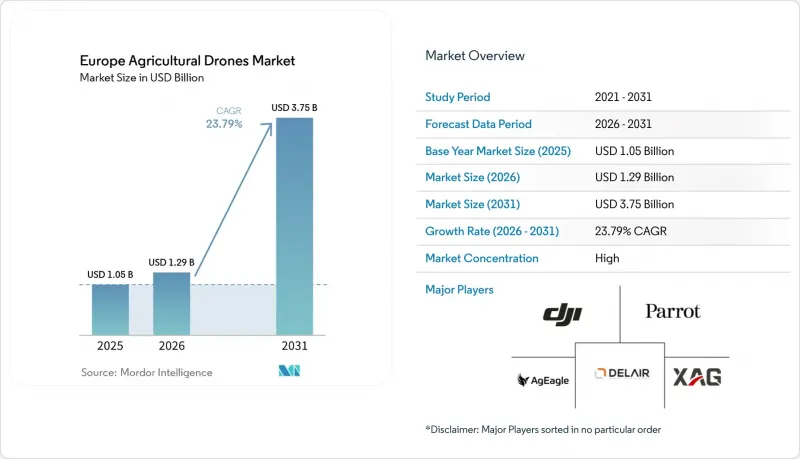
This report is Segmented by Drone Type (Fixed-Wing Drones, Rotary-Wing Drones, and Hybrid/VTOL Drones), by Component (Hardware, Software, and Services), by Application (Crop Spraying, Field Mapping, and More), by Farm Size ( Small-Scale Farms, and More), and by Geography (Germany, France, United Kingdom, Italy, Spain, and More). The Market Forecasts are Provided in Terms of Value (USD).
Europe Agricultural Drones Market Trends and Insights
Subsidy Programs Under the European Union Common Agricultural Policy
Eco-schemes introduced for 2023-2027 reimburse up to 25% of precision agriculture hardware, lowering capital barriers for cooperatives and small farms. In 2025, the French Parliament adopted a bill focused on "improving the treatment of diseases affecting plant crops using remotely piloted aircraft," enabling the use of drones to spray specific pesticides on certain crops. Similarly, in 2025, the Italian Senate approved an amendment to the "Simplifications" Bill (DDL) that allows the use of drones in agriculture under a regulated trial framework. This development, emphasized by Coldiretti as a result of collaborative efforts with Parliament and the Government, aligns with Italy's strategy to promote innovation and sustainability in agriculture.
Growing Labor Shortages Accelerating Farm Automation
Labor shortages are a significant growth driver for the European agricultural drones market, as the declining availability of farm workers is encouraging farmers to automate tasks such as spraying, scouting, and crop monitoring using drones. This trend is particularly pronounced in countries experiencing seasonal labor shortages and increasing labor costs, where drones enable farms to sustain productivity with reduced reliance on manual labor. By 2025, Europe's agricultural sector continues to face acute labor shortages, marked by an aging workforce and limited interest among younger generations, resulting in a net loss of 3.5 million workers between 2009 and 2024. To address this challenge, the European Union has achieved a 9.2% increase in agricultural labor productivity in 2025 through automation and structural reforms, although dependence on non-EU, seasonal, and migrant labor remains insufficient to fully bridge the gap. For instance, Dutch tulip growers have utilized DJI Agras T50 units for overnight slug control, effectively replacing unavailable manual scouts.
High Upfront Hardware and Software Costs
High upfront hardware and software costs pose a restraint on the Europe agricultural drone market. Advanced drones often require costly components such as sensors, spraying systems, flight software, and data analytics tools, which many small and medium-sized farms find difficult to justify. These expenses can lengthen the payback period, particularly when additional costs for training, maintenance, and integration with existing farm systems are factored in. For example, professional-grade drone systems, such as the senseFly eBee X with a Sequoia+ sensor and Pix4D license, cost approximately EUR 25,000 (USD 26,500). Similarly, the DJI nuWay DJI T50 Complete Generator Kit is priced at around USD 23,999. Leasing and per-flight models are emerging, but price wars in French viticulture have already pushed hectare fees near breakeven.
Other drivers and restraints analyzed in the detailed report include:
- Availability of Low-Cost Rotary-Wing Platforms
- Integration of Multispectral Imaging and AI Analytics
- Limited Rural 5G Coverage for Real-Time Analytics
For complete list of drivers and restraints, kindly check the Table Of Contents.
Segment Analysis
Rotary-wing drones led with 59% of Europe agricultural drones market share in 2025, owing to vertical take-off simplifying spraying in narrow vineyards and orchards. Fixed-wing units remain essential for 90-minute endurance over 200-ha wheat lots. Spain's PDRA-S01 favors long-endurance fixed wings for olive estates, while line-of-sight limits in Burgundy make rotary craft the default.
Hybrid/VTOL drones are the fastest-growing, projected to expand at a 29.0% CAGR through 2026 to 2031, combining fixed-wing range with vertical takeoff and landing. Growers now seek fleet consolidation to minimize pilot training and spares inventory. Payload modularity, exemplified by MicaSense Altum-PT clip-on sensors, enables a single airframe to map at dawn and spray at dusk, boosting utilization. The Europe agricultural drones market share shift toward hybrid designs underscores a demand for operational flexibility rather than platform purity.
Hardware was the largest segment, commanding 48% of the Europe agricultural drones market size in 2025. This dominance is attributed to the rising demand for drone platforms, multispectral cameras, GPS modules, sensors, and spraying systems that facilitate precision agriculture practices. For instance, farmers in countries such as Germany and France are increasingly adopting advanced drones for applications like crop health monitoring, irrigation management, and pesticide spraying to enhance productivity and lower operational costs.
Services are the fastest-growing segment, with a 31.0% CAGR through 2026 to 2031, as farms outsource flying, data, and compliance. This growth is driven by farms increasingly outsourcing drone operations, including aerial surveying, data analytics, pilot training, maintenance, and regulatory compliance. For instance, many medium-sized farms are opting to hire specialized drone service providers for seasonal crop assessments and AI-based field reports, enabling them to reduce upfront investments and gain access to technical expertise more effectively.
List of Companies Covered in this Report:
- SZ DJI Technology Co., Ltd.
- Parrot Drones SAS
- senseFly SA (AgEagle Aerial Systems Inc.)
- Delair SAS
- Guangzhou XAircraft Technology Co., Ltd.
- Yamaha Motor Co., Ltd.
- Trimble Inc.
- DroneDeploy Inc.
- PrecisionHawk Inc.
- Drone Volt SA
- MicaSense Inc.
- Gamaya SA
- Skydio Inc.
- Wingtra AG
- Hylio Inc.
Additional Benefits:
- The market estimate (ME) sheet in Excel format
- 3 months of analyst support
TABLE OF CONTENTS
1 Introduction
- 1.1 Study Assumption and Market Definition
- 1.2 Scope of the Study
2 Research Methodology
3 Executive Summary
4 Market Landscape
- 4.1 Market Overview
- 4.2 Market Drivers
- 4.2.1 Subsidy programs under the European Union Common Agricultural Policy
- 4.2.2 Growing labor shortages accelerating farm automation
- 4.2.3 Availability of low-cost rotary-wing platforms
- 4.2.4 Integration of multispectral imaging and AI analytics
- 4.2.5 Carbon-credit-linked eco-drone service models
- 4.2.6 Vineyard-specific pest scouting requirements
- 4.3 Market Restraints
- 4.3.1 Fragmented airspace regulations across member states
- 4.3.2 High upfront hardware and software costs
- 4.3.3 Limited rural 5G coverage for real-time analytics
- 4.3.4 Public concerns over chemical drift from drone spraying
- 4.4 Regulatory Landscape
- 4.5 Technological Outlook
- 4.6 Porter's Five Forces Analysis
- 4.6.1 Bargaining Power of Suppliers
- 4.6.2 Bargaining Power of Buyers
- 4.6.3 Threat of New Entrants
- 4.6.4 Threat of Substitute Products
- 4.6.5 Intensity of Competitive Rivalry
5 Market Size and Growth Forecasts (Value, USD)
- 5.1 By Drone Type
- 5.1.1 Fixed-wing Drones
- 5.1.2 Rotary-wing Drones
- 5.1.3 Hybrid/VTOL Drones
- 5.2 By Component
- 5.2.1 Hardware
- 5.2.2 Software
- 5.2.3 Services
- 5.3 By Application
- 5.3.1 Crop Spraying
- 5.3.2 Field Mapping and Surveying
- 5.3.3 Variable Rate Application
- 5.3.4 Livestock Monitoring
- 5.3.5 Others
- 5.4 By Farm Size
- 5.4.1 Small-scale Farms
- 5.4.2 Medium-scale Farms
- 5.4.3 Large-scale Farms
- 5.5 By Geography
- 5.5.1 Germany
- 5.5.2 France
- 5.5.3 United Kingdom
- 5.5.4 Italy
- 5.5.5 Spain
- 5.5.6 Netherlands
- 5.5.7 Rest of Europe
6 Competitive Landscape
- 6.1 Market Concentration
- 6.2 Strategic Moves
- 6.3 Market Share Analysis
- 6.4 Company Profiles (Includes Global level Overview, Market-level Overview, Core Segments, Financials as Available, Strategic Information, Market Rank/Share for key Companies, Products and Services, and Recent Developments)
- 6.4.1 SZ DJI Technology Co., Ltd.
- 6.4.2 Parrot Drones SAS
- 6.4.3 senseFly SA (AgEagle Aerial Systems Inc.)
- 6.4.4 Delair SAS
- 6.4.5 Guangzhou XAircraft Technology Co., Ltd.
- 6.4.6 Yamaha Motor Co., Ltd.
- 6.4.7 Trimble Inc.
- 6.4.8 DroneDeploy Inc.
- 6.4.9 PrecisionHawk Inc.
- 6.4.10 Drone Volt SA
- 6.4.11 MicaSense Inc.
- 6.4.12 Gamaya SA
- 6.4.13 Skydio Inc.
- 6.4.14 Wingtra AG
- 6.4.15 Hylio Inc.
7 Market Opportunities and Future Outlook

