PUBLISHER: Mordor Intelligence | PRODUCT CODE: 2073061

PUBLISHER: Mordor Intelligence | PRODUCT CODE: 2073061
Core Router - Market Share Analysis, Industry Trends & Statistics, Growth Forecasts (2026 - 2031)
According to Mordor Intelligence, the core router market size reached USD 8.76 billion in 2025 and is expected to reach USD 9.32 billion in 2026 and USD 13.02 billion by 2031, growing at a CAGR of 6.91% from 2026 to 2031.
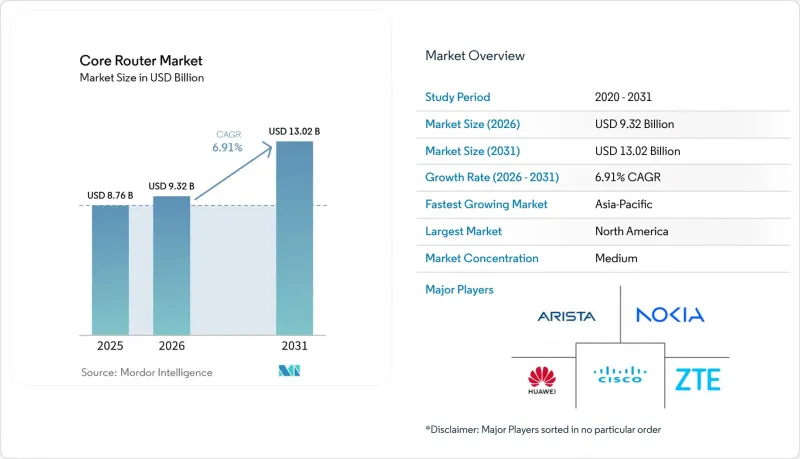
This report is Segmented by Hardware Architecture (Fixed Core Routers, Modular/Chassis-based Core Routers, and More), Throughput Class (Low Throughput, Mid Throughput, and More), End User Industry (BFSI, IT and Telecom, Manufacturing, Government and Public Sector, and More), Interface Density Class (Low Density, Medium Density, and More), and Geography. Market Forecasts are Provided in Terms of Value (USD).
Global Core Router Market Trends and Insights
Rising 5G Backbone Deployments
Operators are migrating from 4G packet cores to standalone 5G architectures that demand higher throughput, microservice granularity, and network slicing. SoftBank's commercial SRv6 mobile user plane went live in December 2025, proving sub-10 ms latency on Jericho2 ASICs running ArcOS. KDDI followed with a nationwide Samsung 5G SA core that delivers geo-redundant failover for gaming and robotics workloads. Ericsson's March 2026 deal with SoftBank adds dual-mode 5G core functions and subscriber data consolidation, increasing packet-processing loads on backbone routers. Containerized network functions amplify east-west traffic inside data centers, accelerating slot upgrades on spine routers. The cascading impact keeps 5G transport among the most material growth levers for the core router market.
Hyperscale Data Center Expansion
Alphabet budgeted USD 175 billion-USD 185 billion for 2026 infrastructure, and combined hyperscaler outlays top USD 690 billion, underwriting hundreds of new availability zones. Arista's R4 chassis offers 576 ports of 800 Gbps and HyperPort 3.2 Tbps interfaces that trimmed AI job time by 44% in lab tests. Huawei's CloudEngine XH9230-128DQ-LC fixed switch pushes 51.2 Tbps using full liquid cooling, doubling rack utilization. These platforms lower power per bit, meeting stringent PUE targets while sustaining GPU cluster growth. As workloads centralize into mega-campuses, high-density core routers become critical aggregation points, propelling the core router market toward terabit fabrics.
High Initial Capital Expenditure
Chassis with 800 Gbps interfaces list above USD 1 million, and optics, redundant PSUs, and support contracts amplify lifetime cost. Regional carriers delay upgrades until regulatory mandates or service degradation override budget caution. Indian payments networks cut total cost by 40% after shifting to SONiC white-box routers, and Rakuten Mobile halved CAPEX with disaggregated hardware, yet smaller operators lack the engineering staff to integrate multivendor stacks. Consequently, many mid-tier providers still order integrated systems, muting unit volume growth across the core router market.
Other drivers and restraints analyzed in the detailed report include:
- Surge in AI-Driven Traffic Engineering
- Cloud Service Provider CAPEX Upswing
- Supply-Chain Volatility in High-Speed ASICs
For complete list of drivers and restraints, kindly check the Table Of Contents.
Segment Analysis
Modular chassis platforms captured 58.42% of the core router market share in 2025 through field-replaceable line cards, redundant control planes, and mature failover software. The core router market size for these chassis benefited from decades-long refresh cycles among incumbent telcos that value proven availability benchmarks. Their embedded telemetry and carrier-grade clocking simplify compliance in regulated environments. However, cost-per-bit metrics favor merchant-silicon white-box devices.
Disaggregated routers are expanding at an 8.94% CAGR as AT&T's backbone now moves more than 80% of its 840 PB daily load on DriveNets software running across generic ASICs. Comcast and KDDI are replicating this model, and SONiC has become the de facto operating system for hyperscaler-style deployments. Although initial systems integration remains complex, successful reference builds are reducing perceived risk. As hyperscalers open-source toolchains, service providers gain confidence, sustaining momentum for disaggregation within the core router market.
Ultra-high-throughput routers exceeding 100 Gbps commanded 62.18% of market revenue in 2025 and will grow at a 7.82% CAGR through 2031, driven by AI cluster back-end networks, DCI links, and 5G user-plane gateways. Cisco's Silicon One G300 enables 25.6 Tbps fabrics, letting operators collapse three-tier topologies into two layers for latency-critical workloads. Juniper's PTX12000 modular router, deployed by KPN in the Netherlands for 800 Gbps coherent transport, uses Nokia's FP5 photonic processor to achieve a 75% per-bit power reduction compared with prior generations, directly addressing sustainability mandates from European regulators.
High-throughput platforms above 10 Gbps but below 100 Gbps continue to serve enterprise campus cores and regional aggregation points, yet their share is eroding as operators consolidate traffic onto fewer, higher-capacity devices to reduce operational complexity and footprint. Mid-range platforms in the 10-100 Gbps span still serve campus cores, yet their share erodes as operators consolidate onto fewer ultra-high-capacity nodes. Low tiers linger in industrial IoT or rural backhaul. With QSFP-DD800 optics in volume and liquid-cooled 1.6 Tbps modules on the roadmap, the ultra-high segment will continue guiding technology direction and grabbing wallet share inside the core router market.
Complete Report Scope:
- By Hardware Architecture
- Fixed Core Routers
- Modular / Chassis-based Core Routers
- Disaggregated (White-box) Core Routers
- By Throughput Class
- Low Throughput (<1 Gbps)
- Mid Throughput (1-10 Gbps)
- High Throughput (10-100 Gbps)
- Ultra-High (>100 Gbps)
- By End User Industry
- BFSI
- IT and Telecom
- Manufacturing
- Government and Public Sector
- Healthcare and Lifesciences
- Retail and E-commerce
- Education
- Other End User Industries
- By Interface Density Class
- Low Density (<64 ports)
- Medium Density (64-256 ports)
- High Density (>256 ports)
- By Geography
- North America
- United States
- Canada
- Mexico
- South America
- Brazil
- Argentina
- Rest of South America
- Europe
- Germany
- United Kingdom
- France
- Italy
- Spain
- Russia
- Rest of Europe
- Asia-Pacific
- China
- Japan
- India
- South Korea
- Australia and New Zealand
- Rest of Asia-Pacific
- Middle East
- Saudi Arabia
- United Arab Emirates
- Turkey
- Rest of Middle East
- Africa
- South Africa
- Egypt
- Nigeria
- Rest of Africa
- North America
Geography Analysis
North America generated 36.22% of 2025 spending as hyperscaler capital programs and Open RAN pilots absorbed vast port volumes. Alphabet, Microsoft, Amazon, and Meta together earmarked nearly USD 690 billion for 2026 infrastructure builds, funneling orders to high-bandwidth chassis with 800 Gbps interfaces. AT&T's nationwide DriveNets rollout shows the region's early adoption of disaggregated software stacks. Rural carriers, such as GCI in Alaska, outsource dual-mode 5G core operations to Ericsson, accelerating deployments despite harsh climates.
Asia-Pacific is the fastest-growing territory at a 7.88% CAGR. SoftBank's SRv6 launch illustrates Japan's appetite for advanced routing protocols. KDDI's DriveNets partnership underscores broader acceptance of open architectures. India's HFCL contract with Vodafone Idea expands 10 Gbps nodes to 100 Gbps without chassis swaps, highlighting cost-sensitive innovation. Chinese hyperscalers are erecting AI mega-clusters that demand lossless Ethernet fabrics, while South Korean telcos deploy 5G SA slicing for autonomous vehicles.
Europe advances steadily as energy-efficiency legislation, 5G SA upgrades, and edge data center rollouts unfold. Wind Tre's network consolidation and Nokia's exclusive deal with Telefonica Espana exemplify the move toward ultra-low-latency regional facilities. The Middle East invests in fiber backhaul to meet smart-city targets, and Africa's modernization agreements, such as Ethio-Ericsson's March 2026 project, extend 4G/5G coverage to underserved populations. Latin America widens 5G coverage in Brazil and Argentina, albeit under tighter macro constraints, leaving North America and Asia-Pacific as the twin engines of volume for the core router market.
- Cisco Systems, Inc.
- Huawei Technologies Co., Ltd.
- Nokia Corporation
- ZTE Corporation
- Arista Networks, Inc.
- Extreme Networks, Inc.
- Dell Technologies Inc.
- Hewlett Packard Enterprise Company
- Ciena Corporation
- Ericsson AB
- NEC Corporation
- Ribbon Communications Inc.
- Edgecore Networks Corporation
- ADVA Optical Networking SE
- ADTRAN Holdings, Inc.
- Infinera Corporation
- Casa Systems, Inc.
- ALE International SAS (Alcatel-Lucent Enterprise)
- Fujitsu Limited
- Tellabs Access LLC
- DriveNets Ltd.
Additional Benefits:
- The market estimate (ME) sheet in Excel format
- 3 months of analyst support
TABLE OF CONTENTS
1 INTRODUCTION
- 1.1 Study Assumptions and Market Definition
- 1.2 Scope of the Study
2 RESEARCH METHODOLOGY
3 EXECUTIVE SUMMARY
4 MARKET LANDSCAPE
- 4.1 Market Overview
- 4.2 Market Drivers
- 4.2.1 Rising 5G Backbone Deployments
- 4.2.2 Hyperscale Data Center Expansion
- 4.2.3 Surge in AI-Driven Traffic Engineering
- 4.2.4 Cloud Service Provider CAPEX Upswing
- 4.2.5 Adoption of Disaggregated Routing Architectures
- 4.2.6 Sustainability-Focused Hardware Refresh Programs
- 4.3 Market Restraints
- 4.3.1 High Initial Capital Expenditure
- 4.3.2 Supply-Chain Volatility in High-Speed ASICs
- 4.3.3 Skills Gap in Programmable Networking
- 4.3.4 Long Depreciation Cycles Limiting Refresh Rates
- 4.4 Industry Value Chain Analysis
- 4.5 Regulatory Landscape
- 4.6 Technological Outlook
- 4.7 Impact of Macroeconomic Factors on the Market
- 4.8 Porter's Five Forces Analysis
- 4.8.1 Threat of New Entrants
- 4.8.2 Bargaining Power of Suppliers
- 4.8.3 Bargaining Power of Buyers
- 4.8.4 Threat of Substitutes
- 4.8.5 Intensity of Competitive Rivalry
5 MARKET SIZE AND GROWTH FORECASTS (VALUE)
- 5.1 By Hardware Architecture
- 5.1.1 Fixed Core Routers
- 5.1.2 Modular / Chassis-based Core Routers
- 5.1.3 Disaggregated (White-box) Core Routers
- 5.2 By Throughput Class
- 5.2.1 Low Throughput (<1 Gbps)
- 5.2.2 Mid Throughput (1-10 Gbps)
- 5.2.3 High Throughput (10-100 Gbps)
- 5.2.4 Ultra-High (>100 Gbps)
- 5.3 By End User Industry
- 5.3.1 BFSI
- 5.3.2 IT and Telecom
- 5.3.3 Manufacturing
- 5.3.4 Government and Public Sector
- 5.3.5 Healthcare and Lifesciences
- 5.3.6 Retail and E-commerce
- 5.3.7 Education
- 5.3.8 Other End User Industries
- 5.4 By Interface Density Class
- 5.4.1 Low Density (<64 ports)
- 5.4.2 Medium Density (64-256 ports)
- 5.4.3 High Density (>256 ports)
- 5.5 By Geography
- 5.5.1 North America
- 5.5.1.1 United States
- 5.5.1.2 Canada
- 5.5.1.3 Mexico
- 5.5.2 South America
- 5.5.2.1 Brazil
- 5.5.2.2 Argentina
- 5.5.2.3 Rest of South America
- 5.5.3 Europe
- 5.5.3.1 Germany
- 5.5.3.2 United Kingdom
- 5.5.3.3 France
- 5.5.3.4 Italy
- 5.5.3.5 Spain
- 5.5.3.6 Russia
- 5.5.3.7 Rest of Europe
- 5.5.4 Asia-Pacific
- 5.5.4.1 China
- 5.5.4.2 Japan
- 5.5.4.3 India
- 5.5.4.4 South Korea
- 5.5.4.5 Australia and New Zealand
- 5.5.4.6 Rest of Asia-Pacific
- 5.5.5 Middle East
- 5.5.5.1 Saudi Arabia
- 5.5.5.2 United Arab Emirates
- 5.5.5.3 Turkey
- 5.5.5.4 Rest of Middle East
- 5.5.6 Africa
- 5.5.6.1 South Africa
- 5.5.6.2 Egypt
- 5.5.6.3 Nigeria
- 5.5.6.4 Rest of Africa
- 5.5.1 North America
6 COMPETITIVE LANDSCAPE
- 6.1 Market Concentration
- 6.2 Strategic Moves
- 6.3 Market Share Analysis
- 6.4 Company Profiles (includes Global Level Overview, Market Level Overview, Core Segments, Financials as available, Strategic Information, Market Rank/Share, Products and Services, Recent Developments)
- 6.4.1 Cisco Systems, Inc.
- 6.4.2 Huawei Technologies Co., Ltd.
- 6.4.3 Nokia Corporation
- 6.4.4 ZTE Corporation
- 6.4.5 Arista Networks, Inc.
- 6.4.6 Extreme Networks, Inc.
- 6.4.7 Dell Technologies Inc.
- 6.4.8 Hewlett Packard Enterprise Company
- 6.4.9 Ciena Corporation
- 6.4.10 Ericsson AB
- 6.4.11 NEC Corporation
- 6.4.12 Ribbon Communications Inc.
- 6.4.13 Edgecore Networks Corporation
- 6.4.14 ADVA Optical Networking SE
- 6.4.15 ADTRAN Holdings, Inc.
- 6.4.16 Infinera Corporation
- 6.4.17 Casa Systems, Inc.
- 6.4.18 ALE International SAS (Alcatel-Lucent Enterprise)
- 6.4.19 Fujitsu Limited
- 6.4.20 Tellabs Access LLC
- 6.4.21 DriveNets Ltd.
7 MARKET OPPORTUNITIES AND FUTURE OUTLOOK
- 7.1 White-Space and Unmet-Need Assessment

