PUBLISHER: Mordor Intelligence | PRODUCT CODE: 2073068

PUBLISHER: Mordor Intelligence | PRODUCT CODE: 2073068
Commercial Desktop PC - Market Share Analysis, Industry Trends & Statistics, Growth Forecasts (2026 - 2031)
According to Mordor Intelligence, the commercial desktop PC market size is projected to be USD 29.43 billion in 2025, USD 31.83 billion in 2026, and reach USD 49.38 billion by 2031, growing at a CAGR of 9.18% from 2026 to 2031.
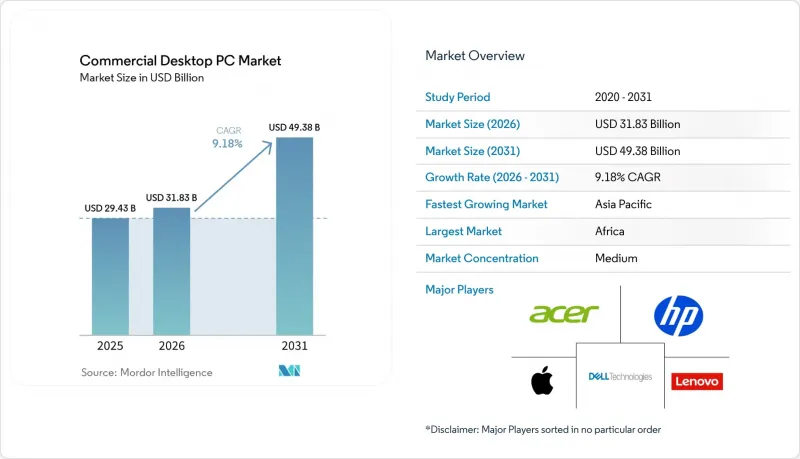
This report is Segmented by Form Factor (Tower, Small Form Factor, All-In-One, and Mini PC), End-User Industry (Corporate, Government, Educational Institutions, and More), Distribution Channel (Direct Sales, Indirect/OEM Channels, and E-Commerce), Processor Architecture (x86-Based, ARM-Based, and Other Architectures), and Geography. The Market Forecasts are Provided in Terms of Value (USD).
Global Commercial Desktop PC Market Trends and Insights
Corporate Fleet Refresh Cycles Post-Pandemic
Microsoft's October 2025 retirement of Windows 10 compelled organizations to migrate hundreds of millions of machines to Windows 11-capable hardware. Many enterprises had already deferred desktop spending during 2020-2022, leaving fleets well beyond their five-year service life and exposed to security gaps. OEMs responded with tightly integrated AI-ready desktops that meet Windows 11 hardware baselines and remote management mandates. Dell Technologies launched its Pro 5 Micro desktop in March 2026, featuring integrated AI-inference accelerators and a Trusted Platform Module 2.0 to meet Windows 11's stringent hardware requirements. Procurement peaked in late 2025, and a second wave is unfolding in 2026 as late adopters finalize budget approvals. Although memory inflation has stretched refresh intervals for a minority of buyers, the compliance deadline has largely locked in near-term demand.
Expanding Esports and AAA Gaming Demand
Permanent esports arenas, collegiate programs, and broadcast studios are moving away from improvised rigs toward purpose-built towers equipped with discrete GPUs and high-frequency CPUs. Hardware configured for 4K, 240 Hz gameplay also doubles as a production workstation for live-stream overlays and content editing, making commercial desktops indispensable for venue operators. OEMs now offer factory-overclocked systems with liquid cooling and hot-swap storage to meet demanding workload profiles. Growth remains fastest in China, the United States, and South Korea, but public gaming centers funded by European municipalities are adding incremental volume.
Prolonged Component Supply Chain Volatility
Foundries have diverted DRAM and NAND capacity to AI accelerators, triggering price spikes of up to 100% and spot shortages for PC-grade memory. OEM gross margins have contracted, and many buyers are pushing refresh cycles out from 4 to 5 years. Micron Technology's USD 1.8 billion acquisition of Powerchip Semiconductor Manufacturing Corporation's P5 fabrication site in Tongluo, Taiwan, was announced in January 2026 and closed in March 2026. Strategic responses include life-cycle extension programs, preferred-supplier agreements, and exploratory trials of desktop-as-a-service contracts that shift inventory risk to managed-service providers. Relief is unlikely before additional wafer capacity comes online in late 2027, leaving the commercial desktop PC market exposed to cost-driven procurement pauses.
Other drivers and restraints analyzed in the detailed report include:
- Hybrid Work Models Requiring High-Performance Workstations
- Government Digitalization Initiatives in Emerging Markets
- Increasing Adoption of High-End Laptops as Desktop Replacements
For complete list of drivers and restraints, kindly check the Table Of Contents.
Segment Analysis
Tower systems accounted for 56.31% of 2025 revenue, illustrating their pivotal role in enterprise IT closets and engineering labs where serviceability and PCIe expansion are essential. The commercial desktop PC market size for tower configurations is poised to climb steadily as organizations integrate AI accelerator cards and high-capacity storage into legacy racks. Mini PCs, on the other hand, are projected to log a 9.98% CAGR, fueled by smart-factory controllers and digital-signage endpoints that demand fanless, palm-sized designs. Although all-in-ones simplify cabling for reception desks and small offices, their non-upgradable nature makes them less attractive in cost-sensitive deployments. Over the forecast window, towers will retain the lead but cede incremental share to mini PCs in edge and hot-desking scenarios.
Across product roadmaps, vendors are compressing workstation-grade performance into ever-smaller footprints. Mini models that once ran low-watt CPUs now ship with 45 W silicon, dual-NVMe slots, and integrated neural processing units. Lenovo's Yoga Mini i, launched in June 2026 at USD 699.99, exemplifies this trend with a palm-sized enclosure housing Intel Core Ultra processors and dual HDMI outputs for digital signage and kiosk applications. Conversely, next-generation towers emphasize modularity, allowing power supplies, storage sleds, and side panels to be swapped for refurbishment under European circular-economy rules. These complementary innovations ensure that every workspace, from the trading floor to the smart-factory cell, can find the right-sized platform within the commercial desktop PC market.
Corporate buyers accounted for 41.89% of 2025 revenue, underscoring their reliance on standardized images, Active Directory integration, and long-term support contracts. Their steady refresh cadence underpins a large share of the commercial desktop PC market, even as some roles migrate to laptops or thin clients. Gaming and entertainment buyers, however, are set to expand spending at a 10.18% CAGR, transforming specialist rigs into broadcast-quality workhorses for esports and content creation. Government and education remain volume purchasers, but budget cycles and bidding rules moderate their growth trajectory.
Within corporations, a dual-approach deployment strategy is becoming increasingly common. Organizations are opting for cost-optimized small-form-factor units to handle administrative and routine tasks efficiently, while GPU-rich towers are being deployed for resource-intensive operations such as data analysis, 3D modeling, and other high-performance computing needs. Meanwhile, esports organizers and AAA game developers are gravitating toward high-end configurations, including top-tier CPUs, discrete graphics cards, and high-refresh-rate displays. This preference for premium specifications is significantly driving up average selling prices, which remain well above the typical enterprise standards. This polarization in demand ensures that profit margins remain attractive, even as shipment growth slows in other segments of the commercial desktop PC industry.
Complete Report Scope:
- By Form Factor
- Tower
- Small Form Factor
- All-in-One
- Mini PC
- By End-user Industry
- Corporate
- Government
- Educational Institutions
- Gaming and Entertainment
- Other End Users
- By Distribution Channel
- Direct Sales
- Indirect/OEM Channels
- E-commerce
- By Processor Architecture
- x86-based
- ARM-based
- Other Architectures
- By Geography
- North America
- United States
- Canada
- Mexico
- South America
- Brazil
- Argentina
- Rest of South America
- Europe
- United Kingdom
- Germany
- France
- Italy
- Spain
- Rest of Europe
- Asia-Pacific
- China
- Japan
- India
- South Korea
- Rest of Asia-Pacific
- Middle East and Africa
- Middle East
- United Arab Emirates
- Saudi Arabia
- Rest of Middle East
- Africa
- South Africa
- Egypt
- Rest of Africa
- Middle East
- North America
Geography Analysis
Asia-Pacific generated 29.32% of global revenue in 2025, buoyed by government digital tenders, robust manufacturing ecosystems, and synchronized Windows 11 migrations. Although shipments are expected to dip in 2026 due to cost headwinds, long-run prospects remain strong as India's Make in India policy and Indonesia's vocational center rollouts mature. China's role as an assembly hub ensures supply continuity, while Japan and South Korea demand premium desktops certified for low-failure rates and extended warranties.
Europe experienced a 48% year-on-year revenue spike in the fourth quarter of 2025 as enterprises raced to comply with cybersecurity mandates before component inflation set in. The revised WEEE Directive, effective in 2026, is already steering purchasing toward modular designs and OEM-led refurbishment programs. North America posted single-digit growth, with purchases tilting toward AI-enabled workstations for engineering and finance, even as task-worker roles gravitate to virtual desktops.
South America and Africa represent the fastest-growing territories. Africa is forecast to record a 10.13% CAGR through 2031, driven by smart-city and e-learning initiatives in South Africa, Egypt, and Nigeria. Brazil's USD 130 million federal desktop tender and broader PC-as-a-Service uptake exemplify how budget-constrained governments can still catalyze significant volumes. The Middle East, particularly Saudi Arabia and the United Arab Emirates, is scaling Arabic-language desktops for public administrations, expanding the global footprint of the commercial desktop PC market.
- Dell Technologies Inc.
- Lenovo Group Limited
- HP Inc.
- Acer Inc.
- ASUSTeK Computer Inc.
- Apple Inc.
- Micro-Star International Co., Ltd.
- Samsung Electronics Co., Ltd.
- Fujitsu Limited
- Dynabook Inc.
- Gigabyte Technology Co., Ltd.
- NEC Corporation
- Huawei Technologies Co., Ltd.
- Positivo Tecnologia S.A.
- Elitegroup Computer Systems Co., Ltd.
- Chuwi Innovation Limited
- Hasee Computer Co., Ltd.
- Tongfang Co., Ltd.
- Velocity Micro, Inc.
- Clevo Co.
Additional Benefits:
- The market estimate (ME) sheet in Excel format
- 3 months of analyst support
TABLE OF CONTENTS
1 INTRODUCTION
- 1.1 Study Assumptions and Market Definition
- 1.2 Scope of the Study
2 RESEARCH METHODOLOGY
3 EXECUTIVE SUMMARY
4 MARKET LANDSCAPE
- 4.1 Market Overview
- 4.2 Market Drivers
- 4.2.1 Expanding Esports and AAA Gaming Demand
- 4.2.2 Corporate Fleet Refresh Cycles Post-Pandemic
- 4.2.3 Hybrid Work Models Requiring High-Performance Workstations
- 4.2.4 Government Digitalization Initiatives in Emerging Markets
- 4.2.5 Rise of Edge Computing Requiring On-Premise Processing
- 4.2.6 Growing Demand for Privacy-Controlled Local Data Storage
- 4.3 Market Restraints
- 4.3.1 Prolonged Component Supply Chain Volatility
- 4.3.2 Increasing Adoption of High-End Laptops as Desktop Replacements
- 4.3.3 Macroeconomic Uncertainty Dampening CapEx Budgets
- 4.3.4 Environmental Regulations Driving Refurbishment over New Purchases
- 4.4 Impact of Macroeconomic Factors on the Market
- 4.5 Industry Value Chain Analysis
- 4.6 Regulatory Landscape
- 4.7 Technological Outlook
- 4.8 Porter's Five Forces Analysis
- 4.8.1 Bargaining Power of Suppliers
- 4.8.2 Bargaining Power of Buyers
- 4.8.3 Threat of New Entrants
- 4.8.4 Threat of Substitutes
- 4.8.5 Intensty of Competitive Rivalry
5 MARKET SIZE AND GROWTH FORECASTS (VALUE)
- 5.1 By Form Factor
- 5.1.1 Tower
- 5.1.2 Small Form Factor
- 5.1.3 All-in-One
- 5.1.4 Mini PC
- 5.2 By End-user Industry
- 5.2.1 Corporate
- 5.2.2 Government
- 5.2.3 Educational Institutions
- 5.2.4 Gaming and Entertainment
- 5.2.5 Other End Users
- 5.3 By Distribution Channel
- 5.3.1 Direct Sales
- 5.3.2 Indirect/OEM Channels
- 5.3.3 E-commerce
- 5.4 By Processor Architecture
- 5.4.1 x86-based
- 5.4.2 ARM-based
- 5.4.3 Other Architectures
- 5.5 By Geography
- 5.5.1 North America
- 5.5.1.1 United States
- 5.5.1.2 Canada
- 5.5.1.3 Mexico
- 5.5.2 South America
- 5.5.2.1 Brazil
- 5.5.2.2 Argentina
- 5.5.2.3 Rest of South America
- 5.5.3 Europe
- 5.5.3.1 United Kingdom
- 5.5.3.2 Germany
- 5.5.3.3 France
- 5.5.3.4 Italy
- 5.5.3.5 Spain
- 5.5.3.6 Rest of Europe
- 5.5.4 Asia-Pacific
- 5.5.4.1 China
- 5.5.4.2 Japan
- 5.5.4.3 India
- 5.5.4.4 South Korea
- 5.5.4.5 Rest of Asia-Pacific
- 5.5.5 Middle East and Africa
- 5.5.5.1 Middle East
- 5.5.5.1.1 United Arab Emirates
- 5.5.5.1.2 Saudi Arabia
- 5.5.5.1.3 Rest of Middle East
- 5.5.5.2 Africa
- 5.5.5.2.1 South Africa
- 5.5.5.2.2 Egypt
- 5.5.5.2.3 Rest of Africa
- 5.5.5.1 Middle East
- 5.5.1 North America
6 COMPETITIVE LANDSCAPE
- 6.1 Market Concentration
- 6.2 Strategic Moves
- 6.3 Market Share Analysis
- 6.4 Company Profiles (includes Global Level Overview, Market Level Overview, Core Segments, Financials as available, Strategic Information, Market Rank/Share, Products and Services, Recent Developments)
- 6.4.1 Dell Technologies Inc.
- 6.4.2 Lenovo Group Limited
- 6.4.3 HP Inc.
- 6.4.4 Acer Inc.
- 6.4.5 ASUSTeK Computer Inc.
- 6.4.6 Apple Inc.
- 6.4.7 Micro-Star International Co., Ltd.
- 6.4.8 Samsung Electronics Co., Ltd.
- 6.4.9 Fujitsu Limited
- 6.4.10 Dynabook Inc.
- 6.4.11 Gigabyte Technology Co., Ltd.
- 6.4.12 NEC Corporation
- 6.4.13 Huawei Technologies Co., Ltd.
- 6.4.14 Positivo Tecnologia S.A.
- 6.4.15 Elitegroup Computer Systems Co., Ltd.
- 6.4.16 Chuwi Innovation Limited
- 6.4.17 Hasee Computer Co., Ltd.
- 6.4.18 Tongfang Co., Ltd.
- 6.4.19 Velocity Micro, Inc.
- 6.4.20 Clevo Co.
7 MARKET OPPORTUNITIES AND FUTURE OUTLOOK
- 7.1 White-Space and Unmet-Need Assessment

