PUBLISHER: Mordor Intelligence | PRODUCT CODE: 2073143

PUBLISHER: Mordor Intelligence | PRODUCT CODE: 2073143
Industrial Network Switch - Market Share Analysis, Industry Trends & Statistics, Growth Forecasts (2026 - 2031)
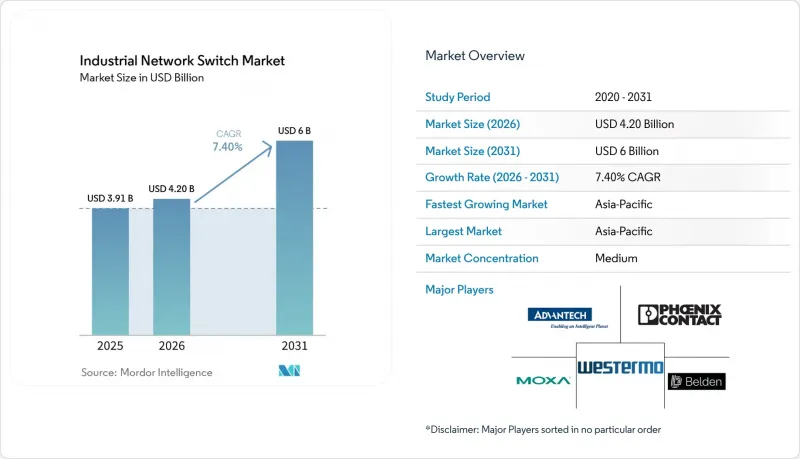
According to Mordor Intelligence, the industrial network switch market size is expected to increase from USD 3.91 billion in 2025 to USD 4.20 billion in 2026 and reach USD 6.00 billion by 2031, growing at a CAGR of 7.4% over 2026-2031.
This report is Segmented by Type (Managed Switches, Unmanaged Switches, and Smart/Web-Managed Switches), Port Count (2-8 Ports, 9-16 Ports, 17-24 Ports, 25-48 Ports, and More), Port Speed (Fast Ethernet 100 Mbps, and More), Poe Capability (PoE Switches, and Non-PoE Switches), Industry Vertical (Manufacturing, and More), and Geography. The Market Forecasts are Provided in Terms of Value (USD).
Global Industrial Network Switch Market Trends and Insights
Surge in Industry 4.0 Automation
Factory operators are converting legacy fieldbus islands into unified Ethernet fabrics that support digital twins, AI-driven defect detection, and closed-loop quality control. A 2026 Cisco survey found that 61% of manufacturers are already deploying artificial intelligence on the shop floor and 97% anticipate higher connectivity density, underscoring rising demand for managed switch ports.Siemens observed productivity gains of 49% in Indonesian pilot lines after migrating to software-defined production cells. Automotive assemblers are standardizing on Ethernet-based motion control, which accelerates switch refresh cycles and lifts access-layer bandwidth from Fast Ethernet to 10 Gigabit. The industrial network switch market therefore benefits from every new edge AI workload that pushes ports toward higher speeds and deterministic traffic scheduling. Vendors that bundle NETCONF interfaces and VLAN templates help plant managers overcome configuration complexity, shortening commissioning windows by up to 30%.
Rapid Adoption of Time-Sensitive Networking for Deterministic Ethernet
IEEE 802.1AS time synchronization, 802.1Qbv time-aware shaping, and 802.1Qbu frame pre-emption together let Ethernet match fieldbus-level determinism, a prerequisite for closed-loop motion and safety cells. IEC/IEEE 60802 published in 2024 codified industrial TSN profiles that require sub-microsecond jitter. France's grid operator RTE validated multi-vendor TSN interoperability across 400 kV substations in 2025, demonstrating carrier-grade robustness. Automotive Ethernet committees have also ratified TSN scheduling to carry camera, LiDAR, and over-the-air update streams simultaneously. Consequently, the industrial network switch market sees surging orders for devices that certify to both TSN and legacy industrial protocols on a single hardware platform. Suppliers that embed IEEE 1588-based clock recovery and hot-standby paths secure a technical moat against low-end entrants.
Cybersecurity Vulnerabilities in Operational Technology Networks
Converged IT-OT topologies expose legacy PLCs and HMIs to ransomware that exploits unpatched firmware and default credentials. CISA issued 47 advisories in 2025 addressing switch vulnerabilities that allowed remote code execution. Less than 30% of installed industrial switches meet IEC 62443-4-2 security levels as of early 2026. Dragos reported that 68% of industrial organizations logged at least one cyber incident in 2025, with Ethernet devices as the initial access vector in 42% of cases. Phoenix Contact's FL Switch 2000 achieved IEC 62443-4-2 certification in December 2025, proving compliance is feasible but costly. Rising insurance premiums for non-segmented networks further restrain short-run purchasing decisions.
Other drivers and restraints analyzed in the detailed report include:
- Growing Deployment of Industrial PoE Cameras and Sensors
- Expansion of Smart Grids and Digital Substations
- Shortage of Industrial Networking Skill Sets
For complete list of drivers and restraints, kindly check the Table Of Contents.
Segment Analysis
Managed switches captured 65.8% of the industrial network switch market in 2025 and are forecast to deliver a 10.3% CAGR through 2031, as VLAN segmentation, QoS queuing, and remote diagnostics become essential in Industry 4.0 production zones. Utilities deploying digital substations demand sub-10-millisecond failover, which unmanaged models cannot provide. Smart or web-managed variants appeal to small plants by offering browser GUIs without the full CLI complexity. Cybersecurity-certified managed switches now command 25-40% price premiums, yet critical-infrastructure buyers consider compliance non-negotiable.
In contrast, unmanaged switches remain viable for single-machine islands but face headwinds where safety traffic needs deterministic prioritization. Vendors are therefore investing in firmware upgradability that lets customers unlock management features later, future-proofing entry-level hardware. As the industrial network switch market matures, analysts expect the managed tier to exceed 70% share by mid-decade, reinforcing the shift toward centrally orchestrated, API-driven fabrics.
The 2-8-port class held 35.6% share in 2025, serving compact machine cells, while switches above 48 ports are projected to post a 9.3% CAGR through 2031 as automotive, electronics, and semiconductor fabs consolidate edge cabinets into aggregation-layer racks. Automotive lines deploy 48-port Gigabit access blocks feeding 10 G uplinks to handle thousands of vision frames per second. High port density trims per-port costs, yet it introduces single points of failure unless redundant PSUs and hot-swap fan trays are adopted.
Ruggedized 19-inch chassis with modular PSU bays are therefore supplanting DIN-rail boxes in control rooms. Vendors also push software-defined provisioning so engineers can repurpose idle ports without manual patching. As virtualization spreads, the industrial network switch market size for the above-48-port bracket is set to climb steadily, particularly inside brownfield plants seeking cable reduction.
Complete Report Scope:
- By Switch Type
- Managed Switches
- Unmanaged Switches
- Smart / Web-Managed Switches
- By Port Count
- 2-8 Ports
- 9-16 Ports
- 17-24 Ports
- 25-48 Ports
- Above 48 Ports
- By Port Speed
- Fast Ethernet (100 Mbps)
- Gigabit Ethernet (1G)
- 10 Gigabit Ethernet (10G)
- Above 10G (25G / 40G / 100G)
- By PoE Capability
- PoE Switches
- Non-PoE Switches
- By Industry Vertical
- Manufacturing
- Energy and Power (Electric Utilities / Smart Grid)
- Oil and Gas
- Transportation (Rail, Ports, Intelligent Transport Systems)
- Automotive
- Aerospace and Defense
- Mining and Metals
- Others Industry Verticals
- By Geography
- North America
- South America
- Europe
- Asia-Pacific
- Middle East
- Africa
Geography Analysis
Asia-Pacific commanded 37.2% of the industrial network switch market in 2025 and is forecast to expand at a 9.7% CAGR through 2031. China's Made in China 2025 plan, India's Production-Linked Incentives, and Southeast Asian smart-factory grants jointly sustain multi-year capex cycles. Siemens estimated factory-automation outlays could climb to USD 125.84 billion by 2030, citing 49% productivity gains in Indonesian pilots. Japanese and South Korean fabs require TSN switches for 5 nm lithography sync, while India's solar parks install IEC 61850 gear to balance renewable intermittency. Domestic Taiwanese and Chinese vendors undercut incumbents on price, but Tier-1 automotive and aerospace OEMs still prefer global suppliers with 24-hour support.
North America benefits from the USD 52.7 billion CHIPS and Science Act, which underwrites Intel's USD 20 billion Arizona fabs, TSMC's USD 40 billion Phoenix campus, Micron's USD 20 billion New York line, and Samsung's USD 17 billion Texas facility. Each fab specifies TSN-capable 10 G and 100 G fabrics to synchronize lithography, metrology, and automated material handling. Utilities across the United States and Canada modernize substations to meet NERC CIP, which accelerates demand for IEC 62443-compliant switches. Mexico's nearshoring wave further expands regional sales as automotive clusters replicate U.S. line architectures.
Europe's market hinges on smart-grid roll-outs, automotive electrification, and NIS2 cybersecurity rules. RTE's multi-vendor TSN deployment across 400 kV sites validated commercial viability and sets a precedent for other grid operators. German automakers now embed Ethernet backbones to manage camera and LiDAR streams, lifting local demand for low-latency switches. The EU Digital Decade targets 80% enterprise cloud and big-data adoption by 2030, nudging manufacturers to upgrade legacy fieldbus networks to Ethernet fabrics.
- Moxa Inc.
- Advantech Co., Ltd.
- Belden Inc.
- Phoenix Contact GmbH & Co. KG
- Antaira Technologies, LLC
- Westermo Network Technologies AB
- Beijer Electronics Group AB
- Hirschmann Automation and Control GmbH
- Red Lion Controls, Inc.
- RuggedCom Inc.
- PLANET Technology Corporation
- TRENDnet, Inc.
- Allied Telesis Holdings K.K.
- Lantronix, Inc.
- ORing Industrial Networking Corporation
- Korenix Technology Co., Ltd.
- EtherWAN Systems, Inc.
- Weidmuller Interface GmbH & Co. KG
- Patton Electronics Co.
- Siemens AG
Additional Benefits:
- The market estimate (ME) sheet in Excel format
- 3 months of analyst support
TABLE OF CONTENTS
1 INTRODUCTION
- 1.1 Study Assumptions and Market Definition
- 1.2 Scope of the Study
2 RESEARCH METHODOLOGY
3 EXECUTIVE SUMMARY
4 MARKET LANDSCAPE
- 4.1 Market Overview
- 4.2 Market Drivers
- 4.2.1 Surge in Industry 4.0 Automation
- 4.2.2 Rapid Adoption of Time-Sensitive Networking for Deterministic Ethernet
- 4.2.3 Growing Deployment of Industrial PoE Cameras and Sensors
- 4.2.4 Expansion of Smart Grids and Digital Substations
- 4.2.5 Edge Computing Requirements in Harsh Environments
- 4.2.6 Government-Led Reshoring of Critical Manufacturing
- 4.3 Market Restraints
- 4.3.1 Cybersecurity Vulnerabilities in Operational Technology Networks
- 4.3.2 Shortage of Industrial Networking Skill Sets
- 4.3.3 Volatility in Industrial Semiconductor Supply Chains
- 4.3.4 Higher Total Cost of Ownership versus Commercial-Grade Switches
- 4.4 Industry Supply-Chain Analysis
- 4.5 Regulatory Landscape
- 4.6 Technological Outlook
- 4.7 Impact of Macroeconomic Factors on the Market
- 4.8 Porter's Five Forces Analysis
- 4.8.1 Bargaining Power of Suppliers
- 4.8.2 Bargaining Power of Buyers
- 4.8.3 Threat of New Entrants
- 4.8.4 Threat of Substitutes
- 4.8.5 Competitive Rivalry
5 MARKET SIZE AND GROWTH FORECASTS (VALUE)
- 5.1 By Switch Type
- 5.1.1 Managed Switches
- 5.1.2 Unmanaged Switches
- 5.1.3 Smart / Web-Managed Switches
- 5.2 By Port Count
- 5.2.1 2-8 Ports
- 5.2.2 9-16 Ports
- 5.2.3 17-24 Ports
- 5.2.4 25-48 Ports
- 5.2.5 Above 48 Ports
- 5.3 By Port Speed
- 5.3.1 Fast Ethernet (100 Mbps)
- 5.3.2 Gigabit Ethernet (1G)
- 5.3.3 10 Gigabit Ethernet (10G)
- 5.3.4 Above 10G (25G / 40G / 100G)
- 5.4 By PoE Capability
- 5.4.1 PoE Switches
- 5.4.2 Non-PoE Switches
- 5.5 By Industry Vertical
- 5.5.1 Manufacturing
- 5.5.2 Energy and Power (Electric Utilities / Smart Grid)
- 5.5.3 Oil and Gas
- 5.5.4 Transportation (Rail, Ports, Intelligent Transport Systems)
- 5.5.5 Automotive
- 5.5.6 Aerospace and Defense
- 5.5.7 Mining and Metals
- 5.5.8 Others Industry Verticals
- 5.6 By Geography
- 5.6.1 North America
- 5.6.2 South America
- 5.6.3 Europe
- 5.6.4 Asia-Pacific
- 5.6.5 Middle East
- 5.6.6 Africa
6 COMPETITIVE LANDSCAPE
- 6.1 Market Concentration
- 6.2 Strategic Moves
- 6.3 Market Share Analysis
- 6.4 Company Profiles (includes Global Level Overview, Market Level Overview, Core Segments, Financials as available, Strategic Information, Market Rank/Share, Products and Services, Recent Developments)
- 6.4.1 Moxa Inc.
- 6.4.2 Advantech Co., Ltd.
- 6.4.3 Belden Inc.
- 6.4.4 Phoenix Contact GmbH & Co. KG
- 6.4.5 Antaira Technologies, LLC
- 6.4.6 Westermo Network Technologies AB
- 6.4.7 Beijer Electronics Group AB
- 6.4.8 Hirschmann Automation and Control GmbH
- 6.4.9 Red Lion Controls, Inc.
- 6.4.10 RuggedCom Inc.
- 6.4.11 PLANET Technology Corporation
- 6.4.12 TRENDnet, Inc.
- 6.4.13 Allied Telesis Holdings K.K.
- 6.4.14 Lantronix, Inc.
- 6.4.15 ORing Industrial Networking Corporation
- 6.4.16 Korenix Technology Co., Ltd.
- 6.4.17 EtherWAN Systems, Inc.
- 6.4.18 Weidmuller Interface GmbH & Co. KG
- 6.4.19 Patton Electronics Co.
- 6.4.20 Siemens AG
7 MARKET OPPORTUNITIES AND FUTURE OUTLOOK
- 7.1 White-Space and Unmet-Need Assessment

