PUBLISHER: Mordor Intelligence | PRODUCT CODE: 2073236

PUBLISHER: Mordor Intelligence | PRODUCT CODE: 2073236
Middle East Feed Pigments - Market Share Analysis, Industry Trends & Statistics, Growth Forecasts (2026 - 2031)
According to Mordor Intelligence, the middle east feed pigments market size is projected to expand from USD 45.04 million in 2025 and USD 47.31 million in 2026 to USD 60.66 million by 2031, registering a 5.10% CAGR between 2026 and 2031.
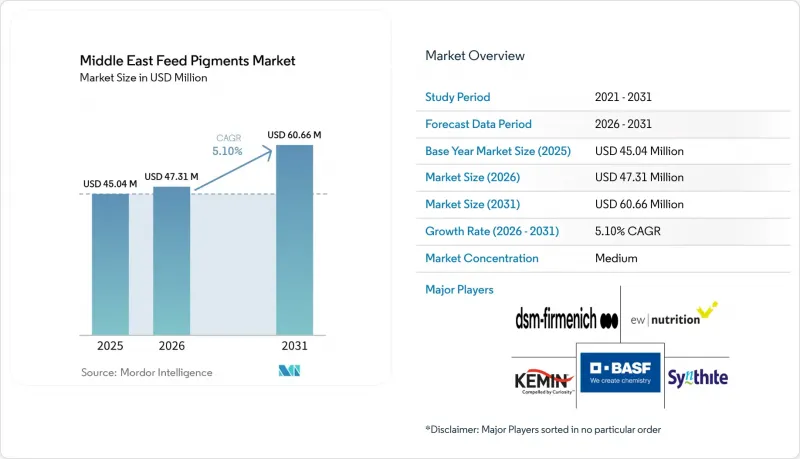
This report is Segmented by Type (Carotenoids, Curcumin, Spirulina, and Other Types), by Animal Type (Aquaculture, Poultry, Ruminants, Swine, and Other Animal Types), and by Geography (Saudi Arabia, United Arab Emirates, Israel, Qatar, Kuwait, Oman, and Rest of the Middle East). The Market Forecasts are Provided in Terms of Value (USD) and Volume (Metric Tons).
Middle East Feed Pigments Market Trends and Insights
Rising Poultry and Aquaculture Pigment Intensity in Hot-Climate Production Systems
Poultry and aquaculture systems in the Gulf operate under persistent heat stress, which makes pigment stability a daily formulation issue rather than a cosmetic choice. Carotenoids break down more easily under thermal stress, which means feed producers often need more stable forms to protect active value before deposition in yolk, skin, or fish tissue. This raises the importance of encapsulation, controlled handling, and dependable dosing in the Middle East feed pigments market. BASF SE participates in the feed pigment market through products that help poultry and aquaculture producers achieve targeted yolk and flesh color characteristics while maintaining product quality and consistency. DSM-Firmenich has also documented the effects of storage and processing conditions on carotenoid stability, supporting the need for protected pigment delivery in warm regional conditions. The aquaculture side follows the same pattern because high ambient temperatures can reduce astaxanthin retention during feed storage and handling. This is one reason the Middle East feed pigments market continues to reward suppliers that can prove stable performance across pelleting, transport, and on-farm use. The result is steady demand for technically differentiated pigments instead of a simple shift toward low-cost imported material.
Premiumization of Egg Yolk, Broiler Skin, and Fish Flesh Color in Gulf Retail Channels
Color remains one of the clearest product signals in fresh poultry, eggs, and farmed fish across Gulf retail channels. Deep yolk color, uniform broiler skin tone, and attractive fish flesh color continue to influence how buyers judge freshness and value at the point of purchase. That keeps pigmentation programs commercially relevant even when feed budgets come under pressure. Feed pigments are widely used to help producers achieve consistent coloration, reflecting the importance of visual quality attributes for product differentiation and consumer acceptance. In the Middle East feed pigments market, this preference supports repeat use rather than occasional supplementation, especially among integrated operations serving modern retail and hospitality channels. It also strengthens the case for standardized color scoring and tighter dosing routines. Fish producers benefit similarly because appearance matters in premium sales channels and repeat purchase behavior. This keeps the Middle East feed pigments market aligned with retail presentation standards as much as with animal nutrition needs.
High Dependence on Imported Carotenoid and Spirulina Inputs
The Middle East feed pigments market still depends on imported carotenoids and spirulina for most of its functional supply. That leaves feed mills and integrators exposed to changes in lead times, shipping disruptions, and shifts in raw material pricing that they cannot fully control. The market has very limited local raw material depth, so any issue in upstream supply tends to quickly affect availability and cost. In September 2024, DSM-Firmenich opened a new manufacturing plant in Egypt to serve customers across the Middle East, reflecting the need for stronger local service and lower delivery risk. At the same time, aquaculture expansion in Saudi Arabia continues to drive demand for specialized pigment inputs that lack a regional supply solution. This imbalance matters because a growing market with imported dependence often sees periods of tighter customer planning and more conservative inventory decisions. Smaller buyers feel this first because they usually have less bargaining power and fewer supply alternatives. As long as import reliance stays high, the Middle East feed pigments market will remain more vulnerable to supply-side pressure than categories with stronger domestic production support.
Other drivers and restraints analyzed in the detailed report include:
- Food Security Programs Favoring Specialized Feed Additives in Saudi Arabia and the United Arab Emirates
- Replacement of Broad-Spectrum Synthetic Colorants with Species-Specific Carotenoid Blends
- Narrow Application Base Outside Poultry and Aquaculture
For complete list of drivers and restraints, kindly check the Table Of Contents.
Segment Analysis
Carotenoids accounted for 58.4% of the Middle East feed pigments market share in 2025, making them the clear leader by value. They were followed by spirulina, curcumin, and other types, which together served smaller and more specialized use cases. Carotenoids remain central because they meet both poultry yolk and skin programs and the needs of aquaculture flesh coloration. BASF SE and DSM-Firmenich continue to support this segment through dedicated carotenoid portfolios and heat-protected product formats. Their established regulatory acceptance, proven pigmentation efficiency, and compatibility with commercial feed manufacturing further strengthen demand.
Spirulina is anticipated to record the fastest growth at a 7.4% CAGR from 2026 to 2031, followed by curcumin, carotenoids, and other types. Its appeal lies in providing color support and functional nutritional value in a single ingredient, which is especially useful in aquaculture. Research conducted by the Ministry of Environment, Water and Agriculture, Riyadh, Saudi Arabia, on the Protein, Energy, and Amino Acid Digestibility of Spirulina in 2024 showed a positive feed response and strong digestibility in relevant fish species, which supports its rising adoption in the Middle East feed pigments market. It is also gaining traction in aquaculture applications due to its dual role as a natural pigment source and functional nutritional ingredient, supporting its use in premium and specialized feed formulations.
Complete Report Scope:
- By Type
- Carotenoids
- Curcumin
- Spirulina
- Other Types
- By Animal Type
- Aquaculture
- Fish
- Shrimp
- Other Aquaculture Species
- Poultry
- Broiler
- Layer
- Other Poultry Birds
- Ruminants
- Beef Cattle
- Dairy Cattle
- Other Ruminants
- Swine
- Other Animals
- Aquaculture
- By Geography
- Saudi Arabia
- United Arab Emirates
- Israel
- Qatar
- Kuwait
- Oman
- Rest of Middle East
List of Companies Covered in this Report:
- DSM-Firmenich
- BASF SE
- Bordas S.A.
- Kemin Industries, Inc.
- EW Nutrition
- Nutreco N.V. (SHV Holdings N.V.)
- Innovad (PAI Partners)
- Synthite Industries Ltd.
- Camlin Fine Sciences Ltd.
- Impextraco N.V.
- Unichemie International Private Limited
- Behn Meyer
Additional Benefits:
- The market estimate (ME) sheet in Excel format
- 3 months of analyst support
TABLE OF CONTENTS
1 Introduction
- 1.1 Study Assumptions and Market Definition
- 1.2 Scope of the Study
2 Research Methodology
3 Executive Summary
4 Market Landscape
- 4.1 Market Overview
- 4.2 Market Drivers
- 4.2.1 Rising Poultry and Aquaculture Pigment Intensity in Hot-Climate Production Systems
- 4.2.2 Premiumization of Egg Yolk, Broiler Skin, and Fish Flesh Color in Gulf Retail Channels
- 4.2.3 Food Security Programs Favoring Specialized Feed Additives in Saudi Arabia and the United Arab Emirates
- 4.2.4 Replacement of Broad-Spectrum Synthetic Colorants with Species-Specific Carotenoid Blends
- 4.2.5 Expansion of Halal-Positioned Natural Pigment Demand in Export-Oriented Poultry Supply Chains
- 4.2.6 Localization of Additive Manufacturing to Improve Regional Supply Reliability
- 4.3 Market Restraints
- 4.3.1 High Dependence on Imported Carotenoid and Spirulina Inputs
- 4.3.2 Narrow Application Base Outside Poultry and Aquaculture
- 4.3.3 Approval and Registration Friction Across Multiple Middle Eastern Jurisdictions
- 4.3.4 Heat and Storage Sensitivity of Natural Pigments in Regional Logistics
- 4.4 Regulatory Landscape
- 4.5 Technological Outlook
- 4.6 Porter's Five Forces Analysis
- 4.6.1 Threat of New Entrants
- 4.6.2 Bargaining Power of Suppliers
- 4.6.3 Bargaining Power of Buyers
- 4.6.4 Threat of Substitutes
- 4.6.5 Intensity of Competitive Rivalry
5 Market Size and Growth Forecasts (Value and Volume)
- 5.1 By Type
- 5.1.1 Carotenoids
- 5.1.2 Curcumin
- 5.1.3 Spirulina
- 5.1.4 Other Types
- 5.2 By Animal Type
- 5.2.1 Aquaculture
- 5.2.1.1 Fish
- 5.2.1.2 Shrimp
- 5.2.1.3 Other Aquaculture Species
- 5.2.2 Poultry
- 5.2.2.1 Broiler
- 5.2.2.2 Layer
- 5.2.2.3 Other Poultry Birds
- 5.2.3 Ruminants
- 5.2.3.1 Beef Cattle
- 5.2.3.2 Dairy Cattle
- 5.2.3.3 Other Ruminants
- 5.2.4 Swine
- 5.2.5 Other Animals
- 5.2.1 Aquaculture
- 5.3 By Geography
- 5.3.1 Saudi Arabia
- 5.3.2 United Arab Emirates
- 5.3.3 Israel
- 5.3.4 Qatar
- 5.3.5 Kuwait
- 5.3.6 Oman
- 5.3.7 Rest of Middle East
6 Competitive Landscape
- 6.1 Market Concentration
- 6.2 Strategic Moves
- 6.3 Market Share Analysis
- 6.4 Company Profiles (Includes Global Level Overview, Market Level Overview, Core Segments, Financials as Available, Strategic Information, Market Rank/Share, Products and Services, Recent Developments)
- 6.4.1 DSM-Firmenich
- 6.4.2 BASF SE
- 6.4.3 Bordas S.A.
- 6.4.4 Kemin Industries, Inc.
- 6.4.5 EW Nutrition
- 6.4.6 Nutreco N.V. (SHV Holdings N.V.)
- 6.4.7 Innovad (PAI Partners)
- 6.4.8 Synthite Industries Ltd.
- 6.4.9 Camlin Fine Sciences Ltd.
- 6.4.10 Impextraco N.V.
- 6.4.11 Unichemie International Private Limited
- 6.4.12 Behn Meyer
7 Market Opportunities and Future Outlook

