PUBLISHER: Mordor Intelligence | PRODUCT CODE: 2073283

PUBLISHER: Mordor Intelligence | PRODUCT CODE: 2073283
Africa AI-Powered Energy Management Software - Market Share Analysis, Industry Trends & Statistics, Growth Forecasts (2026 - 2031)
According to Mordor Intelligence, the africa AI-Powered energy management software market size was USD 133.90 million in 2025 and is forecast to reach USD 406.21 million by 2031 at 20.62% CAGR from 2026 to 2031.
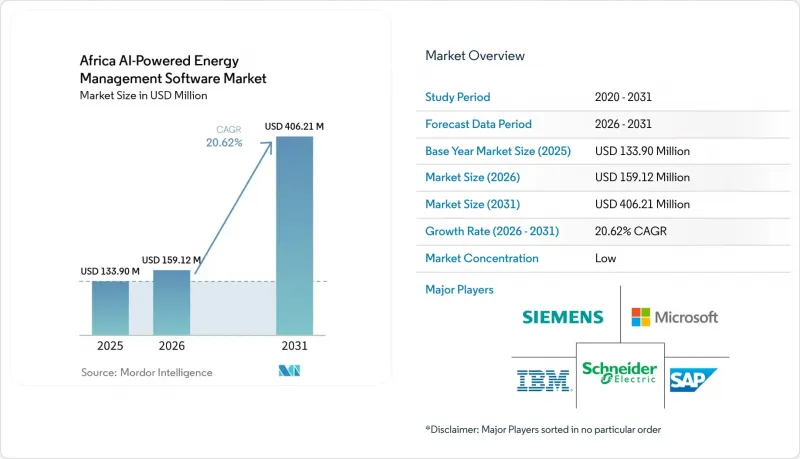
This report is Segmented by Component (Software, and Services), Deployment Mode (Cloud-Based, and More), Application (Energy Consumption and Demand Optimization, Asset Performance and Predictive Maintenance, Renewable Energy Forecasting and Integration, and More), End User (Commercial Buildings, and More), and Geography. The Market Forecasts are Provided in Terms of Value (USD).
Africa AI-Powered Energy Management Software Market Trends and Insights
Rising Need for Real-Time Energy Optimization in Commercial and Industrial Facilities
Commercial and industrial users across the Africa AI-Powered Energy Management Software Market are dealing with a sustained energy cost problem that manual monitoring cannot solve. In South Africa, rising tariffs and recurring supply instability have pushed many operators toward AI-enabled demand response and load-shifting tools to reduce peak consumption and lower exposure to volatile pricing. Honeywell deployed its Forge Performance+ platform at the Dangote Petroleum Refinery in Lagos in April 2026, demonstrating that real-time digital performance management is now in use at one of the continent's largest industrial sites. A June 2026 deployment in Nigeria also showed that AI-driven load management tied to solar and battery storage could reduce manufacturing power costs by 70%, which strengthened the commercial case for broader adoption. As tariff pressure and supply unreliability rise together, payback periods are shortening, and procurement is moving faster across the Africa AI-Powered Energy Management Software Market.
AI Integration With Smart Grids and Distributed Energy Resources
The Africa AI-Powered Energy Management Software Market is also gaining support from utility modernization programs that need better visibility across grids that were long operated with limited digital intelligence. Rocky Mountain Institute reported in October 2025 that many African utilities were still running largely analog systems with limited visibility into customer demand profiles and asset locations, leaving a clear opening for AI-based situational awareness and orchestration tools. GE Vernova, Larsen, and Toubro secured the KETRACO National System Control Center contract in Kenya, bringing GridOS Advanced Energy Management Systems and wide area monitoring capabilities into the national transmission environment. In West Africa, GE Vernova software is also supporting dispatch, stability monitoring, and market operations for the West African Power Pool across 14 ECOWAS member countries. As distributed energy resources approach the 5% to 15% distribution peak threshold noted by RMI, AI software is becoming part of basic grid operations rather than a discretionary digital upgrade.
High Integration Complexity With Legacy OT and IT Systems
A major brake on the Africa AI-Powered Energy Management Software Market is the difficulty of connecting AI software to older operational technology and control environments that were never designed for data-rich automation. In March 2025, many industrial energy deployments in the region still used outdated SCADA and automation systems poorly aligned with cloud-native platforms, thereby extending procurement and implementation cycles. The governance gap between IT and OT compounds the problem because different teams with distinct operating assumptions often handle protection, uptime, and safety priorities. A 2025 review in the Journal of Big Data identified legacy infrastructure and a weak digital data architecture as leading barriers to AI deployment in energy systems, and this challenge is especially evident in African operating environments with long asset replacement cycles. These conditions keep near-term adoption concentrated among larger utilities and industrial groups that can fund integration work without disrupting day-to-day operations in the Africa AI-Powered Energy Management Software Market.
Other drivers and restraints analyzed in the detailed report include:
- Expansion of ESG Reporting and Carbon Accounting Workflows
- Edge AI Adoption for Site-Level Fault Detection and Control
- Data Quality, Interoperability, and Sensor Fragmentation Issues
For complete list of drivers and restraints, kindly check the Table Of Contents.
Segment Analysis
Software accounted for 68.41% of component revenue in 2025, giving it the largest position in the Africa AI-Powered Energy Management Software Market. Buyers initially favored software because analytics, visualization, and optimization tools could be layered onto existing systems before committing to broader transformation work. This pattern was strongest in South Africa, Egypt, and Nigeria, where early adopters sought fast gains in monitoring and control without taking on the full burden of integration. Software also matched the first stage of procurement in many utilities and industrial facilities, where visibility into energy use and operational anomalies mattered more than deep consulting support. That early weighting kept platform licenses and subscriptions at the center of spending in the Africa AI-Powered Energy Management Software Market.
Services are projected to grow at a 23.34% CAGR through 2031, making them the fastest-expanding component of the Africa AI-Powered Energy Management Software Market. The reason is practical, because many users need help with configuration, training, system tuning, and managed analytics long after the first software deployment goes live. Vendors that can link fees to measurable energy cost reduction are gaining traction with customers who want ongoing operational support rather than a one-time installation. Schneider Electric's regional push toward EcoStruxure Energy Intelligence also reflects this shift, as the company is moving from product-led contracts toward AI-linked recurring software and service models. Over time, those services may put pressure on pure software specialists, because broader incumbents can bundle analytics, implementation, and long-term optimization into a single commercial offer.
Cloud-based deployment held a 66.29% share in 2025, making it the leading delivery model across the Africa AI-Powered Energy Management Software Market. Cloud systems appealed to buyers because they lowered upfront infrastructure costs and made it easier to configure, monitor, and update distributed assets across wide geographic footprints. They also fit the needs of organizations that wanted faster deployment and centralized visibility across multiple buildings, substations, or operating sites. For many commercial users, cloud-based platforms provided an accessible entry point into AI-based energy management without requiring large on-site computing investments. This gave cloud deployment a strong early lead in the Africa AI-Powered Energy Management Software Market.
Hybrid deployment is forecast to expand at a 22.77% CAGR through 2031, reflecting the need to combine cloud analytics with local control for critical operations. Utilities, mines, and large industrial sites increasingly need on-site response capacity because real-time decisions cannot always wait for stable connectivity or round-trip cloud processing. Mining deployments highlighted this need in 2025, as edge-based AI solutions were being deployed to remote sites with challenging power and communications conditions. PotisEdge's Zambia microgrid project also showed that local dispatch intelligence is becoming central, as solar, battery, and diesel systems must be continuously balanced. Vendors that can manage both edge and cloud environments through one interface are therefore gaining a stronger position in the Africa AI-Powered Energy Management Software Market.
Complete Report Scope:
- By Component
- Software
- Services
- By Deployment Mode
- Cloud-Based
- On-Premises
- Hybrid
- By Application
- Energy Consumption and Demand Optimization
- Asset Performance and Predictive Maintenance
- Smart Grid and Distributed Energy Resource (DER) Management
- Renewable Energy Forecasting and Integration
- Energy Trading, Pricing and Market Intelligence
- By End User
- Utilities
- Commercial Buildings
- Industrial Facilities
- Residential Buildings
- By Geography
- South Africa
- Egypt
- Rest of Africa
List of Companies Covered in this Report:
- Siemens AG
- Schneider Electric SE
- ABB Ltd.
- Honeywell International Inc.
- IBM Corporation
- Johnson Controls International plc
- General Electric Company
- Eaton Corporation plc
- Emerson Electric Co.
- Oracle Corporation
- Microsoft Corporation
- Amazon Web Services, Inc.
- SAP SE
- C3.ai, Inc.
- Bidgely, Inc.
- Grid4C Ltd.
- Innowatts, Inc.
- Enel X S.r.l.
- GridPoint, Inc.
- Dexma Sensors, S.L.
Additional Benefits:
- The market estimate (ME) sheet in Excel format
- 3 months of analyst support
TABLE OF CONTENTS
1 INTRODUCTION
- 1.1 Study Assumptions and Market Definition
- 1.2 Scope of the Study
2 RESEARCH METHODOLOGY
3 EXECUTIVE SUMMARY
4 MARKET LANDSCAPE
- 4.1 Market Overview
- 4.2 Market Drivers
- 4.2.1 Rising Need for Real-Time Energy Optimization in Commercial and Industrial Facilities
- 4.2.2 AI Integration With Smart Grids and Distributed Energy Resources
- 4.2.3 Expansion of ESG Reporting and Carbon Accounting Workflows
- 4.2.4 Edge AI Adoption for Site-Level Fault Detection and Control
- 4.2.5 Retrofit Demand From Aging Building and Industrial Infrastructure
- 4.2.6 Electrification and Load Flexibility Needs Across Mining and Heavy Industry
- 4.3 Market Restraints
- 4.3.1 High Integration Complexity With Legacy OT and IT Systems
- 4.3.2 Data Quality, Interoperability, and Sensor Fragmentation Issues
- 4.3.3 Cybersecurity and Data Sovereignty Concerns for Critical Energy Assets
- 4.3.4 Limited Payback Visibility in Small and Mid-Sized Sites
- 4.4 Industry Value Chain Analysis
- 4.5 Regulatory Landscape
- 4.6 Technological Outlook
- 4.7 Impact of Macroeconomic Factors on the Market
- 4.8 Porter's Five Forces Analysis
- 4.8.1 Bargaining Power of Suppliers
- 4.8.2 Bargaining Power of Buyers
- 4.8.3 Threat of New Entrants
- 4.8.4 Threat of Substitutes
- 4.8.5 Competitive Rivalry
5 MARKET SIZE AND GROWTH FORECASTS (VALUE)
- 5.1 By Component
- 5.1.1 Software
- 5.1.2 Services
- 5.2 By Deployment Mode
- 5.2.1 Cloud-Based
- 5.2.2 On-Premises
- 5.2.3 Hybrid
- 5.3 By Application
- 5.3.1 Energy Consumption and Demand Optimization
- 5.3.2 Asset Performance and Predictive Maintenance
- 5.3.3 Smart Grid and Distributed Energy Resource (DER) Management
- 5.3.4 Renewable Energy Forecasting and Integration
- 5.3.5 Energy Trading, Pricing and Market Intelligence
- 5.4 By End User
- 5.4.1 Utilities
- 5.4.2 Commercial Buildings
- 5.4.3 Industrial Facilities
- 5.4.4 Residential Buildings
- 5.5 By Geography
- 5.5.1 South Africa
- 5.5.2 Egypt
- 5.5.3 Rest of Africa
6 COMPETITIVE LANDSCAPE
- 6.1 Market Concentration
- 6.2 Strategic Moves
- 6.3 Market Share Analysis
- 6.4 Company Profiles (includes Global Level Overview, Market Level Overview, Core Segments, Financials as available, Strategic Information, Market Rank/Share, Products and Services, Recent Developments)
- 6.4.1 Siemens AG
- 6.4.2 Schneider Electric SE
- 6.4.3 ABB Ltd.
- 6.4.4 Honeywell International Inc.
- 6.4.5 IBM Corporation
- 6.4.6 Johnson Controls International plc
- 6.4.7 General Electric Company
- 6.4.8 Eaton Corporation plc
- 6.4.9 Emerson Electric Co.
- 6.4.10 Oracle Corporation
- 6.4.11 Microsoft Corporation
- 6.4.12 Amazon Web Services, Inc.
- 6.4.13 SAP SE
- 6.4.14 C3.ai, Inc.
- 6.4.15 Bidgely, Inc.
- 6.4.16 Grid4C Ltd.
- 6.4.17 Innowatts, Inc.
- 6.4.18 Enel X S.r.l.
- 6.4.19 GridPoint, Inc.
- 6.4.20 Dexma Sensors, S.L.
7 MARKET OPPORTUNITIES AND FUTURE OUTLOOK
- 7.1 White-Space and Unmet-Need Assessment

