PUBLISHER: Mordor Intelligence | PRODUCT CODE: 2073285

PUBLISHER: Mordor Intelligence | PRODUCT CODE: 2073285
North America AI-Powered Energy Management Software - Market Share Analysis, Industry Trends & Statistics, Growth Forecasts (2026 - 2031)
According to Mordor Intelligence, the north america AI-Powered energy management software market size is projected to expand from USD 1.46 billion in 2025 and USD 1.70 billion in 2026 to USD 3.87 billion by 2031, registering a CAGR of 17.88% between 2026 and 2031.
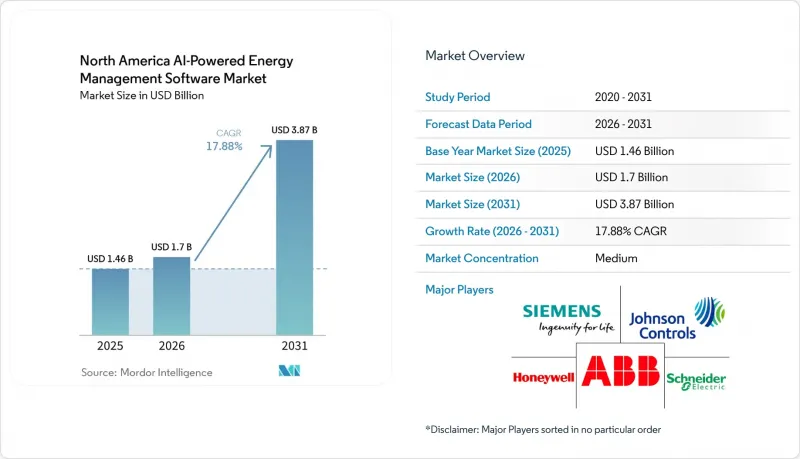
This report is Segmented by Component (Software, and Services), Deployment Mode (Cloud-Based, On-Premises, and Hybrid), Application (Energy Consumption and Demand Optimization, Asset Performance and Predictive Maintenance, and More), End User (Commercial Buildings, Industrial Facilities, and More), and Geography. The Market Forecasts are Provided in Terms of Value (USD).
North America AI-Powered Energy Management Software Market Trends and Insights
Rapid Smart Meter and IoT Sensor Penetration Across Commercial Sites
Rapid meter and sensor adoption is expanding the database that building and facility software can use to learn normal operating patterns. In the North America AI-Powered Energy Management Software Market, this matters because better interval data helps platforms move from simple monitoring to active prediction and automated response. Commercial sites are also bringing HVAC controls, inverter feeds, and occupancy signals onto shared digital layers, which makes multi-site benchmarking more practical. That shift reduces the need for proprietary hardware in every location and improves the case for software-led rollouts across portfolios. Second-wave metering and sensor upgrades are also improving encryption, edge processing, and device reliability, which supports more secure analytics use in operating environments. As that installed base becomes more consistent, vendors in the North America AI-Powered Energy Management Software Market are better positioned to scale recurring software contracts across existing customer sites.
Rising Utility Tariffs and Demand Charges for Peak Load Customers
Rising electricity tariffs are turning energy optimization from a cost-control tool into a direct operating-margin tool for large facilities. Demand charges remain especially important because a short peak event can shape the full monthly bill for commercial and industrial users. Electricity demand in ERCOT grew by more than 9% year over year from October 2025 through March 2026, reflecting data center construction, industrial electrification, and growth in electric vehicle charging. That increase tightened grid conditions and strengthened the value of software that can shift load, automate response, and time battery dispatch more accurately. Facilities without these tools are facing not only higher bills but also greater exposure to short-term price swings as grid operators use more dynamic pricing structures. This is keeping the North America AI-Powered Energy Management Software Market closely tied to tariff pressure in high-load states.
Integration Complexity with Legacy Building Management Systems
Legacy system complexity remains a major barrier because many buildings still operate with mixed protocols and older controllers. In the North America AI-Powered Energy Management Software Market, this slows deployment when building automation layers do not share a common data structure or an easy application interface. Many sites carry years of BACnet, Modbus, and proprietary controls that were installed in stages rather than designed as one connected architecture. That forces software vendors to spend more time on middleware, custom mapping, and validation before the first analytic model can deliver value. Mid-sized commercial properties are affected the most because they are large enough to justify software investment but often lack specialist integration and staff. This keeps deployment costs elevated and makes the North
Other drivers and restraints analyzed in the detailed report include:
- Portfolio Decarbonization Commitments from Enterprises and Campuses
- Integration With Distributed Energy Resources and Battery Storage
- Cybersecurity and Data Governance Concerns for Connected Energy Data
For complete list of drivers and restraints, kindly check the Table Of Contents.
Segment Analysis
Software held 74.12% of the North America AI-Powered Energy Management Software market share in 2025, keeping vendor revenue centered on recurring subscriptions and licensing rather than hardware-led project margins. The North America AI-Powered Energy Management Software Market continues to favor software because customers typically want fast visibility, optimization logic, and reporting without adding significant new field hardware. That revenue profile also gives vendors more room to expand into analytics upgrades, dashboards, forecasting tools, and compliance modules over time. Eaton launched Brightlayer Energy in March 2026 for commercial buildings in healthcare, education, and retail, with functions for real-time analysis, forecasting, automated control, and distributed energy optimization. Product launches like this show how software vendors are tying energy optimization more closely to operational management and local compliance support
Services are smaller in absolute terms, but they are projected to grow at a 17.93% CAGR from 2026 to 2031, slightly ahead of the overall market pace. In the North America AI-Powered Energy Management Software Market, the customer base increasingly needs integration support, managed analytics, and model tuning after initial deployment. Many organizations lack sufficient internal energy analytics or data science staff to maintain complex in-house optimization tools. This is pushing providers to compete on service depth, onboarding quality, and ongoing performance support as much as on software features.
Cloud-based deployment accounted for 63.14% of the market in 2025, reflecting the appeal of simpler rollout and lower infrastructure management for many building and enterprise users. The North America AI-Powered Energy Management Software Market has shifted toward the cloud because multi-site users often need centralized reporting and faster software updates across portfolios. Hybrid deployment is still the fastest-growing mode with an 18.02% CAGR from 2026 to 2031, because many regulated or sensitive environments want analytics scale without fully moving control-plane data outside the local security boundary. That makes hybrid architecture a practical fit for utilities and industrial operators that must keep tighter control over operational systems. It also helps vendors serve customers who want real-time edge decisions on-site while still using cloud layers for broader analytics and oversight.
NERC requirements reinforce the need for careful cyber design when software interfaces with the bulk electric system. AWS and Siemens Energy expanded their collaboration in April 2026 to support digital transformation and energy infrastructure solutions, reflecting how major technology providers are aligning cloud capabilities with the energy sector's operating needs. In the North America AI-Powered Energy Management Software Market, this supports the view that hybrid frameworks will remain central while utilities and large enterprises balance scale, latency, and compliance. Pure on-premises models will remain relevant in more stringent environments, but their relative growth is likely to lag that of more flexible architectures over the forecast period.
Complete Report Scope:
- By Component
- Software
- Services
- By Deployment Mode
- Cloud-Based
- On-Premises
- Hybrid
- By Application
- Energy Consumption and Demand Optimization
- Asset Performance and Predictive Maintenance
- Smart Grid and Distributed Energy Resource (DER) Management
- Renewable Energy Forecasting and Integration
- Energy Trading, Pricing and Market Intelligence
- By End User
- Utilities
- Commercial Buildings
- Industrial Facilities
- Residential Buildings
- By Geography
- United States
- Canada
- Mexico
List of Companies Covered in this Report:
- Schneider Electric SE
- Siemens AG
- Johnson Controls International plc
- Honeywell International Inc.
- ABB Ltd.
- IBM Corporation
- Oracle Corporation
- Cisco Systems, Inc.
- Enel X North America, Inc.
- Delta Electronics, Inc.
- SAP SE
- Eaton Corporation plc
- Carrier Global Corporation
- Trane Technologies plc
- GridPoint, Inc.
- AutoGrid Systems, Inc
- EnergyHub
- Acuity Brands, Inc.
- AutoGrid Systems, Inc.
- Amperon
Additional Benefits:
- The market estimate (ME) sheet in Excel format
- 3 months of analyst support
TABLE OF CONTENTS
1 INTRODUCTION
- 1.1 Study Assumptions and Market Definition
- 1.2 Scope of the Study
2 RESEARCH METHODOLOGY
3 EXECUTIVE SUMMARY
4 MARKET LANDSCAPE
- 4.1 Market Overview
- 4.2 Market Drivers
- 4.2.1 Rapid Smart Meter And IoT Sensor Penetration Across Commercial Sites
- 4.2.2 Rising Utility Tariffs And Demand Charges For Peak Load Customers
- 4.2.3 Portfolio Decarbonization Commitments From Enterprises And Campuses
- 4.2.4 Integration With Distributed Energy Resources And Battery Storage
- 4.2.5 AI-Enabled Fault Detection Reducing Energy Waste From Hidden Equipment Drift
- 4.2.6 New Utility Incentives For Automated Demand Response Participation
- 4.3 Market Restraints
- 4.3.1 Integration Complexity With Legacy Building Management Systems
- 4.3.2 Cybersecurity And Data Governance Concerns For Connected Energy Data
- 4.3.3 Long Enterprise Sales Cycles And Solution Validation Requirements
- 4.3.4 Skilled Facility-Analytics Talent Shortage At Mid-Market End Users
- 4.4 Impact of Macroeconomic Factors on The Market
- 4.5 Industry Value-Chain Analysis
- 4.6 Regulatory Landscape
- 4.7 Technological Outlook
- 4.8 Porter's Five Forces Analysis
- 4.8.1 Bargaining Power of Buyers
- 4.8.2 Bargaining Power of Suppliers
- 4.8.3 Threat of New Entrants
- 4.8.4 Threat of Substitutes
- 4.8.5 Intensity of Competitive Rivalry
5 MARKET SIZE AND GROWTH FORECASTS (VALUE)
- 5.1 By Component
- 5.1.1 Software
- 5.1.2 Services
- 5.2 By Deployment Mode
- 5.2.1 Cloud-Based
- 5.2.2 On-Premises
- 5.2.3 Hybrid
- 5.3 By Application
- 5.3.1 Energy Consumption and Demand Optimization
- 5.3.2 Asset Performance and Predictive Maintenance
- 5.3.3 Smart Grid and Distributed Energy Resource (DER) Management
- 5.3.4 Renewable Energy Forecasting and Integration
- 5.3.5 Energy Trading, Pricing and Market Intelligence
- 5.4 By End User
- 5.4.1 Utilities
- 5.4.2 Commercial Buildings
- 5.4.3 Industrial Facilities
- 5.4.4 Residential Buildings
- 5.5 By Geography
- 5.5.1 United States
- 5.5.2 Canada
- 5.5.3 Mexico
6 COMPETITIVE LANDSCAPE
- 6.1 Market Concentration
- 6.2 Strategic Moves
- 6.3 Market Share Analysis
- 6.4 Company Profiles (includes Global Level Overview, Market Level Overview, Core Segments, Financials as available, Strategic Information, Market Rank/Share, Products and Services, Recent Developments)
- 6.4.1 Schneider Electric SE
- 6.4.2 Siemens AG
- 6.4.3 Johnson Controls International plc
- 6.4.4 Honeywell International Inc.
- 6.4.5 ABB Ltd.
- 6.4.6 IBM Corporation
- 6.4.7 Oracle Corporation
- 6.4.8 Cisco Systems, Inc.
- 6.4.9 Enel X North America, Inc.
- 6.4.10 Delta Electronics, Inc.
- 6.4.11 SAP SE
- 6.4.12 Eaton Corporation plc
- 6.4.13 Carrier Global Corporation
- 6.4.14 Trane Technologies plc
- 6.4.15 GridPoint, Inc.
- 6.4.16 AutoGrid Systems, Inc
- 6.4.17 EnergyHub
- 6.4.18 Acuity Brands, Inc.
- 6.4.19 AutoGrid Systems, Inc.
- 6.4.20 Amperon
7 MARKET OPPORTUNITIES AND FUTURE OUTLOOK
- 7.1 White-Space and Unmet-Need Assessment

