PUBLISHER: Mordor Intelligence | PRODUCT CODE: 2073359

PUBLISHER: Mordor Intelligence | PRODUCT CODE: 2073359
Renewable Energy Insurance - Market Share Analysis, Industry Trends & Statistics, Growth Forecasts (2026 - 2031)
According to Mordor Intelligence, the renewable energy insurance market size in terms of premium value is projected to be USD 18.77 billion in 2025, USD 20.11 billion in 2026, and reach USD 28.35 billion by 2031, growing at a CAGR of 7.12% from 2026 to 2031.
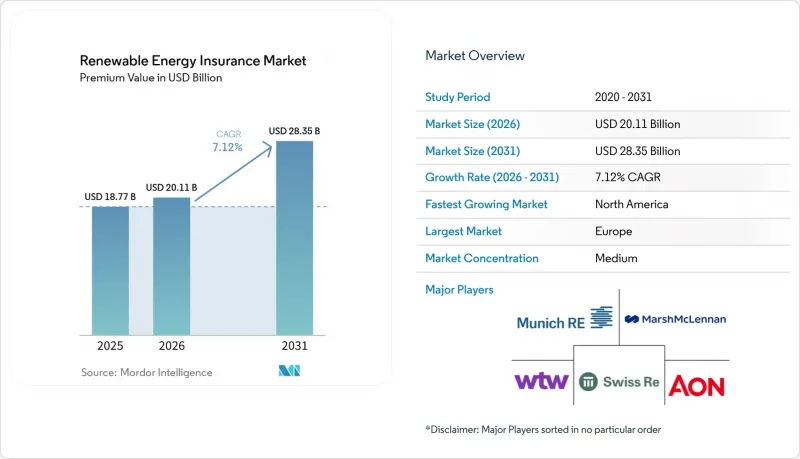
This report is Segmented by Coverage Type (Property Damage & Business Interruption, Construction All-Risk/Erection All-Risk, and More), Renewable Energy Technology (Onshore Wind, Offshore Wind, Utility-Scale Solar PV, and More), End-User (Utility-Scale IPPs & Owners, Commercial & Industrial Operators, and More), and Region. The Market Forecasts are Provided in Value (USD).
Global Renewable Energy Insurance Market Trends and Insights
Global Roll-out of Utility-scale Solar & Wind Assets
Surging deployment of gigawatt-class renewables is widening demand for sophisticated insurance packages that go beyond traditional property indemnity. Swiss Re's participation in reinsuring a 3,500 MW solar-plus-storage complex in the Philippines showcases the scale and complexity now commonplace for clean-energy megaprojects. Coverage frameworks must span construction all-risk, operational performance guarantees, and multi-decade revenue stability while also addressing geographic clustering that amplifies correlated loss potential. Underwriters are responding with larger capacity tranches, granular catastrophe modeling, and multi-trigger structures that blend damage and index-based payouts. As project pipelines in APAC and North America accelerate, this driver exerts the largest positive push on overall premium growth in the renewable energy insurance market.
Escalating NatCat Losses Heighten Risk-Transfer Demand
Natural catastrophe losses tied to renewables have surged, exemplified by USD 300 million in US hail-related solar claims paid during the 2022 season. Although hail events represent just 6% of incidents, they account for more than 70% of photovoltaic system losses. The asymmetric peril profile is pushing carriers toward parametric solutions that trigger hailstone diameter or kinetic energy thresholds while developers adopt proactive measures such as automatic stow protocols. The feedback loop of higher loss ratios and specialty reinsurance pricing is hardening premiums, yet it also widens the addressable pool for differentiated products within the renewable energy insurance market.
Capacity Withdrawal & Premium Hardening Across Renewable Lines
In response to a series of heightened natural catastrophe claims, numerous insurance carriers have either reduced their line sizes or withdrawn from specific perils, leading to significant rate hikes. According to GCube, US solar risks have seen premiums surge from 10 cents to as much as 30 cents for every USD 100 of insured value. This sharp increase reflects the growing challenges in underwriting renewable energy projects, particularly in regions prone to natural disasters. Additionally, reinsurers are tightening retrocession terms, compelling primary underwriters to transfer these increased costs to policyholders. Smaller developers find it challenging to manage rising deductibles and might postpone projects until there is a more favorable capacity. These delays could potentially impact the pace of renewable energy adoption in the short term. While new players with a focus on parametric solutions are stepping in to bridge the gap, traditional property covers, which require substantial balance sheets, remain limited and are expected to retain their high prices until 2026. This constrained capacity and premium hardening underscore the need for innovative risk transfer mechanisms to support the renewable energy sector's growth.
Other drivers and restraints analyzed in the detailed report include:
- Government Decarbonization Mandates & Green-Finance Covenants
- Investor/Lender ESG Compliance Requirements for Bankable Cover
- Limited Actuarial Loss Data for Emerging Technologies
For complete list of drivers and restraints, kindly check the Table Of Contents.
Segment Analysis
Property damage & business interruption policies delivered 37.74% of the 2025 premium, securing the largest slice of the renewable energy insurance market share. They remain indispensable for lenders that require asset-level indemnification through construction and 20-year operational phases. However, parametric structures are projected to post a 9.92% CAGR through 2031, the fastest among all offerings, as buyers seek rapid liquidity following non-damage business interruption events such as wind-resource shortfalls. Construction All-Risk and Erection All-Risk plans to maintain relevance, especially for offshore projects that involve jack-up vessels and deep-water foundations. Liability forms covering third-party and environmental risks are evolving to include gradual pollution and wildlife-habitat clauses. Cyber & Technology Errors/Omissions coverage is expanding steadily as the renewable energy industry digitalizes control systems, raising aggregation exposures that traditional property wordings exclude. Together, these dynamics underscore the sophistication that carriers must embed to keep pace with evolving renewable energy insurance market requirements.
Innovation is visible in solar-radiation hedges, hail-parametric triggers, and wildfire smoke outage indices that compensate distributed energy resources for curtailed production. Carriers increasingly bundle conventional property contracts with parametric layers that drop down when deductibles erode profits. Brokers report that combined structures improve bankability by satisfying lender-mandated indemnity parameters while providing near-instant liquidity options for sponsors. The shift alters premium allocation and expands the renewable energy insurance market size for hybrid products that capture both physical damage and revenue stability needs.
Complete Report Scope:
- By Coverage Type
- Property Damage & Business Interruption
- Construction All-Risk / Erection All-Risk
- Liability (General, Environmental, Professional)
- Cyber & Technology Errors/Omissions
- Parametric / Index-based Covers
- By Renewable Energy Technology
- Onshore Wind
- Offshore Wind
- Utility-scale Solar PV
- Commercial & Industrial (C&I) Solar
- Hydropower & Marine Energy
- Bioenergy & Waste-to-Energy
- Battery Energy Storage Systems (BESS)
- By End-User
- Utility-Scale IPPs & Owners
- Commercial & Industrial Operators
- Residential Aggregators & Community Solar
- By Geography
- North America
- United States
- Canada
- Mexico
- Europe
- Germany
- United Kingdom
- France
- Italy
- Spain
- Russia
- Rest of Europe
- Asia-Pacific
- China
- India
- Japan
- South Korea
- Southeast Asia
- Rest of Asia-Pacific
- South America
- Brazil
- Argentina
- Rest of South America
- Middle East & Africa
- Saudi Arabia
- United Arab Emirates
- South Africa
- Rest of Middle East & Africa
- North America
Geography Analysis
Europe maintained a 29.74% premium share in 2025, supported by stringent climate-risk disclosure regimes and well-established public-private NatCat pools that backstop insurer balance sheets. Regional offshore wind maturity delivers actuarial credibility, allowing competitive pricing and reducing the cost of capital for sponsors. Innovation hubs in Denmark, Germany, and the Netherlands accelerate the adoption of parametric hail and low-wind index covers, further widening Europe's impact on the renewable energy insurance market.
North America is the fastest-growing region, charting a 8.93% CAGR on the strength of Inflation Reduction Act incentives and tailored solutions such as Marsh's tax-investment-default coverage that insulates investors when tax-credit allocations fall short. However, catastrophic hail in the Midwest and wildfire-driven exclusions in California strain capacity, leading some carriers to reduce aggregate limits or enforce peril sub-limits. Developers are responding through elevated deductibles and layered captive programs to preserve bankability. Despite these headwinds, the renewable energy insurance market continues expanding as US and Canadian provincial programs fund grid modernization and BESS roll-outs.
Asia-Pacific is emerging as a pivotal demand center. China alone is commissioning multi-gigawatt solar parks and offshore arrays that require reinsurance treaties surpassing USD 1 billion in aggregate limits. Swiss Re's involvement in the Philippines' integrated solar-plus-storage megaproject demonstrates the scale of opportunity. Southeast Asian nations adopting blended-finance models rely on bank-guaranteed insurance structures to attract international capital. Diverse regulatory landscapes and climatic extremes, from typhoon-prone coastlines to monsoon-impacted interiors, challenge underwriters to create location-specific perils maps, thereby fueling product localization within the renewable energy insurance market.
South America and Africa remain smaller but high-potential territories. Brazil's distributed-generation rules and Mexico's merchant solar market open doorways for parametric drought covers, while South Africa's REIPPPP program is experimenting with credit-enhanced insurance pools to mitigate PPA termination risks. As policy frameworks stabilize, insurers anticipate double-digit premium growth that will further diversify the global renewable energy insurance market.
- Marsh McLennan
- Willis Towers Watson (WTW)
- Aon
- Munich Re
- Swiss Re
- Liberty Specialty Markets
- GCube Insurance
- Axis Capital
- Zurich Insurance
- Chubb
- Allianz Global Corporate & Specialty (AGCS)
- Travelers
- Hugh Wood Inc (HWI)
- kWh Analytics
- Descartes Underwriting
- Gallagher
- BKS Partners
- RSA Insurance
- Horton Group
- Tokio Marine Kiln
Additional Benefits:
- The market estimate (ME) sheet in Excel format
- 3 months of analyst support
TABLE OF CONTENTS
1 Introduction
- 1.1 Study Assumptions & Market Definition
- 1.2 Scope of the Study
2 Research Methodology
3 Executive Summary
4 Market Landscape
- 4.1 Market Overview
- 4.2 Market Drivers
- 4.2.1 Global roll-out of utility-scale solar & wind assets
- 4.2.2 Escalating NatCat losses heightening risk-transfer demand
- 4.2.3 Government decarbonization mandates & green-finance covenants
- 4.2.4 Investor/lender ESG compliance requirements for bankable cover
- 4.2.5 Rise of battery-energy-storage systems (BESS) needing bespoke cover
- 4.2.6 Adoption of parametric weather-index products for faster payouts
- 4.3 Market Restraints
- 4.3.1 Capacity withdrawal & premium hardening across renewable lines
- 4.3.2 Limited actuarial loss data for emerging technologies
- 4.3.3 Hail-related exclusions curbing solar cover in US Midwest
- 4.3.4 Cyber-risk aggregation across distributed assets deterring reinsurers
- 4.4 Value / Supply-Chain Analysis
- 4.5 Regulatory Landscape
- 4.6 Technological Outlook
- 4.7 Porter's Five Forces
- 4.7.1 Threat of New Entrants
- 4.7.2 Bargaining Power of Buyers
- 4.7.3 Bargaining Power of Suppliers
- 4.7.4 Threat of Substitutes
- 4.7.5 Intensity of Competitive Rivalry
5 Market Size & Growth Forecasts (Value)
- 5.1 By Coverage Type
- 5.1.1 Property Damage & Business Interruption
- 5.1.2 Construction All-Risk / Erection All-Risk
- 5.1.3 Liability (General, Environmental, Professional)
- 5.1.4 Cyber & Technology Errors/Omissions
- 5.1.5 Parametric / Index-based Covers
- 5.2 By Renewable Energy Technology
- 5.2.1 Onshore Wind
- 5.2.2 Offshore Wind
- 5.2.3 Utility-scale Solar PV
- 5.2.4 Commercial & Industrial (C&I) Solar
- 5.2.5 Hydropower & Marine Energy
- 5.2.6 Bioenergy & Waste-to-Energy
- 5.2.7 Battery Energy Storage Systems (BESS)
- 5.3 By End-User
- 5.3.1 Utility-Scale IPPs & Owners
- 5.3.2 Commercial & Industrial Operators
- 5.3.3 Residential Aggregators & Community Solar
- 5.4 By Geography
- 5.4.1 North America
- 5.4.1.1 United States
- 5.4.1.2 Canada
- 5.4.1.3 Mexico
- 5.4.2 Europe
- 5.4.2.1 Germany
- 5.4.2.2 United Kingdom
- 5.4.2.3 France
- 5.4.2.4 Italy
- 5.4.2.5 Spain
- 5.4.2.6 Russia
- 5.4.2.7 Rest of Europe
- 5.4.3 Asia-Pacific
- 5.4.3.1 China
- 5.4.3.2 India
- 5.4.3.3 Japan
- 5.4.3.4 South Korea
- 5.4.3.5 Southeast Asia
- 5.4.3.6 Rest of Asia-Pacific
- 5.4.4 South America
- 5.4.4.1 Brazil
- 5.4.4.2 Argentina
- 5.4.4.3 Rest of South America
- 5.4.5 Middle East & Africa
- 5.4.5.1 Saudi Arabia
- 5.4.5.2 United Arab Emirates
- 5.4.5.3 South Africa
- 5.4.5.4 Rest of Middle East & Africa
- 5.4.1 North America
6 Competitive Landscape
- 6.1 Market Concentration
- 6.2 Strategic Moves
- 6.3 Market Share Analysis
- 6.4 Company Profiles (includes Global level Overview, Market level overview, Core Segments, Financials as available, Strategic Information, Market Rank/Share for key companies, Products & Services, and Recent Developments)
- 6.4.1 Marsh McLennan
- 6.4.2 Willis Towers Watson (WTW)
- 6.4.3 Aon
- 6.4.4 Munich Re
- 6.4.5 Swiss Re
- 6.4.6 Liberty Specialty Markets
- 6.4.7 GCube Insurance
- 6.4.8 Axis Capital
- 6.4.9 Zurich Insurance
- 6.4.10 Chubb
- 6.4.11 Allianz Global Corporate & Specialty (AGCS)
- 6.4.12 Travelers
- 6.4.13 Hugh Wood Inc (HWI)
- 6.4.14 kWh Analytics
- 6.4.15 Descartes Underwriting
- 6.4.16 Gallagher
- 6.4.17 BKS Partners
- 6.4.18 RSA Insurance
- 6.4.19 Horton Group
- 6.4.20 Tokio Marine Kiln
7 Market Opportunities & Future Outlook
- 7.1 White-space & Unmet-Need Assessment

