PUBLISHER: Mordor Intelligence | PRODUCT CODE: 2073413

PUBLISHER: Mordor Intelligence | PRODUCT CODE: 2073413
Middle East Oilfield Services - Market Share Analysis, Industry Trends & Statistics, Growth Forecasts (2026 - 2031)
According to Mordor Intelligence, the middle east oilfield services market size is expected to grow from USD 29.34 billion in 2025 to USD 31.08 billion in 2026 and is forecast to reach USD 40.56 billion by 2031 at 5.47% CAGR over 2026-2031.
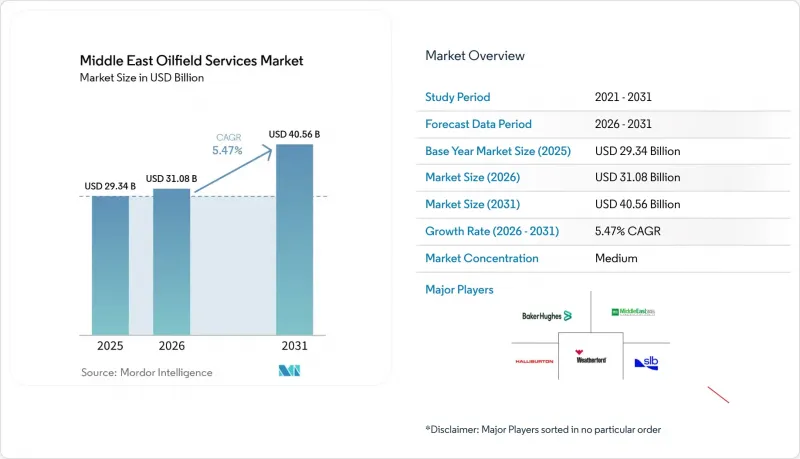
This report is Segmented by Service Type (Drilling Services, Completion Services, Production and Intervention Services, and Other Services), Location (Onshore and Offshore), Well Type (Conventional and Unconventional), and Geography (Saudi Arabia, United Arab Emirates, Qatar, Kuwait, Oman, Iran, and Rest of Middle East). The Market Sizes and Forecasts are Provided in Terms of Value (USD).
Middle East Oilfield Services Market Trends and Insights
Rising Drilling Activity Across GCC Fields
Active rig counts climbed to multi-year highs in 2025 as Saudi Arabia operated more than 100 rigs and the UAE exceeded 60, sustained by national oil companies determined to keep collective capacity above 12 million barrels per day. Increased drilling is targeting infill locations and bypassed zones, which demand advanced rotary-steerable systems and real-time data services. Qatar's North Field LNG build-out alone added 20 offshore rigs, sharpening demand for jack-up units and subsea completions. Kuwait is increasing well density in heavy-oil acreage to improve steam distribution, requiring corrosion-resistant tubulars and high-temperature logging. Chinese contractors, led by COSL, have entered Saudi offshore campaigns with five-year contracts, putting downward pressure on established providers' day rates. The expansion underscores how drilling volume and well complexity together underpin the immediate growth of the Middle East oilfield services market.
Post-COVID Oil-Price Recovery Fueling CAPEX
Brent crude averaged USD 82 per barrel in 2025, restoring cash flow for Gulf majors and unfreezing projects that had been deferred during 2020. Saudi Aramco's 2025 capital expenditure rose to USD 50 billion, while ADNOC committed USD 150 billion across five years, channeling much of that sum into drilling, completion, and production solutions. Higher prices have reactivated long-cycle offshore developments along with unconventional gas projects that carry larger service intensity. Yet OPEC+ supply management still introduces quarterly swings, pushing operators to negotiate performance-based pricing that shifts more risk to contractors. Integrated project-management models, where service companies assume reservoir delivery responsibility, are gaining traction, illustrated by Schlumberger's framework in Oman's tight-gas assets. Collectively, resilient Brent levels continue to lift the Middle East oilfield services market, even as volatility demands flexible commercial structures.
Volatile Crude-Oil Prices
Price swings between USD 70 and USD 90 per barrel through 2025 produced uneven investment patterns and forced mid-contract repricing on several service agreements. Performance-linked structures adopted by Saudi Aramco and ADNOC transfer revenue risk to contractors, shrinking cash visibility. Smaller independents in Kuwait and Oman pause work when Brent softens, weighing on fleet utilization. Uncertainty also deters rig-new-build commitments, tightening supply and elevating spot day rates when demand rebounds. Diversified service providers now bundle maintenance annuities and digital subscriptions to smooth earnings during price troughs, helping mitigate but not eliminate volatility drag on the Middle East oilfield services market.
Other drivers and restraints analyzed in the detailed report include:
- National-Oil-Company Investment in Unconventional Resources
- Local-Content Mandates Boosting Regional Contracts
- Water-Scarcity Limits on Large-Scale Hydraulic Fracturing
For complete list of drivers and restraints, kindly check the Table Of Contents.
Segment Analysis
Production and intervention services are projected to grow at a 7.5% CAGR to 2031, eclipsing the expansion pace of drilling despite drilling's 34.9% Middle East oilfield services market share in 2025. Operators now favor coiled-tubing cleanouts, acid stimulations, and artificial-lift retrofits that squeeze additional barrels from mature assets. Digital well surveillance tools flag underperforming producers sooner, triggering immediate remedial activity. Completion services, especially multi-stage fracturing for tight-gas horizons, are also scaling, supported by Jafurah and Rub al Khali work programs. Drilling retains scale, yet horizontal well designs demand fewer rig days per foot, reallocating spend toward high-value downhole tools and telemetry. Layering these trends, the production-oriented segment accounts for rising contract share, illustrating how capital efficiency priorities shape the Middle East oilfield services market.
Drilling contractors respond by integrating measurement-while-drilling analytics, autonomous rotary-steerable systems, and managed-pressure kits to preserve relevance. Intervention providers further differentiate through fit-for-purpose EOR packages that combine fiber-optic diagnostics with high-temperature packers. Cementing players introduce self-healing slurries to cope with high-pressure, high-temperature wells, expanding average revenue per job. While other ancillary services, such as seismic or decommissioning, deliver steady but modest growth, the spotlight stays on production optimisation as the quickest route to uphold national output targets without massive greenfield outlays.
Complete Report Scope:
- By Service Type
- Drilling Services
- Completion Services (Cementing, Hydraulic Fracturing)
- Production and Intervention Services
- Other Services (OSV, seismic, decomm., aviation)
- By Location
- Onshore
- Offshore
- By Well Type
- Conventional
- Unconventional
- By Geography
- Saudi Arabia
- United Arab Emirates
- Qatar
- Kuwait
- Oman
- Iran
- Rest of Middle East
List of Companies Covered in this Report:
- Schlumberger Limited
- Halliburton Company
- Baker Hughes Company
- Weatherford International plc
- National Energy Services Reunited Corp (NESR)
- ADNOC Drilling
- KCA Deutag
- OiLServ Ltd
- Welltec A/S
- Anton Oilfield Services Group
- Swire Energy Services
- Denholm Oilfield Services
- Saipem SpA
- Expro Group
- Petrofac Limited
- China Oilfield Services Limited (COSL)
- Vallourec
- Nabors Industries Ltd
- Shelf Drilling
- Arabian Drilling Company
- Arabian Oilfield Services
Additional Benefits:
- The market estimate (ME) sheet in Excel format
- 3 months of analyst support
TABLE OF CONTENTS
1 Introduction
- 1.1 Study Assumptions & Market Definition
- 1.2 Scope of the Study
2 Research Methodology
3 Executive Summary
4 Market Landscape
- 4.1 Market Overview
- 4.2 Market Drivers
- 4.2.1 Rising drilling activity across GCC fields
- 4.2.2 Post-COVID oil-price recovery fueling CAPEX
- 4.2.3 National-oil-company investment in unconventional resources
- 4.2.4 Local-content mandates boosting regional contracts
- 4.2.5 Thermal EOR projects to maximize mature-field output
- 4.2.6 Digital-oilfield adoption to offset manpower shortages
- 4.3 Market Restraints
- 4.3.1 Volatile crude-oil prices
- 4.3.2 Tighter regional CO2-emission regulations
- 4.3.3 Sanctions-driven procurement delays (Iran focus)
- 4.3.4 Water-scarcity limits on large-scale hydraulic fracturing
- 4.4 Supply-Chain Analysis
- 4.5 Regulatory Landscape
- 4.6 Technological Outlook
- 4.7 Porter's Five Forces
- 4.7.1 Bargaining Power of Suppliers
- 4.7.2 Bargaining Power of Buyers
- 4.7.3 Threat of New Entrants
- 4.7.4 Threat of Substitutes
- 4.7.5 Intensity of Competitive Rivalry
5 Market Size & Growth Forecasts
- 5.1 By Service Type
- 5.1.1 Drilling Services
- 5.1.2 Completion Services (Cementing, Hydraulic Fracturing)
- 5.1.3 Production and Intervention Services
- 5.1.4 Other Services (OSV, seismic, decomm., aviation)
- 5.2 By Location
- 5.2.1 Onshore
- 5.2.2 Offshore
- 5.3 By Well Type
- 5.3.1 Conventional
- 5.3.2 Unconventional
- 5.4 By Geography
- 5.4.1 Saudi Arabia
- 5.4.2 United Arab Emirates
- 5.4.3 Qatar
- 5.4.4 Kuwait
- 5.4.5 Oman
- 5.4.6 Iran
- 5.4.7 Rest of Middle East
6 Competitive Landscape
- 6.1 Market Concentration
- 6.2 Strategic Moves (M&A, Partnerships, PPAs)
- 6.3 Market Share Analysis (Market Rank/Share for key companies)
- 6.4 Company Profiles (includes Global level Overview, Market level overview, Core Segments, Financials as available, Strategic Information, Products & Services, and Recent Developments)
- 6.4.1 Schlumberger Limited
- 6.4.2 Halliburton Company
- 6.4.3 Baker Hughes Company
- 6.4.4 Weatherford International plc
- 6.4.5 National Energy Services Reunited Corp (NESR)
- 6.4.6 ADNOC Drilling
- 6.4.7 KCA Deutag
- 6.4.8 OiLServ Ltd
- 6.4.9 Welltec A/S
- 6.4.10 Anton Oilfield Services Group
- 6.4.11 Swire Energy Services
- 6.4.12 Denholm Oilfield Services
- 6.4.13 Saipem SpA
- 6.4.14 Expro Group
- 6.4.15 Petrofac Limited
- 6.4.16 China Oilfield Services Limited (COSL)
- 6.4.17 Vallourec
- 6.4.18 Nabors Industries Ltd
- 6.4.19 Shelf Drilling
- 6.4.20 Arabian Drilling Company
- 6.4.21 Arabian Oilfield Services
7 Market Opportunities & Future Outlook
- 7.1 White-space & Unmet-Need Assessment

