PUBLISHER: Mordor Intelligence | PRODUCT CODE: 2073444

PUBLISHER: Mordor Intelligence | PRODUCT CODE: 2073444
CRM Analytics - Market Share Analysis, Industry Trends & Statistics, Growth Forecasts (2026 - 2031)
According to Mordor Intelligence, the CRM analytics market size is valued at USD 12.11 billion in 2026 and is projected to reach USD 20.65 billion by 2031, registering an 11.26% CAGR during the forecast period.
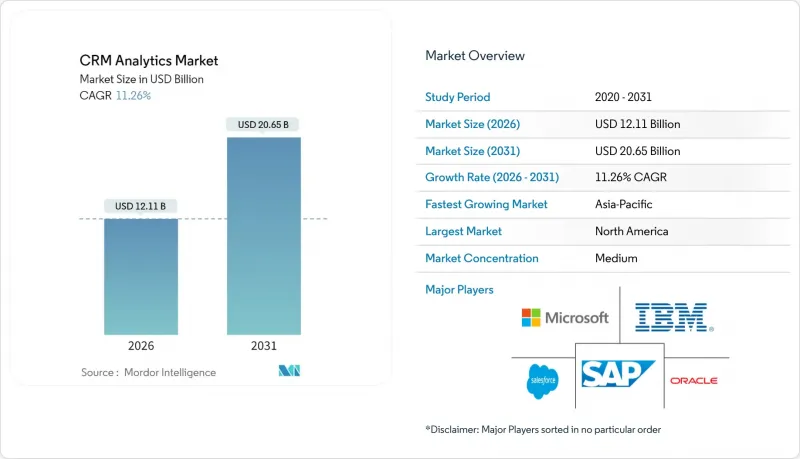
This report is Segmented by Type (Sales and Marketing Analytics, Contact Center Analytics, and More), Deployment (On-Premise, and Cloud), End-User (BFSI, Healthcare, Retail and E-Commerce, Telecom and IT Services, Transportation and Logistics, and More), Organization Size (Small and Medium Enterprises (SMEs), and Large Enterprises), and Geography. The Market Forecasts are Provided in Terms of Value (USD).
Global CRM Analytics Market Trends and Insights
Rising Adoption of Cloud-based CRM Analytics
Cloud deployment removes capital expenditure, enables near-instant sandbox creation for A/B testing, and supports consumption pricing that aligns cost with usage, an approach 78% of Einstein Analytics seats adopted in 2025. Microsoft Dynamics integrates Azure Synapse and Azure Machine Learning to condense weeks of data-wrangling into days, while Oracle Fusion Cloud CX released per-prediction pricing that peaks only during holiday surges. Certified security frameworks such as ISO/IEC 27001 and SOC 2 Type II reduce audit burdens, further accelerating migration to cloud platforms.
Demand for Hyper-personalized Customer Engagement
Managed services such as Amazon Personalize have delivered 23% higher conversion rates in retail pilots by embedding collaborative filtering directly into checkout flows. Shopify now adjusts product bundles in real time through event-driven propensity scoring, while Salesforce Interaction Studio triggers next-best-action recommendations within milliseconds of user clicks. The move from nightly batch segmentation to streaming micro-moments favors platforms that can ingest clickstreams, score intent, and deploy tailored content before a prospect abandons a session.
Data Integration Complexity Across Siloed Sources
IBM reported that 42% of AI projects stalled in 2025 due to fragmented schemas and mismatched identifiers, forcing data engineers to spend 38% of their time troubleshooting connector failures. Legacy databases lack modern APIs, while SaaS tools impose proprietary rate limits. Change-data-capture streams must reconcile simultaneous updates across systems, extending project timelines by six weeks on average. Without unified identifiers, predictive accuracy degrades and total cost of ownership rises.
Other drivers and restraints analyzed in the detailed report include:
- Rapid Integration of AI and ML for Predictive Insights
- Real-time CDP-CRM Convergence
- Heightened Data-privacy Compliance Costs (GDPR/CPRA)
For complete list of drivers and restraints, kindly check the Table Of Contents.
Segment Analysis
Sales and marketing analytics held 41.36% of the CRM Analytics market share in 2025, underlining its role in pipeline forecasting and attribution reporting. However, social media and web analytics are advancing at a 12.66% CAGR, reflecting recognition that unstructured social sentiment predicts churn and product failures earlier than ticket volume. For example, social monitoring detected emerging issues 4.2 days sooner, reducing churn by 18%. Contact center analytics blends speech-to-text transcription and emotion detection to lower service costs, while customer analytics remains the backbone for lifetime-value modeling. Vendors now bundle these once-separate modules, as HubSpot's Customer Platform unifies marketing, sales, and service analytics in a single interface.
The convergence simplifies user experience but demands platforms handle multimodal data at scale. Real-time text, voice, and video inputs require low-latency processing and elastic storage, capabilities delivered through cloud data lakes and stream engines. Regulatory frameworks such as the EU Digital Services Act drive adoption by mandating content-moderation transparency for platforms exceeding 45 million users. This spurs demand for advanced social listening metrics such as flagged-post tracking and appeal outcomes. The type segmentation gap will narrow as sales, service, and social insights merge into a unified analytical fabric.
Cloud deployments captured 63.84% of the CRM Analytics market in 2025 and are forecast to grow at a 13.35% CAGR through 2031. Elastic compute engines enable training of transformer-scale models and power real-time inference workloads. On-premises installations persist in finance and government but increasingly adopt hybrid designs. Oracle Fusion Cloud CX allows banks to store personal data on-premises Oracle Exadata while streaming anonymized telemetry to Oracle Cloud Infrastructure for modeling, resolving data-sovereignty mandates under China's PIPL. Consumption-based pricing further tips economics in favor of cloud and reduces unused capacity endemic to on-premises data centers.
Hybrid clouds also streamline compliance. FedRAMP, ISO/IEC 27001, and SOC 2 Type II attestations shift audit responsibility from the customer to the vendor. Microsoft bills Dynamics 365 Customer Insights by the number of unified profiles, aligning cost with value. Salesforce Einstein Analytics Flex introduced per-query billing, enabling thousands of occasional users without per-seat fees. Security, elasticity, and economic viability jointly reinforce cloud supremacy in the deployment landscape.
Complete Report Scope:
- By Type
- Sales and Marketing Analytics
- Contact Center Analytics
- Customer Analytics
- Social Media and Web Analytics
- By Deployment
- On-premise
- Cloud
- By End-User
- Banking, Financial Services and Insurance (BFSI)
- Healthcare
- Retail and E-commerce
- Telecom and IT Services
- Transportation and Logistics
- Media and Entertainment
- Other End-Users
- By Organization Size
- Small and Medium Enterprises (SMEs)
- Large Enterprises
- By Geography
- North America
- United States
- Canada
- Mexico
- South America
- Brazil
- Argentina
- Rest of South America
- Europe
- Germany
- United Kingdom
- France
- Italy
- Spain
- Rest of Europe
- Asia-Pacific
- China
- Japan
- India
- South Korea
- ASEAN
- Rest of Asia-Pacific
- Middle East
- Saudi Arabia
- United Arab Emirates
- Rest of Middle East
- Africa
- South Africa
- Nigeria
- Rest of Africa
- North America
Geography Analysis
North America retained 36.75% of the CRM Analytics market in 2025, anchored by a dense ecosystem of platform vendors, hyperscale clouds, and early adopters in retail and financial services. U.S. banks implement analytics to meet open-banking standards, while Canadian institutions align with the FCAC's framework. Europe balances growth with GDPR compliance costs; vendors emphasize privacy-by-design to satisfy EDPB guidelines. Germany and France lead in manufacturing analytics, while the United Kingdom accelerates fintech experimentation supported by open-banking APIs.
Asia-Pacific is the fastest-growing region at 13.05% CAGR. India's Digital Personal Data Protection Act triggers demand for consent orchestration, spurring hybrid cloud adoption. China enforces data-localization under PIPL, favoring domestic clouds such as Alibaba and Tencent. Japan migrates legacy on-premises deployments as Salesforce opens a third Tokyo data center, mitigating residency concerns. ASEAN markets embrace analytics to support digital banking and super-app ecosystems; Grab integrates ride-hailing, food delivery, and payments data into unified profiles.
South America faces macroeconomic volatility yet incrementally adopts cloud analytics through consumption pricing, led by Brazilian retailers digitizing loyalty programs. The Middle East aligns CRM analytics with Saudi Vision 2030 diversification mandates, deploying Salesforce and Dynamics to manage citizen services. Africa remains nascent but shows momentum in South Africa and Nigeria, where mobile-first architectures require real-time churn prediction and personalized top-ups. Zoho's Johannesburg data center helps local enterprises comply with the Protection of Personal Information Act.
- Salesforce, Inc.
- Oracle Corporation
- SAP SE
- Microsoft Corporation
- International Business Machines Corporation
- SAS Institute Inc.
- Adobe Inc.
- Teradata Corporation
- Accenture plc
- Infor, Inc.
- Zoho Corporation Pvt. Ltd.
- HubSpot, Inc.
- SugarCRM Inc.
- Pegasystems Inc.
- Zendesk, Inc.
- Freshworks Inc.
- NICE Ltd.
- Verint Systems Inc.
- Altair Engineering Inc.
- MicroStrategy Incorporated
- TIBCO Software Inc.
- Dun & Bradstreet Holdings, Inc.
- Insightly, Inc.
- Sage Group plc
Additional Benefits:
- The market estimate (ME) sheet in Excel format
- 3 months of analyst support
TABLE OF CONTENTS
1 INTRODUCTION
- 1.1 Study Assumptions and Market Definition
- 1.2 Scope of the Study
2 RESEARCH METHODOLOGY
3 EXECUTIVE SUMMARY
4 MARKET LANDSCAPE
- 4.1 Market Overview
- 4.2 Market Drivers
- 4.2.1 Rising Adoption of Cloud-based CRM Analytics
- 4.2.2 Demand for Hyper-personalised Customer Engagement
- 4.2.3 Rapid Integration of AI/ML for Predictive Insights
- 4.2.4 Real-time CDP-CRM Convergence
- 4.2.5 Open Banking and Ecosystem APIs Unlocking New Ideas
- 4.2.6 Privacy-perserving Analytics (Federated Learning)
- 4.3 Market Restraints
- 4.3.1 Data Integration Complexity Across Siloed Sources
- 4.3.2 Skill-set Shortages in Advanced Analytics
- 4.3.3 Heightened Data-privacy Compliance Costs (GDPR/CPRA)
- 4.3.4 Algorithmic Bias and Model-governance Concerns
- 4.4 Industry Value Chain Analysis
- 4.5 Regulatory Landscape
- 4.6 Technological Outlook
- 4.7 Porter's Five Forces Analysis
- 4.7.1 Bargaining Power of Suppliers
- 4.7.2 Bargaining Power of Buyers
- 4.7.3 Threat of New Entrants
- 4.7.4 Threat of Substitutes
- 4.7.5 Intensity of Competitive Rivalry
5 MARKET SIZE AND GROWTH FORECASTS (VALUE)
- 5.1 By Type
- 5.1.1 Sales and Marketing Analytics
- 5.1.2 Contact Center Analytics
- 5.1.3 Customer Analytics
- 5.1.4 Social Media and Web Analytics
- 5.2 By Deployment
- 5.2.1 On-premise
- 5.2.2 Cloud
- 5.3 By End-User
- 5.3.1 Banking, Financial Services and Insurance (BFSI)
- 5.3.2 Healthcare
- 5.3.3 Retail and E-commerce
- 5.3.4 Telecom and IT Services
- 5.3.5 Transportation and Logistics
- 5.3.6 Media and Entertainment
- 5.3.7 Other End-Users
- 5.4 By Organization Size
- 5.4.1 Small and Medium Enterprises (SMEs)
- 5.4.2 Large Enterprises
- 5.5 By Geography
- 5.5.1 North America
- 5.5.1.1 United States
- 5.5.1.2 Canada
- 5.5.1.3 Mexico
- 5.5.2 South America
- 5.5.2.1 Brazil
- 5.5.2.2 Argentina
- 5.5.2.3 Rest of South America
- 5.5.3 Europe
- 5.5.3.1 Germany
- 5.5.3.2 United Kingdom
- 5.5.3.3 France
- 5.5.3.4 Italy
- 5.5.3.5 Spain
- 5.5.3.6 Rest of Europe
- 5.5.4 Asia-Pacific
- 5.5.4.1 China
- 5.5.4.2 Japan
- 5.5.4.3 India
- 5.5.4.4 South Korea
- 5.5.4.5 ASEAN
- 5.5.4.6 Rest of Asia-Pacific
- 5.5.5 Middle East
- 5.5.5.1 Saudi Arabia
- 5.5.5.2 United Arab Emirates
- 5.5.5.3 Rest of Middle East
- 5.5.6 Africa
- 5.5.6.1 South Africa
- 5.5.6.2 Nigeria
- 5.5.6.3 Rest of Africa
- 5.5.1 North America
6 COMPETITIVE LANDSCAPE
- 6.1 Market Concentration
- 6.2 Strategic Moves
- 6.3 Market Share Analysis
- 6.4 Company Profiles (includes Global level Overview, Market Level Overview, Core Segments, Financials as Available, Strategic Information, Market Rank/Share for Key Companies, Products and Services, and Recent Developments)
- 6.4.1 Salesforce, Inc.
- 6.4.2 Oracle Corporation
- 6.4.3 SAP SE
- 6.4.4 Microsoft Corporation
- 6.4.5 International Business Machines Corporation
- 6.4.6 SAS Institute Inc.
- 6.4.7 Adobe Inc.
- 6.4.8 Teradata Corporation
- 6.4.9 Accenture plc
- 6.4.10 Infor, Inc.
- 6.4.11 Zoho Corporation Pvt. Ltd.
- 6.4.12 HubSpot, Inc.
- 6.4.13 SugarCRM Inc.
- 6.4.14 Pegasystems Inc.
- 6.4.15 Zendesk, Inc.
- 6.4.16 Freshworks Inc.
- 6.4.17 NICE Ltd.
- 6.4.18 Verint Systems Inc.
- 6.4.19 Altair Engineering Inc.
- 6.4.20 MicroStrategy Incorporated
- 6.4.21 TIBCO Software Inc.
- 6.4.22 Dun & Bradstreet Holdings, Inc.
- 6.4.23 Insightly, Inc.
- 6.4.24 Sage Group plc
7 MARKET OPPORTUNITIES AND FUTURE OUTLOOK
- 7.1 White-space and Unmet-Need Assessment

