PUBLISHER: Mordor Intelligence | PRODUCT CODE: 2073638

PUBLISHER: Mordor Intelligence | PRODUCT CODE: 2073638
North America Same Day Delivery - Market Share Analysis, Industry Trends & Statistics, Growth Forecasts (2026 - 2031)
According to Mordor Intelligence, the north america same day delivery market size was valued at USD 10.94 billion in 2025 and estimated to grow from USD 11.59 billion in 2026 to reach USD 15.47 billion by 2031, at a CAGR of 5.92% during the forecast period (2026-2031).
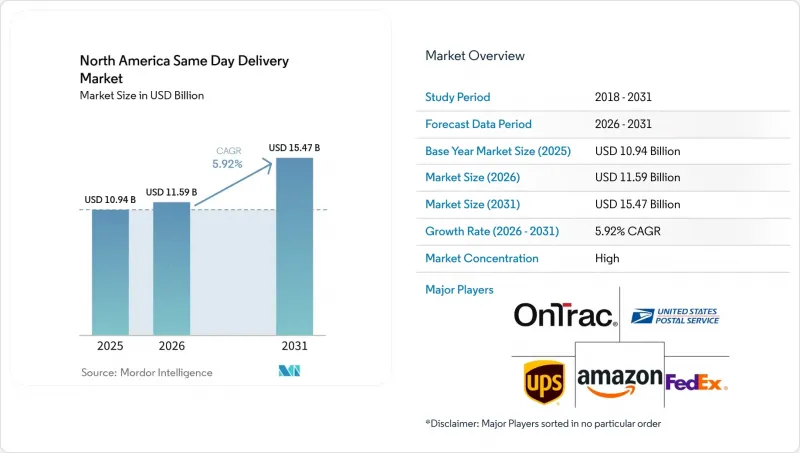
This report is Segmented by End User Industry (E-Commerce, Healthcare, Manufacturing, Primary Industry, Wholesale and Retail Trade, and Others), Destination (Domestic and International), Shipment Weight (Heavy Weight Shipments, Light Weight Shipments, and More), Mode of Transport (Air, Road, and Others), and Country (Canada and More). The Market Forecasts are Provided in Terms of Value (USD).
North America Same Day Delivery Market Trends and Insights
Explosive B2C E-Commerce Volumes Post-COVID-19
U.S. parcel throughput hit 23.4 billion in 2024 equal to 70 packages per resident and the surge has locked same-day expectations into the mainstream. Amazon alone is pouring USD 4 billion into rural station build-outs to bring four-hour delivery to 13,000 ZIP codes, widening geographic coverage of rapid fulfillment. Canadian grocery platforms mirror this shift, with third-party apps favored by 54% of consumers and sector revenue on pace for USD 28.6 billion by 2030. These volumes create a predictable, high-density order flow that underpins network utilization and capex returns, even as carriers battle margin compression.
Retailers Deploying Micro-Fulfillment and Ship-from-Store Networks
Big-box chains are repurposing store backrooms into automated micro-fulfillment hubs, placing inventory within 10 miles of most urban shoppers. Walmart and Target have already rolled out robotics-enabled storage grids that trim picking times and repurpose store labor during off-peak periods. The model reduces reliance on distant distribution centers and enhances supply-chain resiliency by dispersing inventory risk. As a result, brick-and-mortar footprints have flipped from perceived liabilities to strategic assets, intensifying competition with pure-play e-commerce rivals.
Driver Shortages and Escalating Labor Costs
Thirty-eight percent of North American logistics firms report severe driver scarcity, pushing companies to raise wages, bonuses, and flexible-schedule perks to keep seats filled. Gig-economy platforms have softened the blow but introduce quality-control and insurance complications that elevate per-delivery costs. Automation investments from parcel-sorting robotics to larger route territories enabled by AI are now essential to sustain service levels amid talent constraints.
Other drivers and restraints analyzed in the detailed report include:
- AI-Driven Route Optimization Cutting Last-Mile Costs
- Boom in Quick-Commerce Grocery and Food Delivery Platforms
- Urban Congestion Fees and Curb-Management Penalties
For complete list of drivers and restraints, kindly check the Table Of Contents.
Segment Analysis
E-commerce platforms maintained a 52.68% hold on 2025 revenue as shoppers expect doorstep delivery within hours for everyday needs, from apparel to electronics. Wholesale and retail trade (offline) is the breakout, slated for a 6.04% CAGR between 2026-2031 as brick-and-mortar chains weaponize local inventory via ship-from-store models that mimic pure-play speed without the real-estate drag.
Healthcare's policy-driven requirement for same-day prescription fulfillment is adding controlled-temperature and chain-of-custody complexity, carving out premium service niches for certified couriers. Financial-services clients, meanwhile, continue to pay top dollar for secure, time-stamped document movement. Across sectors, route-density economics dictate that the North America same day delivery market increasingly relies on a mixed basket of consumer and enterprise demand to maintain efficiency.
Domestic routes captured 78.55% share in 2025, reflecting streamlined documentation and the absence of customs holds that can derail a same-day clock. Yet cross-border lanes are heating up; international volumes are forecast to climb at a 6.12% CAGR between 2026-2031 on the back of rising U.S.-Mexico near-shoring trade.
Trade value between both nations surpassed USD 475.6 billion in 2024, feeding demand for expedited components that traverse the border multiple times during assembly cycles. Infrastructure upgrades, such as DSV's 900,000 sq ft automated hub in Laredo, are designed to punch customs dwell time below the one-hour mark, a crucial threshold for reliable same-day service. Political harmonization under USMCA provides a regulatory tailwind, though cargo-theft risks and security escorts inflate insurance premiums on certain corridors.
Complete Report Scope:
- Mode of Transport
- Air
- Road
- Others
- Shipment Weight
- Heavy Weight Shipments
- Light Weight Shipments
- Medium Weight Shipments
- Destination
- Domestic
- International
- End User Industry
- E-Commerce
- Financial Services (BFSI)
- Healthcare
- Manufacturing
- Primary Industry
- Wholesale and Retail Trade (Offline)
- Others
- Country
- Canada
- Mexico
- United States
- Rest of North America
List of Companies Covered in this Report:
- Amazon
- Aramex
- DHL Group
- DTDC Express Limited
- Fastfrate Inc.
- FedEx
- International Distributions Services (including GLS)
- Jet Delivery Inc.
- OnTrac
- Spee-Dee Delivery Service, Inc.
- United Parcel Service (UPS)
- USPS
Additional Benefits:
- The market estimate (ME) sheet in Excel format
- 3 months of analyst support
TABLE OF CONTENTS
1 Introduction
- 1.1 Study Assumptions and Market Definition
- 1.2 Scope of the Study
2 Research Methodology
3 Executive Summary
4 Market Landscape
- 4.1 Market Overview
- 4.2 Demographics
- 4.3 GDP Distribution by Economic Activity
- 4.4 GDP Growth by Economic Activity
- 4.5 Inflation
- 4.6 Economic Performance and Profile
- 4.6.1 Trends in E-Commerce Industry
- 4.6.2 Trends in Manufacturing Industry
- 4.7 Transport and Storage Sector GDP
- 4.8 Export Trends
- 4.9 Import Trends
- 4.10 Fuel Price
- 4.11 Logistics Performance
- 4.12 Infrastructure
- 4.13 Regulatory Framework
- 4.13.1 Canada
- 4.13.2 Mexico
- 4.13.3 United States
- 4.14 Value Chain and Distribution Channel Analysis
- 4.15 Market Drivers
- 4.15.1 Explosive B2C E-Commerce Volumes Post-COVID-19
- 4.15.2 Retailers Deploying Micro-Fulfilment and Ship-from-Store Networks
- 4.15.3 AI-Driven Route Optimization Cutting Last-Mile Costs
- 4.15.4 Boom in Quick-Commerce Grocery and Food Delivery Platforms
- 4.15.5 Same-Day Prescription-Delivery Mandates by U.S. Payors
- 4.15.6 State Carbon-Pricing Accelerating EV/Robot Delivery Fleets
- 4.16 Market Restraints
- 4.16.1 Driver Shortages and Escalating Labor Costs
- 4.16.2 Urban Congestion Fees and Curb-Management Penalties
- 4.16.3 FAA Delays on Beyond Visual Line-of-Sight (BVLOS) Drone-Operation Approvals
- 4.16.4 2025 U.S. Tariffs Inflating Delivery-Van Component Prices
- 4.17 Technology Innovations in the Market
- 4.18 Porter's Five Forces Analysis
- 4.18.1 Threat of New Entrants
- 4.18.2 Bargaining Power of Buyers
- 4.18.3 Bargaining Power of Suppliers
- 4.18.4 Threat of Substitutes
- 4.18.5 Competitive Rivalry
5 Market Size and Growth Forecasts (Value, USD)
- 5.1 Mode of Transport
- 5.1.1 Air
- 5.1.2 Road
- 5.1.3 Others
- 5.2 Shipment Weight
- 5.2.1 Heavy Weight Shipments
- 5.2.2 Light Weight Shipments
- 5.2.3 Medium Weight Shipments
- 5.3 Destination
- 5.3.1 Domestic
- 5.3.2 International
- 5.4 End User Industry
- 5.4.1 E-Commerce
- 5.4.2 Financial Services (BFSI)
- 5.4.3 Healthcare
- 5.4.4 Manufacturing
- 5.4.5 Primary Industry
- 5.4.6 Wholesale and Retail Trade (Offline)
- 5.4.7 Others
- 5.5 Country
- 5.5.1 Canada
- 5.5.2 Mexico
- 5.5.3 United States
- 5.5.4 Rest of North America
6 Competitive Landscape
- 6.1 Market Concentration
- 6.2 Key Strategic Moves
- 6.3 Market Share Analysis
- 6.4 Company Profiles (Includes Global Level Overview, Market Level Overview, Core Segments, Financials as Available, Strategic Information, Market Rank/Share for Key Companies, Products and Services, and Recent Developments)
- 6.4.1 Amazon
- 6.4.2 Aramex
- 6.4.3 DHL Group
- 6.4.4 DTDC Express Limited
- 6.4.5 Fastfrate Inc.
- 6.4.6 FedEx
- 6.4.7 International Distributions Services (including GLS)
- 6.4.8 Jet Delivery Inc.
- 6.4.9 OnTrac
- 6.4.10 Spee-Dee Delivery Service, Inc.
- 6.4.11 United Parcel Service (UPS)
- 6.4.12 USPS
7 Market Opportunities and Future Outlook
- 7.1 White-Space and Unmet-Need Assessment

