PUBLISHER: Mordor Intelligence | PRODUCT CODE: 2116819

PUBLISHER: Mordor Intelligence | PRODUCT CODE: 2116819
United Kingdom Same Day Delivery - Market Share Analysis, Industry Trends & Statistics, Growth Forecasts (2026 - 2031)
According to Mordor Intelligence, the United Kingdom same day delivery market size is estimated at USD 1.49 billion in 2026, and is expected to reach USD 1.76 billion by 2031, at a CAGR of 3.47% during the forecast period (2026-2031).
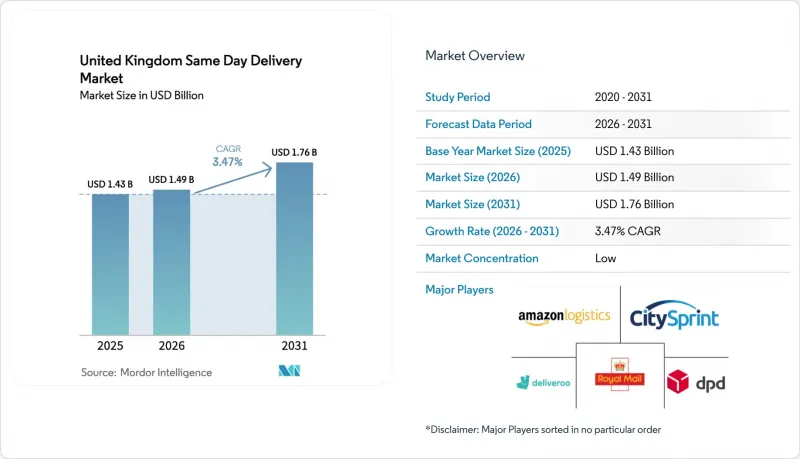
This report is Segmented by Mode of Transport (Air, Road, Others), by Customer Type (B2C Consumer Deliveries, B2B Including B2G), by Shipment Weight (Heavy Weight, Light Weight, and More), by End User Industry (E-Commerce, Financial Services BFSI, and Others). The Market Forecasts are Provided in Terms of Value (USD).
United Kingdom Same Day Delivery Market Trends and Insights
Surging Hyper-local E-grocery Demand Post-pandemic
On-demand grocery platforms processed close to 100 million UK orders worth about USD 4.06 billion in 2025, yet Deliveroo's withdrawal from dark stores exposed fragile unit economics, pushing capacity back into supermarket estates. Waitrose's GBP 85 (USD 114) annual Delivery Pass underwrote same-day slots from 200-plus stores, illustrating how subscriptions anchor repeat demand. Ocado's micro-fulfillment sites now exceed 300 picks per hour, enabling two-hour windows that manual warehouses cannot match. With average delivery radii shrinking under five kilometers, cargo-bike fleets gain a cost advantage inside low-emission zones. As a result, the United Kingdom's same-day delivery market is pivoting from long-haul trunking toward dense urban spokes that reward micro-hubs and zero-emission assets.
Retailer Investment in Urban Micro-fulfillment Centers
Marks & Spencer committed USD 460 million to an automated DC in 2025, targeting 300 picks per hour to support 500 stores' click-and-collect promises. British Land is converting vacant high-street units into logistics nodes, as rents per square meter for parcel throughput now exceed those for apparel tenants. Argos already fulfills Fast Track orders from 300 outlets, demonstrating parity with pure-play e-commerce on speed while lowering return rates through in-person inspection. These moves cement brick-and-mortar stores as last-mile inventory buffers, sustaining the United Kingdom's same-day delivery market shift toward store-as-warehouse configurations in traffic-restricted cores.
Chronic Courier Labor Shortages & Rising Wage Floors
The Road Haulage Association calculates a 60,000-driver annual recruitment need from 2025 onward, while the National Living Wage climbed to USD 16.54 per hour in April 2025, squeezing operators reliant on gig labor. Automation helps only at the margin: Prime Air drones remove some van routes, but payload limits confine them to sub-2-kilogram parcels. Carriers without the scale to spread higher wages over dense routes risk ceding share to integrators able to fund electric fleets and robotics.
Other drivers and restraints analyzed in the detailed report include:
- Rapid Shift to 100%-tracked Deliveries by Major Carriers
- ULEZ-linked Incentives for Zero-emission Cargo-bike Fleets
- Van-mile Congestion Penalties in Major UK Cities
For complete list of drivers and restraints, kindly check the Table Of Contents.
Segment Analysis
The United Kingdom same-day delivery market size for air freight is expanding at a 3.92% CAGR, outpacing all other modes, even though road still owns 51.09% share in 2025. High-value consignments such as temperature-controlled pharmaceuticals and mission-critical aerospace parts justify per-kilogram rates exceeding USD 67.69, explaining IAG Cargo's "Critical" service gains. Virgin Atlantic's Courier product and DHL's Air Priority bridge standard next-day and bespoke charter pricing, giving shippers a mid-tier option.
Road networks remain indispensable for e-commerce volume, yet zero-emission vans and cargo bikes increasingly handle inner-city drops, while rail lanes pre-position goods overnight to cut peak-hour van mileage. This multimodal mix demonstrates how the United Kingdom's same-day delivery market is diverging: air competes on reliability, road on cost per drop, and bikes on regulatory compliance.
B2C retained 69.71% of the United Kingdom's same-day delivery market share in 2025 and will continue growing at a 3.58% CAGR, buoyed by Amazon's 80-city footprint. Nonetheless, willingness to pay seldom exceeds USD 13.54, forcing carriers toward automation to achieve a sub-USD 4.06 cost per drop. In contrast, B2B and B2G clients pay USD 27.07-USD 67.69 for mission-critical shipments, safeguarding margins against consumer belt-tightening.
Healthcare, aerospace, and finance depend on guaranteed delivery windows backed by chain-of-custody documentation, and UPS Healthcare's cold-chain launch exemplifies this specialization. Carriers that balance high-volume B2C with high-margin B2B therefore enjoy a more resilient revenue mix across economic cycles.
Complete Report Scope:
- By Mode of Transport
- Air
- Road
- Others
- By Customer Type/Buyer
- B2C (Consumer Deliveries)
- B2B (Incl. B2G)
- By Shipment Weight
- Heavy Weight Shipments
- Light Weight Shipments
- Medium Weight Shipments
- By End User Industry
- E-Commerce
- Financial Services (BFSI)
- Healthcare
- Manufacturing
- Primary Industry
- Wholesale & Retail Trade (Offline)
- Others
List of Companies Covered in this Report:
- Royal Mail (Sameday)
- DPD UK
- CitySprint
- Amazon Logistics UK
- Deliveroo Hop
- Addison Lee
- Stuart (GeoPost)
- Gophr
- FedEx SameDay UK
- UPS Express Critical
- DHL Express SameDay
- Epaxs
- Quiqup
- Zedify
- TVS SCS/TVS Rico
- Absolutely Couriers
- Beelivery
- eCourier
- Brisqq
- National Couriers Direct
Additional Benefits:
- The market estimate (ME) sheet in Excel format
- 3 months of analyst support
TABLE OF CONTENTS
1 Introduction
- 1.1 Study Assumptions & Market Definition
- 1.2 Scope of the Study
2 Research Methodology
3 Executive Summary
4 Market Landscape
- 4.1 Market Overview
- 4.2 Demographics
- 4.3 GDP Distribution by Economic Activity
- 4.4 GDP Growth by Economic Activity
- 4.5 Inflation
- 4.6 Economic Performance and Profile
- 4.6.1 Trends in E-Commerce Industry
- 4.6.2 Trends in Manufacturing Industry
- 4.7 Transport and Storage Sector GDP
- 4.8 Export Trends
- 4.9 Import Trends
- 4.10 Fuel Price
- 4.11 Logistics Performance
- 4.12 Infrastructure
- 4.13 Regulatory Framework
- 4.14 Value Chain and Distribution Channel Analysis
- 4.15 Market Drivers
- 4.15.1 Surging Hyper-local E-grocery Demand Post-pandemic
- 4.15.2 Retailer Investment in Urban Micro-fulfilment Centres
- 4.15.3 Rapid Shift to 100 %-tracked Deliveries by Major Carriers
- 4.15.4 ULEZ-linked Incentives for Zero-emission Cargo-bike Fleets
- 4.15.5 Retail Delivery-pass/Subscription Models Increasing Repeat Same-day Orders
- 4.15.6 Public Sustainability Policy Driving Urban Micro-hubs & Micromobility
- 4.16 Market Restraints
- 4.16.1 Chronic Courier Labor Shortages & Rising Wage Floors
- 4.16.2 Van-mile Congestion Penalties in Major UK Cities
- 4.16.3 Tight Working-time Reforms for Gig Riders from 2027
- 4.16.4 Retailer Push-back on Premium-speed Fees Amid Cost Crunch
- 4.17 Value / Supply-Chain Analysis
- 4.18 Regulatory Landscape
- 4.19 Technology Innovations Outlook
- 4.20 Porter's Five Forces
- 4.20.1 Threat of New Entrants
- 4.20.2 Bargaining Power of Suppliers
- 4.20.3 Bargaining Power of Buyers
- 4.20.4 Threat of Substitutes
- 4.20.5 Rivalry Among Competitors
5 Market Size & Growth Forecasts (Value, 2026-2031)
- 5.1 By Mode of Transport
- 5.1.1 Air
- 5.1.2 Road
- 5.1.3 Others
- 5.2 By Customer Type/Buyer
- 5.2.1 B2C (Consumer Deliveries)
- 5.2.2 B2B (Incl. B2G)
- 5.3 By Shipment Weight
- 5.3.1 Heavy Weight Shipments
- 5.3.2 Light Weight Shipments
- 5.3.3 Medium Weight Shipments
- 5.4 By End User Industry
- 5.4.1 E-Commerce
- 5.4.2 Financial Services (BFSI)
- 5.4.3 Healthcare
- 5.4.4 Manufacturing
- 5.4.5 Primary Industry
- 5.4.6 Wholesale & Retail Trade (Offline)
- 5.4.7 Others
6 Competitive Landscape
- 6.1 Market Concentration
- 6.2 Key Strategic Moves
- 6.3 Market Share Analysis
- 6.4 Company Profiles (includes Global level Overview, Market level overview, Core Segments, Financials as available, Strategic Information, Market Rank/Share for key companies, Products & Services, and Recent Developments)
- 6.4.1 Royal Mail (Sameday)
- 6.4.2 DPD UK
- 6.4.3 CitySprint
- 6.4.4 Amazon Logistics UK
- 6.4.5 Deliveroo Hop
- 6.4.6 Addison Lee
- 6.4.7 Stuart (GeoPost)
- 6.4.8 Gophr
- 6.4.9 FedEx SameDay UK
- 6.4.10 UPS Express Critical
- 6.4.11 DHL Express SameDay
- 6.4.12 Epaxs
- 6.4.13 Quiqup
- 6.4.14 Zedify
- 6.4.15 TVS SCS/TVS Rico
- 6.4.16 Absolutely Couriers
- 6.4.17 Beelivery
- 6.4.18 eCourier
- 6.4.19 Brisqq
- 6.4.20 National Couriers Direct
7 Market Opportunities & Future Outlook
- 7.1 White-space & Unmet-Need Assessment

