PUBLISHER: Mordor Intelligence | PRODUCT CODE: 2073662

PUBLISHER: Mordor Intelligence | PRODUCT CODE: 2073662
United Kingdom OOH and DOOH - Market Share Analysis, Industry Trends & Statistics, Growth Forecasts (2026 - 2031)
According to Mordor Intelligence, the united kingdom OOH and DOOH market size is expected to grow from USD 1.91 billion in 2025 to USD 1.96 billion in 2026 and is forecast to reach USD 2.32 billion by 2031 at 3.68% CAGR over 2026-2031.
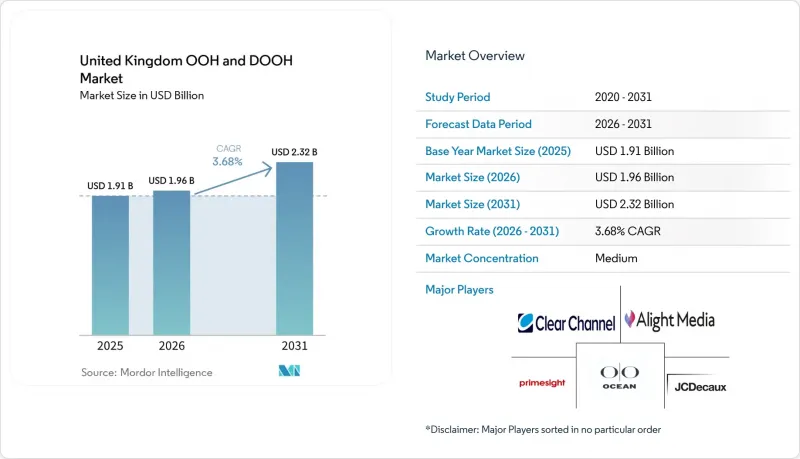
This report is Segmented by Solution Type (Traditional OOH, and Digital OOH), Application (Billboard, Transit, Street Furniture, and More), Location Environment (Roadside Outdoor, Airports, In-Store and Indoor Venues, and More), End-User Industry (Automotive, Retail, Healthcare, BFSI, Media and Entertainment, and More), and Geography. The Market Forecasts are Provided in Terms of Value (USD).
United Kingdom OOH and DOOH Market Trends and Insights
Rapid Expansion of Programmatic Trading Platforms Among UK Media Buyers
Programmatic penetration has lifted to 47% of UK campaigns, up 18 percentage points year-on-year, as VIOOH, Hivestack, Broadsign, and Place Exchange standardize biddable access to roadside, transit, and retail screens. Programmatic-guaranteed deals still dominate, but non-guaranteed volumes are scaling quickly, echoing online display behavior. OOH specialist agencies now manage almost four-fifths of programmatic budgets, reflecting a pivot toward data-driven planning. With 91% of advertisers prioritizing audience over location, investment is being re-routed from other digital channels rather than expanding total spend. This shift is redefining operator differentiation around first-party data, dynamic creative optimization, and supply-side platform partnerships.
Growth of Smart-City Digital Infrastructure in Major UK Metropolitan Areas
City councils are embedding screens into public assets to fund connectivity roll-outs. Manchester's 10-year GBP 70 million (USD 89 million) concession prioritizes large-format digital panels, and London's Connected London program adds thousands of small cells and fiber back-haul to support real-time DOOH. BT Street Hubs blend 75-inch screens with public Wi-Fi, while Havering's 7-year deal with JCDecaux installs panels fitted with air-quality sensors. Transport for London stipulates LED conversions that cut power use 60% and align with its 2030 net-zero goal. Infrastructure-first deployment speeds permit approvals, shortens payback periods and hooks DOOH growth to municipal sustainability agendas.
Measurement-Standardization Gaps Across Multiple OOH Owners Hindering Cross-Network ROI Reporting
Route's audience currency delivers reach and frequency, yet programmatic trades on impression-based CPMs, leaving planners to reconcile two incompatible frameworks. Advertisers, therefore, default to single-operator deals, chilling open-exchange liquidity and limiting optimization. Industry bodies are piloting OpenDirect and OpenRTB for DOOH, but the lack of a unified, UK GDPR-compliant attribution system delays decision-grade reporting. The result is slower budget allocation to cross-network campaigns, despite evidence that OOH drives double-digit uplifts in smartphone actions.
Other drivers and restraints analyzed in the detailed report include:
- Integration of Data-Driven Audience Targeting via Mobile Location Analytics
- Retail Media Networks Extending OOH Partnerships for Omnichannel Campaigns
- High Energy Costs Pressuring DOOH Operating Margins Post-2022 Price Shocks
For complete list of drivers and restraints, kindly check the Table Of Contents.
Segment Analysis
Digital OOH claimed 64.83% of United Kingdom OOH and DOOH market share in 2025 and is projected to widen its lead at a 3.81% trajectory. Programmatic channels already handle 47% of campaigns, diverting spend from static panels toward biddable inventory where creative and targeting can refresh in real time. JCDecaux doubled its London digital footprint to 2,000 screens, while Global's rail estate adds immersive curved LEDs, actions that enlarge the United Kingdom OOH and DOOH market size allocated to premium formats. Traditional OOH persists where landlords or planning rules restrict digital roll-outs, and its lower energy consumption retains value for long-dwell brand campaigns. Sustainability pledges, such as printing on recycled paper with vegetable inks, help classic billboards defend share against energy-intensive LEDs.
Retrofitting efficiency upgrades is accelerating, with Transport for London mandating 60% power cuts through LED conversions. Supply-side platform consolidation, typified by Broadsign's purchase of Place Exchange, promises unified programmatic pipes that could unlock untapped mid-market screens for national buys. Advertiser capability remains the bottleneck: half the buyer community still lacks dynamic creative competencies, suggesting education will be as decisive as infrastructure in determining future share gains for digitized formats.
Billboards represented 39.96% of the United Kingdom OOH and DOOH market in 2025, yet transit inventory is expanding fastest at 4.38% a year as contracts with Transport for London and Network Rail pump more than 1,000 new screens into stations. The Elizabeth line alone adds 329 sites, while 160-meter multi-sensory travelator takeovers at Waterloo illustrate the premium CPMs that immersive environments secure. Commuters' average 25-minute dwell delivers attentive exposures that outperform brief roadside glances, elevating advertiser ROI and boosting the UK OOH and DOOH market size attributed to transit nodes.
Street-furniture upgrades complement this surge, with 4,700 bus shelters under LED conversion, and interactive touchscreens at London Bridge supplying live travel data in 11 languages to heighten engagement. Regulatory shifts, including the 2026 high-fat-salt-sugar advertising watershed, require geo-filters and schedules that digital screens can enact instantaneously, incentivizing further digitization of transit assets. Large-format billboard landlords respond by locking in 99-year leases that embed digital rights, demonstrating that while transit outpaces in growth, roadside owners are future-proofing through very long concessions.
Complete Report Scope:
- By Solution Type
- Traditional OOH
- Digital OOH
- Programmatic-DOOH
- Non-Programmatic-DOOH
- By Application
- Billboard
- Transit
- Street Furniture
- Other Applications
- By Location Environment
- Roadside Outdoor
- Airports
- Malls and Transit Hubs
- In-Store and Indoor Venues
- Other Location Environments
- By End-User Industry
- Automotive
- Retail
- Healthcare
- Banking and Financial Services (BFSI)
- Media and Entertainment
- Other End-User Industries
List of Companies Covered in this Report:
- JCDecaux UK Limited
- Global Media & Entertainment Limited
- Clear Channel UK Limited
- Ocean Outdoor UK Limited
- 75Media Limited
- Smart Outdoor Limited
- Admedia Limited
- Redbus Media Group Limited
- Alight Media Limited
- Elonex Outdoor Media Limited
- Limited Space Media Group Limited
- blowUP media UK Limited
- Signature Outdoor Limited
- Wildstone Group Limited
- Eye Airports Limited
- Maximus Networks Limited
- VIOOH Limited
- Talon Outdoor Limited
- KBH On-Train Media Limited
- London Lites Limited
Additional Benefits:
- The market estimate (ME) sheet in Excel format
- 3 months of analyst support
TABLE OF CONTENTS
1 INTRODUCTION
- 1.1 Study Assumptions and Market Definition
- 1.2 Scope of the Study
2 RESEARCH METHODOLOGY
3 EXECUTIVE SUMMARY
4 MARKET LANDSCAPE
- 4.1 Market Overview
- 4.2 Market Drivers
- 4.2.1 Rapid Expansion of Programmatic Trading Platforms Among UK Media Buyers
- 4.2.2 Growth of Smart-City Digital Infrastructure in Major UK Metropolitan Areas
- 4.2.3 Integration of Data-Driven Audience Targeting via Mobile Location Analytics
- 4.2.4 Retail Media Networks Extending OOH Partnerships for Omnichannel Campaigns
- 4.2.5 Rising Airport-Terminal Redevelopments Ahead of 2030 Net-Zero Aviation Targets
- 4.2.6 London Underground Digital Roll-Out Driving Premium CPMs and Advertiser Adoption
- 4.3 Market Restraints
- 4.3.1 Measurement-Standardization Gaps Across Multiple OOH Owners Hindering Cross-Network ROI Reporting
- 4.3.2 High Energy Costs Pressuring DOOH Operating Margins Post-2022 Price Shocks
- 4.3.3 Community and Council Restrictions on New Digital Screens to Protect Heritage Sites
- 4.3.4 Declining Roadside Traffic During Hybrid Work Weeks Reducing City-Centre Impression Volumes
- 4.4 Impact of Macroeconomic Factors on the Market
- 4.5 Industry Value Chain Analysis
- 4.6 Porter's Five Forces Analysis
- 4.6.1 Bargaining Power of Suppliers
- 4.6.2 Bargaining Power of Buyers
- 4.6.3 Threat of New Entrants
- 4.6.4 Threat of Substitutes
- 4.6.5 Competitive Rivalry
5 MARKET SIZE AND GROWTH FORECASTS (VALUE)
- 5.1 By Solution Type
- 5.1.1 Traditional OOH
- 5.1.2 Digital OOH
- 5.1.2.1 Programmatic-DOOH
- 5.1.2.2 Non-Programmatic-DOOH
- 5.2 By Application
- 5.2.1 Billboard
- 5.2.2 Transit
- 5.2.3 Street Furniture
- 5.2.4 Other Applications
- 5.3 By Location Environment
- 5.3.1 Roadside Outdoor
- 5.3.2 Airports
- 5.3.3 Malls and Transit Hubs
- 5.3.4 In-Store and Indoor Venues
- 5.3.5 Other Location Environments
- 5.4 By End-User Industry
- 5.4.1 Automotive
- 5.4.2 Retail
- 5.4.3 Healthcare
- 5.4.4 Banking and Financial Services (BFSI)
- 5.4.5 Media and Entertainment
- 5.4.6 Other End-User Industries
6 COMPETITIVE LANDSCAPE
- 6.1 Market Concentration
- 6.2 Strategic Moves
- 6.3 Market Share Analysis
- 6.4 Company Profiles (includes Global Level Overview, Market Level Overview, Core Segments, Financials as available, Strategic Information, Market Rank/Share, Products and Services, Recent Developments)
- 6.4.1 JCDecaux UK Limited
- 6.4.2 Global Media & Entertainment Limited
- 6.4.3 Clear Channel UK Limited
- 6.4.4 Ocean Outdoor UK Limited
- 6.4.5 75Media Limited
- 6.4.6 Smart Outdoor Limited
- 6.4.7 Admedia Limited
- 6.4.8 Redbus Media Group Limited
- 6.4.9 Alight Media Limited
- 6.4.10 Elonex Outdoor Media Limited
- 6.4.11 Limited Space Media Group Limited
- 6.4.12 blowUP media UK Limited
- 6.4.13 Signature Outdoor Limited
- 6.4.14 Wildstone Group Limited
- 6.4.15 Eye Airports Limited
- 6.4.16 Maximus Networks Limited
- 6.4.17 VIOOH Limited
- 6.4.18 Talon Outdoor Limited
- 6.4.19 KBH On-Train Media Limited
- 6.4.20 London Lites Limited
7 MARKET OPPORTUNITIES AND FUTURE OUTLOOK
- 7.1 White-Space and Unmet-Need Assessment

