PUBLISHER: Mordor Intelligence | PRODUCT CODE: 2097102

PUBLISHER: Mordor Intelligence | PRODUCT CODE: 2097102
Industrial Coatings - Market Share Analysis, Industry Trends & Statistics, Growth Forecasts (2026 - 2031)
According to Mordor Intelligence, the industrial coatings market size is expected to grow from USD 41.97 billion in 2025 to USD 43.37 billion in 2026 and is forecast to reach USD 51.14 billion by 2031 at a 3.35% CAGR over 2026-2031.
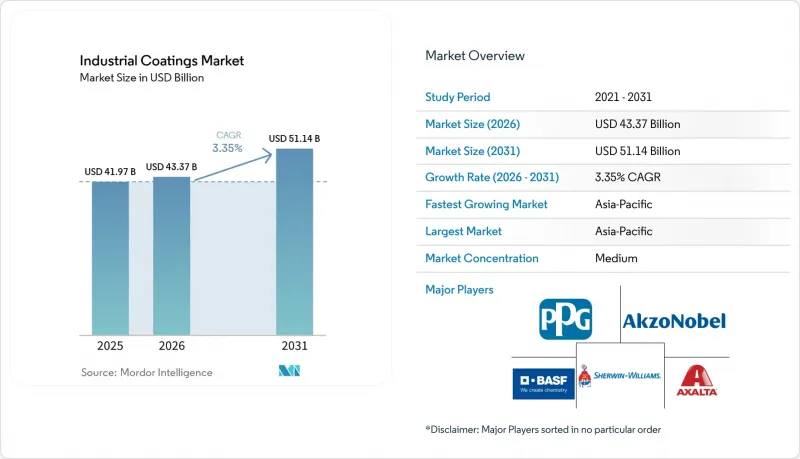
This report is Segmented by Resin Type (Epoxy, Polyurethane, Acrylic, Polyester, and Other Resins), Technology (Solvent-Borne, Water-Borne, Powder, and More), End-Use Industry (General Industrial and Protective Coatings), Substrate (Metal and Concrete), and Geography (Asia-Pacific, North America, Europe, South America, and Middle East and Africa). Market Forecasts are Provided in Terms of Value (USD).
Global Industrial Coatings Market Trends and Insights
Surge in Protective-Coatings Demand for Aging Oil and Gas Assets
Deferred upkeep left roughly 40% of offshore platforms in the North Sea and Gulf of Mexico running past their original corrosion-protection lifespans, triggering large-scale recoating programs. Shell dedicated USD 1.2 billion in 2025 to upgrade 15 U.K. platforms with three-coat glass-flake epoxies that stretch service intervals to 25 years. TotalEnergies allocated USD 800 million for West African subsea pipelines exposed to hydrogen sulfide and chloride attack. Middle-East petrochemical complexes are simultaneously lining storage tanks with high-build polyurethane to satisfy updated API 653 integrity provisions. This multi-billion-dollar backlog keeps the industrial coatings market on a stable upward track as asset owners now prioritize lifecycle economics over first-cost savings. Because the underlying infrastructure is capital-intensive and safety-critical, specification shifts are deliberate, extending revenue visibility for suppliers through the next decade.
Rapid APAC Industrial Expansion Fueling General-Industrial Volumes
China's 2025 infrastructure stimulus of USD 140 billion funded high-speed rail, metro extensions, and large steel bridges across the Yangtze basin, each requiring multi-layer epoxy or polyurethane defenses. India's production-linked incentive program secured USD 22 billion in fresh factory spending, with automated spray booths in Gujarat and Tamil Nadu alone consuming an estimated 180,000 metric tons of coatings. Vietnam has become a manufacturing relocation hotspot, where cleanroom electronics plants specify anti-static epoxy floors tested to IEC 61340. Indonesia's nickel-smelter boom demands silicone films able to resist 600°C furnace conditions. Taken together, the region applies more kilograms of coating per USD of manufacturing value added than any other geography, illustrating a structural edge that lifts the industrial coatings market throughout the forecast horizon.
Tightening VOC and PFAS Regulations on Solvent-Borne Systems
A draft European Union restriction seeks to phase out per- and polyfluoroalkyl substances in fluoropolymer films used in chemical reactors and semiconductor tools, pushing formulators toward less proven siloxane or ceramic routes. California extended its 250 g/L VOC ceiling to industrial maintenance categories, forcing fast-dry alkyds either into costly reformulations or retirement. Compliance adds USD 0.30-0.50 per liter in R&D and plant retooling, squeezing mid-tier suppliers without global scale. China's environment ministry signaled a plan to harmonize VOC limits with EU norms by 2027, potentially sidelining one-quarter of domestic solvent capacity. Collectively, these curbs temper overall industrial coatings market growth during the transition, even as they accelerate uptake of low-emission chemistries.
Other drivers and restraints analyzed in the detailed report include:
- Environmental Mandates Accelerating Water-Borne and Powder Uptake
- UV-LED Instant-Cure Lines Adopted by OEM Factories
- Titanium-Dioxide and Epoxy-Resin Price Volatility
For complete list of drivers and restraints, kindly check the Table Of Contents.
Segment Analysis
Epoxy, despite sliding marginally in high-growth niches, still accounted for 30.85% of the industrial coatings market size in 2025, supported by marine, pipeline, and heavy-duty structural jobs that require tenacious adhesion on blasted steel. Acrylic emulsions built incremental share in refinish and light-industrial tasks because they comply with California's 250 g/L VOC ceiling straight from the drum. Polyester resins, largely in powder form, stayed essential to appliance shells and office furniture, a segment now capturing zero-emission credits in Europe. Hybrid formulations blending epoxy primers with polyurethane topcoats continue to rise because they marry bond strength with weather-fast gloss. Polyurethane demand climbed at a 5.08% CAGR between 2026 and 2031 as aerospace, wind-turbine, and high-durability infrastructure owners specified two-component films for their superior flex-crack resistance and UV holdout.
Suppliers are widening castor oil or palm kernel polyol content to raise renewable carbon share while maintaining mechanical stability. Fluoropolymer volumes flattened as pending PFAS bans and customer hesitancy slowed project validation. Vinyl ester, alkyd, and novolac chemistries remained confined to niche corrosion or fast-drying roles. Altogether, resin diversification both cushions raw-material shocks and broadens the addressable industrial coatings market without sacrificing core epoxy reliability.
Solvent-borne products captured 36.91% of 2025 revenue; their trajectory tilts down as protective-coatings formulations prove water-borne options can now survive splash-zone immersion and 120°C cycling. Powder coatings grew briskly in wheels, radiators, shelving, and small tractors, buoyed by 97-99% transfer efficiency and elimination of hazardous-air-pollutant permitting. Ultraviolet-curable lines progressed from boutique to mainstream once LED arrays reduced heat load and lamp changeouts. Collectively, these shifts push the industrial coatings market toward lower emissions, shorter cure times, and reduced energy footprints while preserving throughput. Water-borne chemistries advanced 4.91% annually through 2031, lifted by North American and European plant upgrades that swapped solvent alkyds for acrylic dispersions under new VOC laws.
Suppliers are layering digital color-match and near-infrared cure additives into their offerings, letting job shops hit exact shades with fewer coats. Electro-deposition remains dominant for automotive bodies, yet next-gen cationic baths now include bio-based co-solvents and F-free surfactants. Thermal-spray metalizing and high-solid novolac epoxies keep niche footholds where 200-μm films in one pass pay for themselves in offshore upkeep costs. As regulatory scrutiny heightens, the technology mix will continue to tip toward water and powder, reinforcing sustainability narratives that echo across the broader industrial coatings market.
Complete Report Scope:
- By Resin Type
- Epoxy
- Polyurethane
- Acrylic
- Polyester
- Other Resins (Alkyd, Fluoropolymer, and Vinyl Ester)
- By Technology
- Solvent-borne
- Water-borne
- Powder
- UV Technology
- By End-use Industry
- General Industrial
- Protective Coatings
- Oil and Gas
- Mining
- Power
- Infrastructure
- Other Protective Coatings
- By Substrate
- Metal
- Concrete
- By Geography
- Asia-Pacific
- China
- India
- Japan
- South Korea
- ASEAN
- Australia
- New Zealand
- Rest of Asia-Pacific
- North America
- United States
- Canada
- Mexico
- Europe
- Germany
- United Kingdom
- France
- Italy
- Russia
- Nordics
- Rest of Europe
- South America
- Brazil
- Argentina
- Chile
- Rest of South America
- Middle East and Africa
- Saudi Arabia
- United Arab Emirates
- Turkey
- South Africa
- Nigeria
- Rest of Middle-East and Africa
- Asia-Pacific
Geography Analysis
Asia-Pacific dominated the industrial coatings market in 2025 with a 51.16% share and is set to pace forward at a 4.35% CAGR as China, India, Vietnam, and Indonesia underpin structural spending on transport, energy, and manufacturing. China's ambitious 2025 stimulus is channeling funds into high-speed rail spines and new bridges over the Yangtze. These projects are projected to consume significant amounts of epoxy and polyurethane annually. Meanwhile, India's foreign direct investment (FDI) initiative, bolstered by an incentive program, has accelerated the installation of water-borne lines in Gujarat and Tamil Nadu. This advancement has notably reduced both the cycle time and emissions associated with automotive shells and consumer appliances.
In North America and Europe, growth was modest, constrained by mature stock levels and stringent environmental regulations. The U.S. set a VOC limit for industrial maintenance films, leading to increased investments in acrylic-emulsion R&D and heightened capital needs for solvent vapor recovery. In 2025, Germany introduced UV-LED paint lines, achieving energy savings at BMW and Volkswagen facilities. However, the EU's proposal to ban PFAS has cast a shadow of uncertainty over high-performance fluoropolymer sectors, causing delays in some chemical processing rollouts.
Outside of Asia, emerging regions in South America, the Middle East, and Africa present the most significant growth opportunities. Brazil has initiated a tender for highway resurfacing, utilizing acrylic sealers and polyurethane tops tailored for the country's humid tropical cycles. In Saudi Arabia, a water initiative has specified epoxy-modified cementitious linings for concrete reservoirs, addressing chloride loads. South Africa's Transnet has allocated funds for refurbishing coastal rail assets, employing ISO 12944 C5-M epoxies. Concurrently, Nigeria's Dangote refinery utilized protective films during its 2024-25 plant commissioning. Collectively, these endeavors not only diversify revenue streams but also shield the industrial coatings market from regional disruptions.
- 3M
- AkzoNobel N.V.
- Arkema
- Asian Paints
- Axalta Coating Systems
- BASF
- Beckers Group
- Chugoku Marine Paints Ltd.
- Daikin Industries Ltd.
- Hempel A/S
- Henkel AG & Co. KGaA
- Jotun
- Kansai Paint Co., Ltd.
- Nippon Paint Holdings Co., Ltd.
- OC Oerlikon Management AG
- PPG Industries, Inc.
- RPM International Inc.
- Rust-Oleum Corporation
- Sika AG
- The Sherwin-Williams Company
- Tikkurila
- Wacker Chemie AG
Additional Benefits:
- The market estimate (ME) sheet in Excel format
- 3 months of analyst support
TABLE OF CONTENTS
1 Introduction
- 1.1 Study Assumptions & Market Definition
- 1.2 Scope of the Study
2 Research Methodology
3 Executive Summary
4 Market Landscape
- 4.1 Market Overview
- 4.2 Market Drivers
- 4.2.1 Surge in protective-coatings demand for aging oil and gas assets
- 4.2.2 Rapid APAC industrial expansion fueling general-industrial volumes
- 4.2.3 Environmental mandates accelerating water-borne and powder uptake
- 4.2.4 UV-LED instant-cure lines adopted by OEM factories
- 4.2.5 Data-driven predictive-maintenance coatings with embedded sensors
- 4.3 Market Restraints
- 4.3.1 Tightening VOC + PFAS regulations on solvent-borne systems
- 4.3.2 Titanium-dioxide and epoxy-resin price volatility
- 4.3.3 Global shortage of micronized-aluminum pigments for metallic finishes
- 4.4 Value Chain Analysis
- 4.5 Regulatory Outlook
- 4.6 Porter's Five Forces
- 4.6.1 Bargaining Power of Suppliers
- 4.6.2 Bargaining Power of Buyers
- 4.6.3 Threat of New Entrants
- 4.6.4 Threat of Substitutes
- 4.6.5 Degree of Competition
5 Market Size & Growth Forecasts (Value)
- 5.1 By Resin Type
- 5.1.1 Epoxy
- 5.1.2 Polyurethane
- 5.1.3 Acrylic
- 5.1.4 Polyester
- 5.1.5 Other Resins (Alkyd, Fluoropolymer, and Vinyl Ester)
- 5.2 By Technology
- 5.2.1 Solvent-borne
- 5.2.2 Water-borne
- 5.2.3 Powder
- 5.2.4 UV Technology
- 5.3 By End-use Industry
- 5.3.1 General Industrial
- 5.3.2 Protective Coatings
- 5.3.2.1 Oil and Gas
- 5.3.2.2 Mining
- 5.3.2.3 Power
- 5.3.2.4 Infrastructure
- 5.3.2.5 Other Protective Coatings
- 5.4 By Substrate
- 5.4.1 Metal
- 5.4.2 Concrete
- 5.5 By Geography
- 5.5.1 Asia-Pacific
- 5.5.1.1 China
- 5.5.1.2 India
- 5.5.1.3 Japan
- 5.5.1.4 South Korea
- 5.5.1.5 ASEAN
- 5.5.1.6 Australia
- 5.5.1.7 New Zealand
- 5.5.1.8 Rest of Asia-Pacific
- 5.5.2 North America
- 5.5.2.1 United States
- 5.5.2.2 Canada
- 5.5.2.3 Mexico
- 5.5.3 Europe
- 5.5.3.1 Germany
- 5.5.3.2 United Kingdom
- 5.5.3.3 France
- 5.5.3.4 Italy
- 5.5.3.5 Russia
- 5.5.3.6 Nordics
- 5.5.3.7 Rest of Europe
- 5.5.4 South America
- 5.5.4.1 Brazil
- 5.5.4.2 Argentina
- 5.5.4.3 Chile
- 5.5.4.4 Rest of South America
- 5.5.5 Middle East and Africa
- 5.5.5.1 Saudi Arabia
- 5.5.5.2 United Arab Emirates
- 5.5.5.3 Turkey
- 5.5.5.4 South Africa
- 5.5.5.5 Nigeria
- 5.5.5.6 Rest of Middle-East and Africa
- 5.5.1 Asia-Pacific
6 Competitive Landscape
- 6.1 Market Concentration
- 6.2 Strategic Moves (M&A, JVs, Capacity Expansions)
- 6.3 Market Share Analysis
- 6.4 Company Profiles {(includes Global level Overview, Market level overview, Core Segments, Financials as available, Strategic Information, Market Rank/Share for key companies, Products & Services, and Recent Developments)}
- 6.4.1 3M
- 6.4.2 AkzoNobel N.V.
- 6.4.3 Arkema
- 6.4.4 Asian Paints
- 6.4.5 Axalta Coating Systems
- 6.4.6 BASF
- 6.4.7 Beckers Group
- 6.4.8 Chugoku Marine Paints Ltd.
- 6.4.9 Daikin Industries Ltd.
- 6.4.10 Hempel A/S
- 6.4.11 Henkel AG & Co. KGaA
- 6.4.12 Jotun
- 6.4.13 Kansai Paint Co., Ltd.
- 6.4.14 Nippon Paint Holdings Co., Ltd.
- 6.4.15 OC Oerlikon Management AG
- 6.4.16 PPG Industries, Inc.
- 6.4.17 RPM International Inc.
- 6.4.18 Rust-Oleum Corporation
- 6.4.19 Sika AG
- 6.4.20 The Sherwin-Williams Company
- 6.4.21 Tikkurila
- 6.4.22 Wacker Chemie AG
7 Market Opportunities & Future Outlook
- 7.1 Technological Advancements in Coating Formulations
- 7.2 White-space & Unmet-need Assessment

