PUBLISHER: Mordor Intelligence | PRODUCT CODE: 2097106

PUBLISHER: Mordor Intelligence | PRODUCT CODE: 2097106
United Kingdom Anti-Caking - Market Share Analysis, Industry Trends & Statistics, Growth Forecasts (2026 - 2031)
According to Mordor Intelligence, the United Kingdom anti-caking agents market size is expected to increase from USD 73.04 million in 2025 to reach USD 77 million in 2026 and is forecast to reach USD 99.48 million by 2031 at a CAGR of 5.26% over 2026-2031.
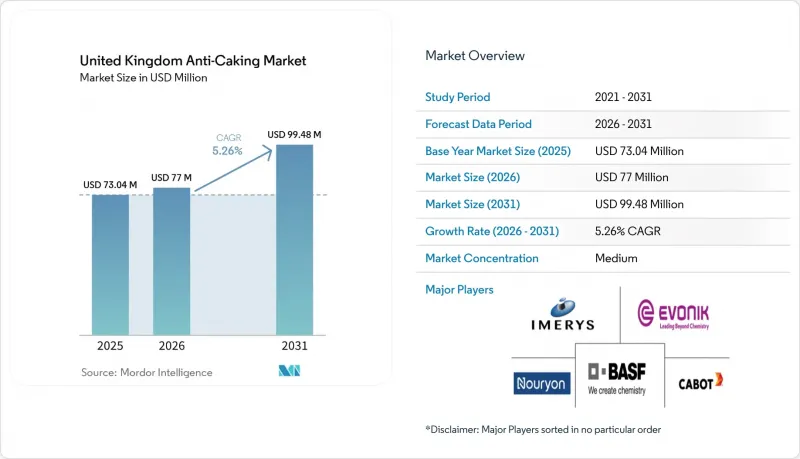
This report is Segmented by Type (Silicon Dioxide, Calcium Compounds, Sodium Compounds, Magnesium Compounds, Microcrystalline Cellulose, and Others), and by Application (Food and Beverages, Animal Feed, Pharmaceuticals, Personal Care and Cosmetics, and Other Applications). The Forecasts are Provided in Terms of Value in USD Million.
United Kingdom Anti-Caking Market Trends and Insights
Rising demand for shelf-stable powdered food formats
The United Kingdom anti-caking agents market is benefiting from stronger investment in shelf-stable and low-moisture product formats, including powdered soups, seasoning blends, meal-kit bases, spray-dried dairy inputs, and fortified beverage mixes. These formats help manufacturers reduce cold-chain dependence and simplify handling, which matters in a cost-sensitive operating environment. In 2025, the Food & Drink Federation stated that 65% of United Kingdom food and drink manufacturers were prioritizing domestic sales growth while operating under elevated cost pressure, which supports continued interest in dry and efficient product formats. This shift is also bringing the UK anti-caking agents market into categories that were previously less dependent on flow aids, such as plant protein powders, functional instant drinks, and nutrient-fortified dry blends. Silicon dioxide continues to benefit because it performs reliably across spray-dried and dry-blended systems and fits a wide range of existing production setups. As a result, anti-caking selection is increasingly being made earlier in product design, which gives approved suppliers a stronger position in future formulation pipelines.
United Kingdom clean label reformulation is accelerating silicon dioxide and mineral-based substitution
The United Kingdom anti-caking agents market is being influenced by a clean-label push that makes food manufacturers review every additive declaration more closely, even though the retained United Kingdom version of Regulation (EC) No 1333/2008 has not yet created a major shift in approved anti-caking categories. In October 2024, the European Food Safety Authority (EFSA) re-evaluation of silicon dioxide confirmed that E551 did not raise safety concerns for any population group at current exposure levels, which supports its continued use in relevant formulations. At the same time, cleaner ingredient language is encouraging manufacturers to consider plant-derived flow agents and cellulose-based options where label presentation matters more. Campden BRI noted in 2024 that additives used to support clean-label positioning still need to meet the relevant regulatory requirements, which limits the speed at which novel alternatives can move into regular use in the United Kingdom. This is helping Microcrystalline Cellulose gain attention because it aligns better with consumer-friendly naming in some supplement formats while still offering functional value.
Tight ingredient approval and labeling requirements limit reformulation flexibility
The United Kingdom anti-caking agents market still faces a real constraint from the current food additive approval framework, especially for suppliers that want to introduce reformulated or next-generation grades. Under the retained additives regime enforced by the Food Standards Agency, approved anti-caking agents need to meet category-specific use conditions, while suppliers that serve Northern Ireland also need to handle an additional layer of alignment with the EU framework. In 2025, the Food Standards Agency said it planned to modernize the food regulatory system, which reflects clear recognition that the current process can be slow for regulated product approvals. That leaves established materials such as silicon dioxide and several calcium-based compounds in a stronger commercial position, while new plant-derived alternatives face a longer route to regular adoption. The United Kingdom anti-caking agents market also carries added administrative complexity because national suppliers must work across different enforcement settings in the devolved administrations. This does not stop reformulation, but it does slow the pace at which new anti-caking concepts can move from trial stage to scaled use.
Other drivers and restraints analyzed in the detailed report include:
- Growth in specialty feed premixes is increasing flow-aid usage
- Powdered nutraceuticals and functional foods are expanding downstream consumption
- Volatile feedstock costs for specialty silica and mineral input pressure margins
For complete list of drivers and restraints, kindly check the Table Of Contents.
Segment Analysis
Silicon Dioxide held 45.5% of the United Kingdom anti-caking agents market share in 2025, reflecting long-standing approval status, dependable performance in moisture-sensitive powders, and broad use across food, feed, and nutraceutical applications. Its position remains strong because United Kingdom manufacturers can use a familiar grade with clear regulatory standing and a long record in spray-dried, blended, and tableted products. The 2024 European Food Safety Authority's scientific opinion added further confidence by confirming that silicon dioxide did not raise safety concerns at current use levels, which helps maintain continuity in formulation planning. Calcium Compounds and Sodium Compounds formed the next volume tiers in the United Kingdom anti-caking agents industry, mainly in bakery, dairy, and powder, where lower-cost mineral performance is often sufficient.
Microcrystalline Cellulose is projected to be the fastest-growing type in the United Kingdom anti-caking agents market at a 6.52% CAGR through 2031. Its growth is tied to a broader move from a mainly pharmaceutical excipient role toward wider use in food supplements and nutraceutical powders, where label presentation and multifunctionality both matter. In several supplement formats, Microcrystalline Cellulose can avoid the same label perception issues that apply to more familiar E-number ingredients, which strengthens its appeal in reformulation work. The United Kingdom anti-caking agents industry is therefore giving more room to co-processed and performance-designed excipients, especially where food and pharmaceutical processing standards begin to overlap. Pharmacopoeial alignment also supports this shift because customers in tablet and nutraceutical production want materials that can meet stricter quality expectations without adding multiple separate inputs.
Complete Report Scope:
- By Type
- Silicon Dioxide
- Calcium Compounds
- Sodium Compounds
- Magnesium Compounds
- Microcrystalline Cellulose
- Others
- By Application
- Food and Beverages
- Animal Feed
- Pharmaceuticals
- Personal Care and Cosmetics
- Other Applications
List of Companies Covered in this Report:
- Evonik Industries AG
- Cabot Corporation
- Nouryon
- BASF SE
- Imerys
- PPG Industries, Inc.
- W. R. Grace and Co.
- Solvay SA
- Kerry Group plc
- Tate and Lyle PLC
- Ingredion Incorporated
- Cargill, Incorporated
- Archer Daniels Midland Company
- Roquette Freres SA
- JRS Pharma GmbH and Co. KG
- Huber Engineered Materials
- Lehmann Ingredients
- Omya AG
- Minerals Technologies Inc.
Additional Benefits:
- The market estimate (ME) sheet in Excel format
- 3 months of analyst support
TABLE OF CONTENTS
1 Introduction
- 1.1 Study Assumptions and Market Definition
- 1.2 Scope of the Study
2 Research Methodology
3 Executive Summary
4 Market Landscape
- 4.1 Market Overview
- 4.2 Market Drivers
- 4.2.1 Rising demand for shelf-stable powdered food formats
- 4.2.2 United Kingdom clean label reformulation is accelerating silicon dioxide and mineral-based substitution
- 4.2.3 Growth in specialty feed premixes is increasing flow-aid usage
- 4.2.4 Food safety and anti-clumping compliance are raising specification-driven demand
- 4.2.5 Micro dosing and precision blending are increasing the demand for high-performance anti-caking systems
- 4.2.6 Powdered nutraceuticals and functional foods are expanding downstream consumption
- 4.3 Market Restraints
- 4.3.1 Tight ingredient approval and labeling requirements limit reformulation flexibility
- 4.3.2 Volatile feedstock costs for specialty silica and mineral input pressure margins
- 4.3.3 Functional trade-offs in low-sodium and clean-label formulations reduce substitute options
- 4.3.4 The dependence on certain specialty grades increases supply risk and leads to longer lead times
- 4.4 Supply Chain Analysis
- 4.5 Regulatory Landscape
- 4.6 Technological Outlook
- 4.7 Porter's Five Forces
- 4.7.1 Threat of New Entrants
- 4.7.2 Bargaining Power of Suppliers
- 4.7.3 Bargaining Power of Buyers
- 4.7.4 Threat of Substitutes
- 4.7.5 Intensity of Competitive Rivalry
5 Market Size and Growth Forecasts (Value)
- 5.1 By Type
- 5.1.1 Silicon Dioxide
- 5.1.2 Calcium Compounds
- 5.1.3 Sodium Compounds
- 5.1.4 Magnesium Compounds
- 5.1.5 Microcrystalline Cellulose
- 5.1.6 Others
- 5.2 By Application
- 5.2.1 Food and Beverages
- 5.2.2 Animal Feed
- 5.2.3 Pharmaceuticals
- 5.2.4 Personal Care and Cosmetics
- 5.2.5 Other Applications
6 Competitive Landscape
- 6.1 Market Concentration
- 6.2 Strategic Moves
- 6.3 Market Positioning Analysis
- 6.4 Company Profiles (includes Global level Overview, Market level overview, Core Segments, Financials as available, Strategic Information, Market Rank/Share for key companies, Products and Services, and Recent Developments)
- 6.4.1 Evonik Industries AG
- 6.4.2 Cabot Corporation
- 6.4.3 Nouryon
- 6.4.4 BASF SE
- 6.4.5 Imerys
- 6.4.6 PPG Industries, Inc.
- 6.4.7 W. R. Grace and Co.
- 6.4.8 Solvay SA
- 6.4.9 Kerry Group plc
- 6.4.10 Tate and Lyle PLC
- 6.4.11 Ingredion Incorporated
- 6.4.12 Cargill, Incorporated
- 6.4.13 Archer Daniels Midland Company
- 6.4.14 Roquette Freres SA
- 6.4.15 JRS Pharma GmbH and Co. KG
- 6.4.16 Huber Engineered Materials
- 6.4.17 Lehmann Ingredients
- 6.4.18 Omya AG
- 6.4.19 Minerals Technologies Inc.
7 Market Opportunities and Future Outlook

