PUBLISHER: Mordor Intelligence | PRODUCT CODE: 2113729

PUBLISHER: Mordor Intelligence | PRODUCT CODE: 2113729
Spain Anti-Caking - Market Share Analysis, Industry Trends & Statistics, Growth Forecasts (2026 - 2031)
According to Mordor Intelligence, the spain anti-Caking market size is estimated at USD 84.39 million in 2026 and is forecast to reach USD 108.73 million by 2031, growing at a CAGR of 4.58% during 2026-2031.
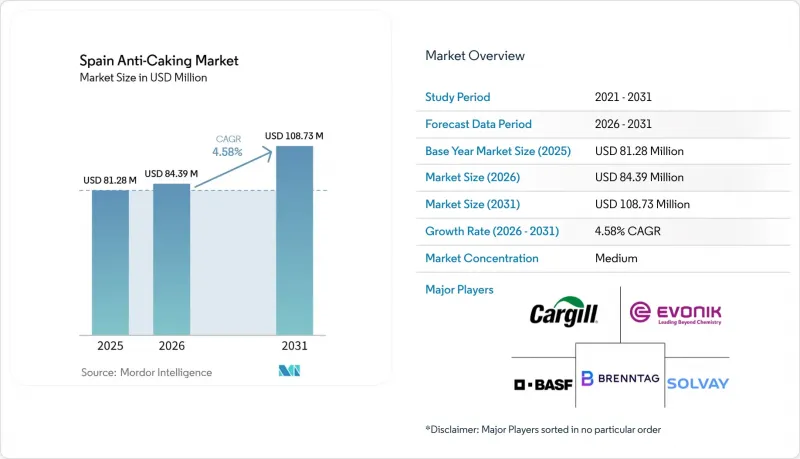
This report is Segmented by Type (Calcium Compounds, Sodium Compounds, Magnesium Compounds, and Other Types) and Application (Food and Beverage, Cosmetic and Personal Care, Feed, and Other Applications). The Market Forecasts are Provided in Terms of Value (USD).
Spain Anti-Caking Market Trends and Insights
Growth of Processed Food, Bakery, and Confectionery Production
Spain's food and beverage manufacturing sector recorded 1.7% real production growth in 2025. The sector generated EUR 137,188 million in real production value and benefited from domestic consumption and export demand. It employed 559,700 people and represented 23.8% of national manufacturing activity. This scale creates recurring demand for free-flow agents used in powdered seasonings, dairy ingredients, beverage blends, and bakery mixes. The United States Department of Agriculture expects Spanish demand for food ingredients to continue increasing in 2026. The Spanish Anti-Caking Market therefore benefits when larger processors standardize ingredient specifications and require more consistent quality documentation. Spanish confectionery turnover reached EUR 8,110 million in 2025, rising 4.5%, while exports reached EUR 2,658 million. Industrial bakery and pastry revenue reached EUR 6,150 million in the same year. These sectors use calcium-based products in baking powder, powdered sugar, cake mixes, and seasoning systems. Longer export routes extend storage and transit periods for powder ingredients. That requirement favors agents that maintain flow during handling and transport. The Spain Anti-Caking Market gains from this need because bakery producers cannot easily substitute lower-performing compounds without affecting processing consistency.
Humidity-Resilient Formulations and Processing Automation
Mediterranean humidity and inland temperature changes can affect the behavior of powder ingredients during warehousing and distribution. Food manufacturers therefore need materials that limit clumping before dosing, blending, and packing. Calcium and magnesium compounds are important where moisture resistance and mineral-origin credentials are both required. The Mediterranean coast, Murcia, and Andalusia combine agricultural production with logistics activity, increasing exposure to storage conditions. Automated lines also require powders with more predictable flow than manual batch operations. The Spain Anti-Caking Market has an opportunity to serve these needs through application testing, storage guidance, and materials matched to local operating conditions. Spanish food processors are increasing their use of automation and digital systems in production operations. Automated dosing equipment depends on consistent bulk density, particle movement, and moisture control. Small variations in powder behavior can interrupt production or reduce batch accuracy. This makes free-flow performance a functional requirement rather than an optional additive benefit. Suppliers with technical support can work with processors during equipment upgrades and product reformulation. The Spain Anti-Caking Market can therefore gain from the modernization of food plants even when underlying food volumes grow gradually.
EU Food Additive Regulation and Reformulation Requirements
Spain applies Regulation (EC) No 1333/2008, which sets permitted food additives and conditions of use across the European Union. The framework requires processors, importers, and manufacturers to maintain compliant ingredient documentation. The European Commission reported that 244 additives had been assessed under the re-evaluation program by February 2026. It also reported that 71 substances remained pending assessment. This ongoing review can delay purchasing decisions where buyers expect future specification changes. The Spain Anti-Caking Market is more resilient where suppliers offer already-reviewed mineral materials supported by complete technical dossiers. EFSA's 2024 opinion on silicon dioxide, E551, found no safety concern across population groups under the evaluated conditions of use. The opinion recommended lower maximum limits for lead, mercury, and arsenic. Manufacturers may need to update specifications, supplier qualification systems, and quality assurance records. Reformulation can require plant trials because a replacement agent may change moisture response or powder movement.
Other drivers and restraints analyzed in the detailed report include:
- Rising Demand for Clean-Label Formulations
- Rising Applications in Cosmetics and Personal Care
- Alternative Processing Technologies and Raw Material Volatility
For complete list of drivers and restraints, kindly check the Table Of Contents.
Segment Analysis
Calcium Compounds held 38.27% of Spain Anti-Caking Market share in 2025. Their position reflects broad acceptance across food categories and cost competitiveness against some synthetic silica products. Calcium silicate and calcium carbonate are used in table salt, baking powders, powdered seasonings, and dairy mixes. These materials are familiar to food processors and can fit established manufacturing practices. Their performance is especially relevant in products exposed to storage and transport moisture. The Spain Anti-Caking Market size for Calcium Compounds is supported by high-volume bakery and confectionery activity. Suppliers also benefit from a clear fit with clean-label and mineral-origin product discussions. Regulatory familiarity lowers the burden of supplier qualification for many applications. This gives calcium products a durable place in the type mix even as specialty materials grow. It also supports demand from processors that prioritize predictable cost and availability.
Sodium Compounds are forecast to expand at a 5.68% CAGR through 2031. Their growth is tied to flexibility across food reformulation and personal care powder production. Sodium aluminosilicate can be selected where formulators need specific flow, absorption, or texture characteristics. The category benefits from the continued use of silica-based functional materials in dry products. EFSA confirmed the safety of silicon dioxide, E551, under its evaluated conditions of use in 2024. That finding provides useful regulatory context for manufacturers assessing free-flow systems. Magnesium Compounds and other types address narrower needs in animal feed and sports nutrition. Tolsa's EXAL range uses Spanish sepiolite clay as a flow aid and carrier in feed production. These smaller categories can expand when customers require absorption capacity, inert behavior, or natural mineral credentials.
Complete Report Scope:
- By Type
- Calcium Compounds
- Sodium Compounds
- Magnesium Compounds
- Other Types
- By Application
- Food and Beverage
- Bakery Products
- Dairy Products
- Soups and Sauces
- Beverages
- Others
- Cosmetic and Personal Care
- Feed
- Other Applications
- Food and Beverage
List of Companies Covered in this Report:
- BASF SE
- Evonik Industries AG
- Solvay SA
- Tolsa, S.A.
- Brenntag AG
- PPG Industries, Inc.
- Cabot Corporation
- J.M. Huber Corporation
- Merck KGaA
- Cargill, Incorporated
- Kao Corporation
- Roquette Freres
- J. RETTENMAIER & SOHNE GMBH + CO KG
- Kemin Industries, Inc.
- EW Nutrition GmbH
- Archer Daniels Midland Company
- Zeocem, a.s.
- Azelis Group NV
- IMCD N.V.
- Univar Solutions Inc.
Additional Benefits:
- The market estimate (ME) sheet in Excel format
- 3 months of analyst support
TABLE OF CONTENTS
1 INTRODUCTION
- 1.1 Study Assumptions and Market Definition
- 1.2 Scope of the Study
2 RESEARCH METHODOLOGY
3 EXECUTIVE SUMMARY
4 MARKET LANDSCAPE
- 4.1 Market Overview
- 4.2 Market Drivers
- 4.2.1 Growth of the Processed Food Industry
- 4.2.2 Strong Bakery and Confectionery Production
- 4.2.3 Humidity-Resilient Formulations for Mediterranean Supply Chains
- 4.2.4 Rising demand for Clean-label formulations
- 4.2.5 Icreasing Automation in Food Processing Facilities, requiring Free-Flowing Ingredients
- 4.2.6 Rising Applications of Anti-Caking Agents in Cosmetics and Personal Care
- 4.3 Market Restraints
- 4.3.1 Stringent EU Food Additive Regulations
- 4.3.2 Availability of Alternative Processing Technologies
- 4.3.3 Volatility in Raw Material Prices
- 4.3.4 Complex Reformulation Requirements
- 4.4 Supply Chain Analysis
- 4.5 Regulatory Landscape
- 4.6 Technological Outlook
- 4.7 Porter's Five Forces
- 4.7.1 Threat of New Entrants
- 4.7.2 Bargaining Power of Buyers/Consumers
- 4.7.3 Bargaining Power of Suppliers
- 4.7.4 Threat of Substitute Products
- 4.7.5 Intensity of Competitive Rivalry
5 MARKET SIZE AND GROWTH FORECASTS (VALUE)
- 5.1 By Type
- 5.1.1 Calcium Compounds
- 5.1.2 Sodium Compounds
- 5.1.3 Magnesium Compounds
- 5.1.4 Other Types
- 5.2 By Application
- 5.2.1 Food and Beverage
- 5.2.1.1 Bakery Products
- 5.2.1.2 Dairy Products
- 5.2.1.3 Soups and Sauces
- 5.2.1.4 Beverages
- 5.2.1.5 Others
- 5.2.2 Cosmetic and Personal Care
- 5.2.3 Feed
- 5.2.4 Other Applications
- 5.2.1 Food and Beverage
6 COMPETITIVE LANDSCAPE
- 6.1 Market Concentration
- 6.2 Strategic Moves
- 6.3 Market Ranking Analysis
- 6.4 Company Profiles (includes Global level Overview, Market level overview, Core Segments, Financials as available, Strategic Information, Market Rank/Share for key companies, Products & Services, and Recent Developments)
- 6.4.1 BASF SE
- 6.4.2 Evonik Industries AG
- 6.4.3 Solvay SA
- 6.4.4 Tolsa, S.A.
- 6.4.5 Brenntag AG
- 6.4.6 PPG Industries, Inc.
- 6.4.7 Cabot Corporation
- 6.4.8 J.M. Huber Corporation
- 6.4.9 Merck KGaA
- 6.4.10 Cargill, Incorporated
- 6.4.11 Kao Corporation
- 6.4.12 Roquette Freres
- 6.4.13 J. RETTENMAIER & SOHNE GMBH + CO KG
- 6.4.14 Kemin Industries, Inc.
- 6.4.15 EW Nutrition GmbH
- 6.4.16 Archer Daniels Midland Company
- 6.4.17 Zeocem, a.s.
- 6.4.18 Azelis Group NV
- 6.4.19 IMCD N.V.
- 6.4.20 Univar Solutions Inc.
7 MARKET OPPORTUNITIES AND FUTURE OUTLOOK

