PUBLISHER: Mordor Intelligence | PRODUCT CODE: 2097124

PUBLISHER: Mordor Intelligence | PRODUCT CODE: 2097124
France Anti-Caking - Market Share Analysis, Industry Trends & Statistics, Growth Forecasts (2026 - 2031)
According to Mordor Intelligence, the France anti-caking market size is expected to grow from USD 71.32 million in 2025 to USD 75.17 million in 2026 and is forecast to reach USD 97.72 million by 2031 at 5.39% CAGR over 2026-2031.
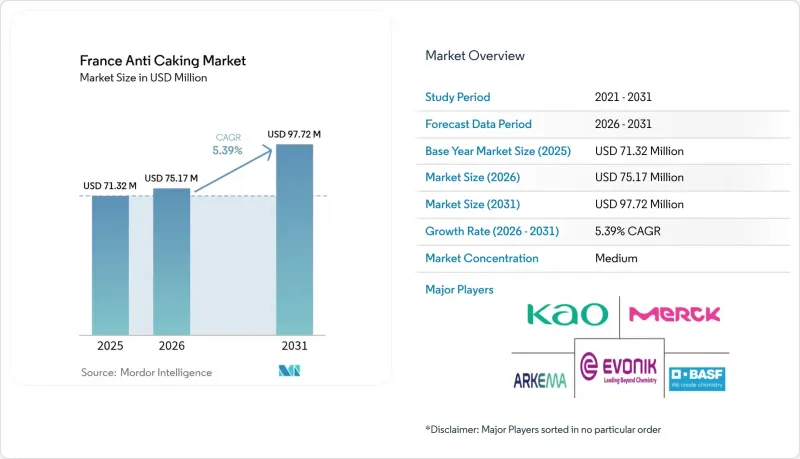
This report is Segmented by Type (Silicon Dioxide, Calcium Compounds, Sodium Compounds, Magnesium Compounds, and Others), Form (Powder, Granule, and Liquid), and Application (Food and Beverages, Cosmetic and Personal Care, Animal Feed, and Others). The Market Forecasts are Provided in Terms of Value (USD) and Volume (Tons).
France Anti-Caking Market Trends and Insights
Rising demand for processed and convenience foods
The increasing demand for processed and convenience foods is a significant driver of the France anti-caking market, reshaping the country's food production landscape. With accelerating urbanization and fast-paced lifestyles, consumers are opting for ready-to-eat, easy-to-prepare, and long-shelf-life products such as instant soups, beverages, bakery mixes, dairy powders, and seasoning blends. These products are particularly susceptible to caking and moisture-induced aggregation. The growing consumption of processed foods directly increases the need for effective anti-caking solutions to preserve the quality of powders during storage, transportation, and handling. According to the United States Department of Agriculture (USDA), as of 2025, France's food processing sector comprises approximately 19,000 companies, generating total annual sales exceeding USD 176.7 billion . This highlights the scale, diversity, and economic importance of the market. The expansive food processing ecosystem not only drives the volume consumption of anti-caking agents but also encourages innovation, as manufacturers develop new formulations to meet evolving consumer expectations for convenience.
Preference for natural and clean-label ingredients
The growing preference for natural and clean-label ingredients is driving the market, as consumers increasingly prioritize transparency, health, and sustainability in food and personal care products. Manufacturers are addressing this demand by developing anti-caking agents derived from natural sources, free from synthetic additives, and compatible with organic or clean-label claims. These products maintain essential functional properties such as moisture absorption, flowability, and product stability. This trend is particularly significant in powdered foods, beverages, and nutritional products, where consumers are closely examining ingredient lists and favoring items that align with health and environmental considerations. Supporting this shift, data from the Bio Agency indicates that in 2024, 23% of French consumers reported consuming organic food products at least once a week, highlighting a substantial and growing segment of the population actively seeking products with natural or certified organic components. This consumer-driven demand for transparency and natural formulations continues to shape market dynamics.
Stringent EU food additive regulations
A significant restraint for the France anti-caking market is the stringent EU food additive regulations, which enforce strict safety, labeling, and usage limits on substances used in food products. Anti-caking agents must adhere to standards established by the European Food Safety Authority (EFSA) and comply with relevant EU directives. These regulations specify permissible types, maximum inclusion levels, and labeling requirements. While these measures ensure consumer safety and maintain product quality, they also restrict formulation flexibility for manufacturers and increase compliance costs. This is particularly challenging for smaller or mid-sized producers who may lack in-house regulatory expertise. Furthermore, the approval process for new anti-caking agents or innovative formulations is often lengthy and resource-intensive, which can delay product launches and hinder manufacturers' ability to quickly adapt to market trends, such as the demand for clean-label or natural ingredients.
Other drivers and restraints analyzed in the detailed report include:
- Technological advancements in additive formulations
- Growth in the pet food industry fuels demand
- Limited effectiveness of natural agents
For complete list of drivers and restraints, kindly check the Table Of Contents.
Segment Analysis
Silicon dioxide accounted for 46.21% of France's anti-caking market in 2025, underscoring its position as the most widely used and trusted anti-caking agent in the country. This dominance is attributed to its excellent functional performance, as it effectively absorbs excess moisture and forms a physical barrier between particles, ensuring free-flowing properties in powders without altering taste, color, or aroma. These features make it particularly valuable in France's food and beverage industry, which emphasizes quality. Silicon dioxide is widely used in various applications, including bakery mixes, dairy powders, soups and sauces, seasonings, and instant beverages. Beyond the food sector, its inert and non-reactive nature supports its use in pharmaceuticals, animal feed, cosmetics, and industrial powders, driving demand across various end-use industries.
Sodium compounds are projected to grow at an annual rate of 5.55% through 2031, highlighting their increasing significance in France's anti-caking market. This growth is driven by their effective performance in moisture control and flow enhancement. Sodium-based anti-caking agents are widely applied in products such as salt, seasoning blends, soups, sauces, and feed formulations, where they help maintain uniformity and prevent lump formation during storage and transportation. Their relatively lower cost compared to calcium- or specialty silica-based alternatives makes them an appealing choice for mass-market food products and feed manufacturers operating under tight margins.
Complete Report Scope:
- By Type
- Silicon Dioxide
- Calcium Compounds
- Sodium Compounds
- Magnesium Compounds
- Others
- By Form
- Powder
- Granule
- Liquid
- By Application
- Food and Beverages
- Bakery Products
- Dairy Products
- Soups and Sauces
- Beverages
- Others
- Cosmetic and Personal Care
- Animal Feed
- Others
- Food and Beverages
List of Companies Covered in this Report:
- BASF SE
- Evonik Industries AG
- Merck KGaA
- Arkema S.A.
- Kao Corporation (Kao Chemicals)
- Solvay S.A.
- Chemische Fabrik Budenheim KG
- Roquette Freres
- PQ Corporation
- Ingredion Inc.
- Cargill Inc.
- Brenntag SE
- Lubrizol Corp.
- ABITEC (ABF Ingredients)
- BK Giulini GmbH
- Prayon S.A.
- Dr. Paul Lohmann GmbH
- Gadot Biochemical Ind.
- JRS Rettenmaier
- TAIFOONG S.A.S.
Additional Benefits:
- The market estimate (ME) sheet in Excel format
- 3 months of analyst support
TABLE OF CONTENTS
1 INTRODUCTION
- 1.1 Study Assumptions and Market Definition
- 1.2 Scope of the Study
2 RESEARCH METHODOLOGY
3 EXECUTIVE SUMMARY
4 MARKET LANDSCAPE
- 4.1 Market Overview
- 4.2 Market Drivers
- 4.2.1 Rising demand for processed and convenience foods
- 4.2.2 Preference for natural and clean-label ingredients
- 4.2.3 Technological advancements in additive formulations
- 4.2.4 Growth in the pet food industry fuels demand
- 4.2.5 Expanding culinary and seasoning culture
- 4.2.6 Growing consumer awareness of quality and safety
- 4.3 Market Restraints
- 4.3.1 Stringent EU food additive regulations
- 4.3.2 Limited effectiveness of natural agents
- 4.3.3 Volatility in raw material prices
- 4.3.4 Complex reformulation challenge
- 4.4 Supply Chain Analysis
- 4.5 Regulatory Landscape
- 4.6 Technological Outlook
- 4.7 Porter's Five Forces Analysis
- 4.7.1 Threat of New Entrants
- 4.7.2 Bargaining Power of Buyers
- 4.7.3 Bargaining Power of Suppliers
- 4.7.4 Threat of Substitutes
- 4.7.5 Intensity of Competitive Rivalry
5 MARKET SIZE AND GROWTH FORECASTS (VALUE AND VOLUME)
- 5.1 By Type
- 5.1.1 Silicon Dioxide
- 5.1.2 Calcium Compounds
- 5.1.3 Sodium Compounds
- 5.1.4 Magnesium Compounds
- 5.1.5 Others
- 5.2 By Form
- 5.2.1 Powder
- 5.2.2 Granule
- 5.2.3 Liquid
- 5.3 By Application
- 5.3.1 Food and Beverages
- 5.3.1.1 Bakery Products
- 5.3.1.2 Dairy Products
- 5.3.1.3 Soups and Sauces
- 5.3.1.4 Beverages
- 5.3.1.5 Others
- 5.3.2 Cosmetic and Personal Care
- 5.3.3 Animal Feed
- 5.3.4 Others
- 5.3.1 Food and Beverages
6 COMPETITIVE LANDSCAPE
- 6.1 Market Concentration
- 6.2 Strategic Moves
- 6.3 Market Positioning Analysis
- 6.4 Company Profiles (includes Global level Overview, Market level overview, Core Segments, Financials as available, Strategic Information, Market Rank/Share for key companies, Products and Services, and Recent Developments)
- 6.4.1 BASF SE
- 6.4.2 Evonik Industries AG
- 6.4.3 Merck KGaA
- 6.4.4 Arkema S.A.
- 6.4.5 Kao Corporation (Kao Chemicals)
- 6.4.6 Solvay S.A.
- 6.4.7 Chemische Fabrik Budenheim KG
- 6.4.8 Roquette Freres
- 6.4.9 PQ Corporation
- 6.4.10 Ingredion Inc.
- 6.4.11 Cargill Inc.
- 6.4.12 Brenntag SE
- 6.4.13 Lubrizol Corp.
- 6.4.14 ABITEC (ABF Ingredients)
- 6.4.15 BK Giulini GmbH
- 6.4.16 Prayon S.A.
- 6.4.17 Dr. Paul Lohmann GmbH
- 6.4.18 Gadot Biochemical Ind.
- 6.4.19 JRS Rettenmaier
- 6.4.20 TAIFOONG S.A.S.
7 MARKET OPPORTUNITIES AND FUTURE OUTLOOK

