
PUBLISHER: Mordor Intelligence | PRODUCT CODE: 2097116

PUBLISHER: Mordor Intelligence | PRODUCT CODE: 2097116
Singapore Retail - Market Share Analysis, Industry Trends & Statistics, Growth Forecasts (2026 - 2031)
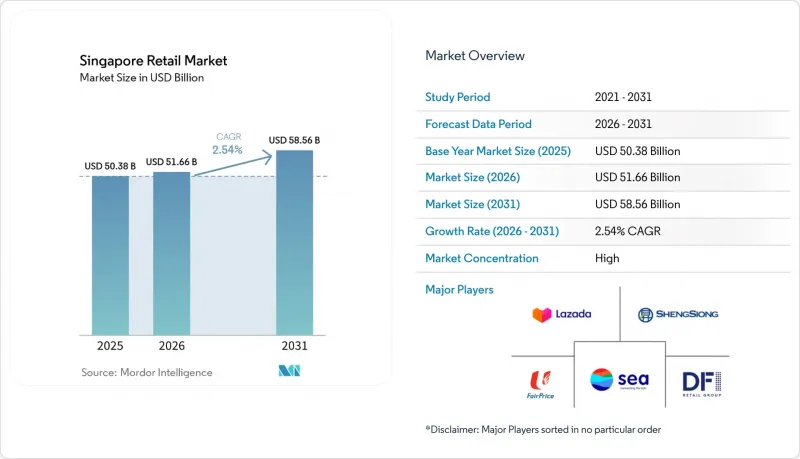
According to Mordor Intelligence, the Singapore retail market size is projected to be USD 50.38 billion in 2025, USD 51.66 billion in 2026, and reach USD 58.56 billion by 2031, growing at a CAGR of 2.54% from 2026 to 2031.
This report is Segmented by Product Type (Food, Beverage & Tobacco Products; Personal Care & Household Care; Apparel, Footwear & Accessories; Furniture, Toys & Hobby, and More), by Retail Channel (Traditional Mom & Pop Retail, Modern Trade Retail, E-Commerce & Others), and by Format (Hypermarkets, Supermarkets, Convenience Stores, and More), The Market Forecasts are Provided in Terms of Value (USD Billion).
Singapore Retail Market Trends and Insights
Rising Omnichannel Consumer Journey Adoption
Singapore shoppers expect a unified experience across browsing, payment, fulfillment, and returns, which forces retailers to integrate online and store systems. IMDA reports that 91% of retail SMEs had adopted at least one sector-specific digital solution by 2023, although overall adoption depth was still modest, which implies meaningful headroom for advanced capabilities like AI and real-time inventory routing in 2026. IMDA's Advanced Digital Solutions program for Omnichannel Retail Management launched in July 2024 with 70% funding support, which lowers barriers for SMEs to add integrated POS, cross-channel inventory, and last-mile orchestration. Online retail penetration reached 14.5% in October 2025, up from 13.1% in July 2025, and categories such as electronics exceeded 50% online share, which illustrates the widening role of digital in total spending. Retailers combine store pickup and rapid delivery windows to reduce friction, while privacy rules require clear consent for personalization that relies on first-party data strategies. The retail industry in Singapore benefits as omnichannel convenience complements, rather than substitutes, physical proximity.
Urban Logistics Micro-Hub Policy Roll-Out
Flexible zoning in the URA Master Plan 2025 allows urban micro-hubs that position inventory near demand, which shortens last-mile distances and supports economically viable 2-hour and same-day delivery. This shift reduces delivery cost per order, supports dark-store models, and lets stores double as local fulfillment nodes that sustain online grocery expansion from low double digits toward higher penetration through 2031. The micro-hub model is well-suited to dense HDB towns and mixed-use precincts where demand can be predicted with fine-grained data. The Singapore retail market sees service-level improvements without requiring significant new GFA, which aligns with land-use priorities. Shared micro-hubs also enable route consolidation and electric van adoption, which supports national emissions goals. The overall result is faster delivery and optimized capacity utilization that improves conversion in time-sensitive categories.
Saturated Mall Density and Limited New Retail Space
Island-wide retail vacancy registered 7.2% in Q3 2025, with regional divergence as the Downtown Core tightened while the Outer Central Region loosened, which signals selective oversupply and limited room for expansive GFA additions. The URA Master Plan 2025 focuses on housing, logistics, and advanced industry, which channels retail growth toward productivity over new footprints. This pattern narrows the greenfield pipeline for large-box formats and pushes retailers to optimize existing locations and formats that can justify rent with higher throughput. The Singapore retail market adjusts to this cap through format conversion, densification in best-in-class assets, and stronger reliance on omnichannel to expand effective catchments. In less productive malls, legacy leases can trap capital, which accelerates selective closures and subdivision strategies by landlords to raise aggregate rent.
Other drivers and restraints analyzed in the detailed report include:
- Real-Time Retail Analytics Via 5G Edge Networks
- Expansion of Supermarket Private-Label Penetration
- Labor Shortages & Rising Minimum-Wage Floor
For complete list of drivers and restraints, kindly check the Table Of Contents.
Segment Analysis
Food, Beverage & Tobacco Products held 48.44% in 2025, reflecting stable everyday demand and deep supermarket networks, while other product types follow category-specific trajectories across online and offline. Personal Care & Household shows the fastest expansion at a 10.87% CAGR through 2031 as shoppers upgrade into premium skincare, wellness, and specialized formats. The Singapore retail market continues to rely on grocery fundamentals for traffic while discretionary categories adjust to changing fashion cycles and online discovery effects. Watches and jewelry benefited from tourism-led spending and duty-free pricing in central precincts, while apparel was softer due to shifting work patterns and higher online return rates that weigh on store productivity. Food, Beverage & Tobacco is positioned to maintain volume resilience even when consumer budgets are tight.
Private labels in staples and pantry categories continue to broaden as chains improve sourcing and cold-chain capabilities that support quality upgrades. The Singapore retail market size for Food, Beverage & Tobacco is anchored by weekly basket missions in HDB towns that keep store visits frequent. Electronics and appliances sustain the highest online penetration in the 52-55% band, which reflects standardized specs and strong digital research behavior that shifts purchase to e-commerce. Furniture, toys, and hobby categories sit near one-third of online share as home delivery and price comparison drive digital adoption. The Singapore retail industry in personal care benefits from omnichannel sampling and subscriptions that raise repeat purchases and support the segment's premiumization path.
Complete Report Scope:
- By Product Type
- Food, Beverage, & Tobacco Products
- Personal Care & Household Care
- Apparel, Footwear, & Accessories
- Furniture, Toys, & Hobby
- Industrial & Automotive
- Electronic & Household Appliances
- Other Products
- By Retail Channel
- Traditional Mom & Pop Retail
- Modern Trade Retail
- E-Commerce & Others
- By Format
- Hypermarkets
- Supermarkets
- Convenience Stores
- Department Stores
- Specialty Stores
- Others (Drugstore, Cash & Carry, Wholesaler)
- By Region
- Central Region
- East Region
- North Region
- North-East Region
- West Region
List of Companies Covered in this Report:
- 7-Eleven (DFI Retail Group)
- Amazon.sg
- Challenger Technologies
- Charles & Keith
- Cold Storage (DFI Retail Group)
- Courts Singapore
- Decathlon Singapore
- Don Don Donki
- FairPrice Group
- Guardian Health & Beauty
- H&M Singapore
- Ikea Singapore
- Lazada Singapore
- Love, Bonito
- MUJI Singapore
- Qoo10 Singapore
- Sheng Siong Group
- Shopee Singapore
- Uniqlo Singapore
- Watsons Singapore
Additional Benefits:
- The market estimate (ME) sheet in Excel format
- 3 months of analyst support
TABLE OF CONTENTS
1 Introduction
- 1.1 Study Assumptions & Market Definition
- 1.2 Scope of the Study
2 Research Methodology
3 Executive Summary
4 Market Landscape
- 4.1 Market Overview
- 4.2 Market Drivers
- 4.2.1 Rising omnichannel consumer journey adoption
- 4.2.2 Expansion of supermarket private-label penetration
- 4.2.3 Tourism rebound boosting discretionary spend
- 4.2.4 ESG-linked financing lowering capex for retrofit
- 4.2.5 Real-time retail analytics via 5G edge networks
- 4.2.6 Urban logistics micro-hub policy roll-out
- 4.3 Market Restraints
- 4.3.1 Saturated mall density and limited new retail space
- 4.3.2 Labour shortages & rising minimum-wage floor
- 4.3.3 Persistent rental cost inflation in prime districts
- 4.3.4 Data-privacy tightening curbing 3rd-party ad-targeting
- 4.4 Value / Supply-Chain Analysis
- 4.5 Regulatory Landscape
- 4.6 Technological Outlook
- 4.7 Porter's Five Forces
- 4.7.1 Threat of New Entrants
- 4.7.2 Bargaining Power of Suppliers
- 4.7.3 Bargaining Power of Buyers
- 4.7.4 Threat of Substitutes
- 4.7.5 Competitive Rivalry
5 Market Size & Growth Forecasts
- 5.1 By Product Type
- 5.1.1 Food, Beverage, & Tobacco Products
- 5.1.2 Personal Care & Household Care
- 5.1.3 Apparel, Footwear, & Accessories
- 5.1.4 Furniture, Toys, & Hobby
- 5.1.5 Industrial & Automotive
- 5.1.6 Electronic & Household Appliances
- 5.1.7 Other Products
- 5.2 By Retail Channel
- 5.2.1 Traditional Mom & Pop Retail
- 5.2.2 Modern Trade Retail
- 5.2.3 E-Commerce & Others
- 5.3 By Format
- 5.3.1 Hypermarkets
- 5.3.2 Supermarkets
- 5.3.3 Convenience Stores
- 5.3.4 Department Stores
- 5.3.5 Specialty Stores
- 5.3.6 Others (Drugstore, Cash & Carry, Wholesaler)
- 5.4 By Region
- 5.4.1 Central Region
- 5.4.2 East Region
- 5.4.3 North Region
- 5.4.4 North-East Region
- 5.4.5 West Region
6 Competitive Landscape
- 6.1 Market Concentration
- 6.2 Strategic Moves
- 6.3 Market Share Analysis
- 6.4 Company Profiles (includes Global level Overview, Market level overview, Core Segments, Financials as available, Strategic Information, Market Rank/Share for key companies, Products & Services, and Recent Developments)
- 6.4.1 7-Eleven (DFI Retail Group)
- 6.4.2 Amazon.sg
- 6.4.3 Challenger Technologies
- 6.4.4 Charles & Keith
- 6.4.5 Cold Storage (DFI Retail Group)
- 6.4.6 Courts Singapore
- 6.4.7 Decathlon Singapore
- 6.4.8 Don Don Donki
- 6.4.9 FairPrice Group
- 6.4.10 Guardian Health & Beauty
- 6.4.11 H&M Singapore
- 6.4.12 Ikea Singapore
- 6.4.13 Lazada Singapore
- 6.4.14 Love, Bonito
- 6.4.15 MUJI Singapore
- 6.4.16 Qoo10 Singapore
- 6.4.17 Sheng Siong Group
- 6.4.18 Shopee Singapore
- 6.4.19 Uniqlo Singapore
- 6.4.20 Watsons Singapore
7 Market Opportunities & Future Outlook
- 7.1 Hyper-personalised Convenience Formats (AI-guided micro-stores)
- 7.2 Circular-economy Retail Platforms (Re-commerce & refill stations)

