PUBLISHER: Mordor Intelligence | PRODUCT CODE: 2097127

PUBLISHER: Mordor Intelligence | PRODUCT CODE: 2097127
Indonesia Textiles - Market Share Analysis, Industry Trends & Statistics, Growth Forecasts (2026 - 2031)
According to Mordor Intelligence, the Indonesia textiles market size is projected to expand from USD 40.65 billion in 2025 and USD 41.27 billion in 2026 to USD 47.36 billion by 2031, registering a CAGR of 2.79% between 2026 to 2031.
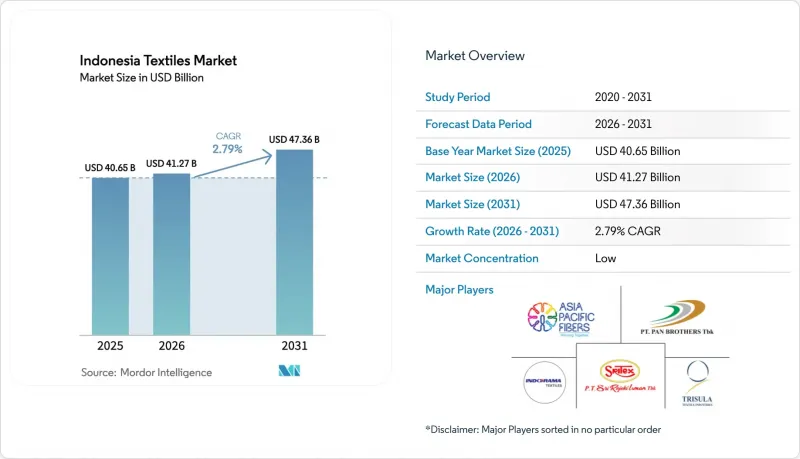
This report is Segmented by Application (Fashion & Apparel, Industrial/Technical, Household & Home, Medical & Healthcare, Automotive & Transport, Others), by Raw Material (Natural Fibers, Synthetic Fibers, Recycled Fibers, Others), by Process (Woven, Knitted, Non-Woven), and by Geography (Java, Sumatra, Kalimantan, Sulawesi, Rest of Indonesia). Market Forecasts are Provided in Terms of Value (USD).
Indonesia Textiles Market Trends and Insights
Middle-Class Fashion E-Commerce Boom Lifting Domestic Yarn & Fabric Orders
Indonesia's fashion category led all online retail in 2024, and live-video commerce captured roughly one-quarter of gross merchandise value. Within the Indonesia textile industry, domestic converters that can deliver 500 to 2,000 meter lots within 10 days now receive rolling orders from direct-to-consumer labels on major platforms. Payment cycles shorten, improving cash flow, but order fragmentation raises planning complexity. The October 2024 removal of unregistered foreign sellers reduced price undercutting, yet parcel-level imports continue through other channels. On balance, steady urban disposable-income growth keeps online fashion a bright spot for polyester-cotton prints and dyed knits.
Acceleration of Machine-Modernization Subsidies Under Making Indonesia 4.0
Jakarta's IDR 20 billion program reimburses up to 25% of qualified textile equipment purchases, directly targeting the 57% of looms and spindles that are more than 15 years old. Early adopters, mainly mid-sized spinners in West and Central Java, pair the rebate with bank loans to upgrade to air-jet looms and compact-spinning lines. Domestic machine builders secure a captive market through the local-content clause, although high-precision gear still arrives from Germany and Japan on the lower 10% rebate tier. Mills must show operating profitability and valid environmental permits, conditions that exclude distressed firms most in need of upgrades. Over the medium term, the scheme is expected to lift run speeds and lower defect rates, modestly improving export competitiveness.
Weakening Rupiah Amplifying Cotton & Synthetic-Feedstock Import Costs
The rupiah fell beyond IDR 16,500 per USD by March 2025, intensifying the landed prices of imported cotton and polyester staple fiber that cover over 95% of spinning needs. Spinners operating at just 40-50% utilization lack the working capital to hedge or bulk-buy, eroding already thin margins. Although a cheaper currency theoretically aids exports, simultaneous 6.5% wage hikes nullify much of the benefit. The overall effect is a direct squeeze on cash-constrained mills.
Other drivers and restraints analyzed in the detailed report include:
- Preferential Tariffs From IA-CEPA and Prospective CPTPP Entry Expanding Export Margins
- Brand Mandates for Recycled-Fiber Content Sparking PET-to-Yarn & Viscose-Recycling Investments
- Sharp Hikes in 2025 Provincial Minimum Wages Narrowing Advantage Versus Vietnam & Bangladesh
For complete list of drivers and restraints, kindly check the Table Of Contents.
Segment Analysis
Fashion and apparel controlled a dominant 56.16% share of Indonesia textiles market size in 2025, reflecting the archipelago's deep garment-making base. Yet margin compression and import competition have slowed its growth to low single digits. Industrial and technical textiles, though smaller, are the fastest-growing niche at a 4.12% CAGR, propelled by demand for filtration media, medical disposables, and automotive upholstery. Several OEMs now insist on local sourcing to meet domestic-content rules, opening avenues for mills able to certify flame retardancy, tensile strength, and traceability. Government incentives for hospital construction similarly expand orders for gowns and drapes, supporting capacity investments in non-woven spunbond and meltblown lines. Over the forecast horizon, technical fabrics are expected to capture incremental share as buyers seek specification-driven suppliers and as fashion volumes plateau.
A more balanced application mix also cushions the Indonesian textiles market against fashion-cycle volatility. Mills entering automotive and geotextile supply chains must adopt rigorous quality systems and often partner with global licensors for proprietary yarns or coatings. While only a handful of domestic plants presently meet airbag or seat-belt specifications, early movers report higher margins and longer contracts than basic fashion programs. The shift requires sustained R&D spending and closer collaboration with end users, but it offers a viable path to offset rising wages and tougher environmental standards.
Complete Report Scope:
- By Application
- Fashion & Apparel
- Industrial/Technical Textiles
- Household & Home Textiles
- Medical & Healthcare Textiles
- Automotive & Transport Textiles
- Others (Protective, Sports Textiles, etc.)
- By Raw Material
- Natural Fibers
- Cotton
- Wool
- Silk
- Synthetic Fibers
- Polyester
- Nylon
- Rayon / Viscose
- Acrylic
- Polypropylene
- Recycled Fibers
- Others (Speciality High-Performance Fibers (Aramid, Carbon, UHMWPE))
- Natural Fibers
- By Process / Technology
- Woven
- Knitted
- Non-woven
- Spunlaid (Spunbond / Melt-blown)
- Dry-laid Hydro-entangled
- Wet-Laid
- Needle-punched
- 3-D Weaving & Spacer Fabrics
- By Region
- Java
- Sumatra
- Kalimantan
- Sulawesi
- Rest of Indonesia
List of Companies Covered in this Report:
- PT Sri Rejeki Isman Tbk
- PT Pan Brothers Tbk
- PT Asia Pacific Fibers Tbk
- PT Trisula Textile Industries Tbk
- PT Indo-Rama Synthetics Tbk
- PT Tifico Fiber Indonesia Tbk
- PT Ever Shine Tex Tbk
- PT Century Textile Industry Tbk
- PT Polychem Indonesia Tbk
- PT Panasia Group
- PT Tyfountex Indonesia
- PT Eratex Djaja Tbk
- PT Argo Pantes Tbk
- PT Indo Kordsa Tbk
- PT Sritex Green (new recycled fibre unit)
- PT Rayon Utama Makmur
- PT Kahatex
- PT Duniatex
- PT Dragon Sweater Indonesia
- PT Behaestex
Additional Benefits:
- The market estimate (ME) sheet in Excel format
- 3 months of analyst support
TABLE OF CONTENTS
1 Introduction
- 1.1 Study Assumptions & Market Definition
- 1.2 Scope of the Study
2 Research Methodology
3 Executive Summary
4 Market Landscape
- 4.1 Market Overview
- 4.2 Market Drivers
- 4.2.1 Acceleration of machine-modernization subsidies under Making Indonesia 4.0 (2025-2027)
- 4.2.2 Middle-class fashion e-commerce boom lifting domestic yarn & fabric orders
- 4.2.3 Preferential tariffs from IA-CEPA & prospective CPTPP entry expanding export margins
- 4.2.4 Brand mandates for recycled-fibre content sparking PET-to-yarn & viscose-recycling investments
- 4.2.5 AI-enabled inline quality-inspection systems cutting defect rates for SME knitwear exporters
- 4.2.6 Renewable-power PPAs reducing energy costs and Scope 3 emissions for dyehouses
- 4.3 Market Restraints
- 4.3.1 Weakening rupiah amplifying cotton & synthetic-feedstock import costs
- 4.3.2 Sharp hikes in 2025 provincial minimum wages narrowing advantage versus Vietnam & Bangladesh
- 4.3.3 Temu/Shein ultra-low-cost imports exploiting US Section 321 loophole flooding domestic market
- 4.3.4 Water-use permits tightening in Central-Java dyeing clusters amid El Nino droughts
- 4.4 Value / Supply-Chain Analysis
- 4.5 Regulatory Landscape
- 4.6 Technological Outlook
- 4.7 Industry Attractiveness - Porter's Five Forces
- 4.7.1 Threat of New Entrants
- 4.7.2 Bargaining Power of Buyers
- 4.7.3 Bargaining Power of Suppliers
- 4.7.4 Threat of Substitutes
- 4.7.5 Competitive Rivalry
5 Market Size & Growth Forecasts (Values, In USD Billion)
- 5.1 By Application
- 5.1.1 Fashion & Apparel
- 5.1.2 Industrial/Technical Textiles
- 5.1.3 Household & Home Textiles
- 5.1.4 Medical & Healthcare Textiles
- 5.1.5 Automotive & Transport Textiles
- 5.1.6 Others (Protective, Sports Textiles, etc.)
- 5.2 By Raw Material
- 5.2.1 Natural Fibers
- 5.2.1.1 Cotton
- 5.2.1.2 Wool
- 5.2.1.3 Silk
- 5.2.2 Synthetic Fibers
- 5.2.2.1 Polyester
- 5.2.2.2 Nylon
- 5.2.2.3 Rayon / Viscose
- 5.2.2.4 Acrylic
- 5.2.2.5 Polypropylene
- 5.2.3 Recycled Fibers
- 5.2.4 Others (Speciality High-Performance Fibers (Aramid, Carbon, UHMWPE))
- 5.2.1 Natural Fibers
- 5.3 By Process / Technology
- 5.3.1 Woven
- 5.3.2 Knitted
- 5.3.3 Non-woven
- 5.3.3.1 Spunlaid (Spunbond / Melt-blown)
- 5.3.3.2 Dry-laid Hydro-entangled
- 5.3.3.3 Wet-Laid
- 5.3.3.4 Needle-punched
- 5.3.4 3-D Weaving & Spacer Fabrics
- 5.4 By Region
- 5.4.1 Java
- 5.4.2 Sumatra
- 5.4.3 Kalimantan
- 5.4.4 Sulawesi
- 5.4.5 Rest of Indonesia
6 Competitive Landscape
- 6.1 Market Concentration
- 6.2 Strategic Moves
- 6.3 Market Share Analysis
- 6.4 Company Profiles (includes Global level Overview, Market level overview, Core Segments, Financials as available, Strategic Information, Products & Services, and Recent Developments)
- 6.4.1 PT Sri Rejeki Isman Tbk
- 6.4.2 PT Pan Brothers Tbk
- 6.4.3 PT Asia Pacific Fibers Tbk
- 6.4.4 PT Trisula Textile Industries Tbk
- 6.4.5 PT Indo-Rama Synthetics Tbk
- 6.4.6 PT Tifico Fiber Indonesia Tbk
- 6.4.7 PT Ever Shine Tex Tbk
- 6.4.8 PT Century Textile Industry Tbk
- 6.4.9 PT Polychem Indonesia Tbk
- 6.4.10 PT Panasia Group
- 6.4.11 PT Tyfountex Indonesia
- 6.4.12 PT Eratex Djaja Tbk
- 6.4.13 PT Argo Pantes Tbk
- 6.4.14 PT Indo Kordsa Tbk
- 6.4.15 PT Sritex Green (new recycled fibre unit)
- 6.4.16 PT Rayon Utama Makmur
- 6.4.17 PT Kahatex
- 6.4.18 PT Duniatex
- 6.4.19 PT Dragon Sweater Indonesia
- 6.4.20 PT Behaestex
7 Market Opportunities & Future Outlook
- 7.1 White-space & Unmet-Need Assessment

